 Back
BackGeneral Chemistry Exam 1 Study Guide: Matter, Measurement, Atoms, Molecules, and Stoichiometry
Study Guide - Smart Notes
 Tailored notes based on your materials, expanded with key definitions, examples, and context.
Measurement, Units, and Significant Figures
Unit Conversions and Useful Constants
Accurate measurement and unit conversion are foundational skills in chemistry. Understanding the relationships between units allows for proper calculation and reporting of results.
Length: 1 inch = 2.54 cm (exact)
Mass: 1 pound (lb) = 453.6 grams (g)
Volume: 1 liter (L) = 1.057 quarts (qt)
Distance: 1 mile = 5280 feet (ft) (exact)
Time: 1 hour = 60 minutes (min) (exact); 1 minute = 60 seconds (sec) (exact)
Significant Figures are the digits in a measurement that are known with certainty plus one digit that is estimated. They are crucial for expressing the precision of calculated results.
Rules for Significant Figures:
Nonzero digits are always significant.
Zeros between nonzero digits are significant.
Leading zeros are not significant.
Trailing zeros in a decimal number are significant.
Calculations: The number of significant figures in the result depends on the operation:
Addition/Subtraction: Result has the same number of decimal places as the measurement with the fewest decimal places.
Multiplication/Division: Result has the same number of significant figures as the measurement with the fewest significant figures.
Example: (11.13 - 2.6) × 104 / (103.05 + 16.9) × 10-6 should be reported with the correct number of significant figures based on the rules above.
Accuracy and Precision
Definitions and Applications
Understanding the difference between accuracy and precision is essential for evaluating experimental results.
Accuracy: How close a measured value is to the true value.
Precision: How close repeated measurements are to each other.
Example: A measurement that is consistently close to the true value is accurate; repeated measurements that are close to each other are precise.
Density and Unit Analysis
Density Calculations
Density is a physical property defined as mass per unit volume.
Formula:
Units: Commonly expressed in g/mL or g/cm3.
Example: A wooden object with mass 10.782 g and volume 13.72 mL has a density calculated as:
Atoms, Molecules, and Ions
Atomic Structure and Isotopes
Atoms are composed of protons, neutrons, and electrons. Isotopes are atoms of the same element with different numbers of neutrons.
Proton: Positively charged, found in the nucleus.
Neutron: Neutral, found in the nucleus.
Electron: Negatively charged, found outside the nucleus.
Smallest and lightest subatomic particle: Electron
Example: The isotope with 45 neutrons can be identified by subtracting the atomic number from the mass number.
Periodic Table Organization
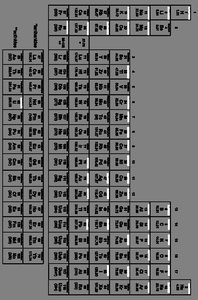
The periodic table arranges elements by increasing atomic number, grouping elements with similar properties.
Groups: Vertical columns, elements with similar chemical properties.
Periods: Horizontal rows.
Chemical Laws and Formulas
Law of Constant Composition
This law states that a given compound always contains the same elements in the same proportion by mass.
Example: Pure water always contains hydrogen and oxygen in a 1:8 mass ratio.
Empirical and Molecular Formulas
The empirical formula is the simplest whole-number ratio of atoms in a compound. The molecular formula gives the actual number of atoms of each element in a molecule.
Example: C2H6SO is both an empirical and molecular formula.
Chemical Reactions and Stoichiometry
Balancing Chemical Equations
Balancing equations ensures the conservation of mass and atoms. Coefficients are used to indicate the number of molecules or moles.
Example:
Balance by adjusting coefficients to ensure equal numbers of each atom on both sides.
Stoichiometry and Limiting Reactants
Stoichiometry involves calculating the quantities of reactants and products in a chemical reaction. The limiting reactant is the reactant that is completely consumed first, limiting the amount of product formed.
Example: In the reaction , determine which reactant is limiting by comparing mole ratios.
Lab Techniques and Mathematical Operations
Density Calculation Example
To find the density of a substance, convert units as necessary and apply the formula:
Example: Acetaminophen (C8H9NO2) occupies 0.1858 nm3. To find density in g/cm3:
Convert nm3 to cm3 using .
Tables and Data Interpretation
Periodic Table Reference
The periodic table is a fundamental tool for identifying element properties, atomic numbers, and group classifications.
Group | Element Example | Property |
|---|---|---|
1 | Na | Alkali metal |
2 | Mg | Alkaline earth metal |
3-12 | Fe | Transition metal |
17 | Cl | Halogen |
18 | Ne | Noble gas |
Additional info: The periodic table image is included to reinforce element classification and atomic structure topics.
----------------------------------------
