 Back
BackGeneral Chemistry Exam 4 Study Guidance: Bonding, Molecular Shapes, and Covalent Theory
Study Guide - Smart Notes
 Tailored notes based on your materials, expanded with key definitions, examples, and context.
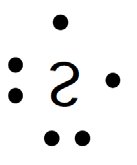
Q1. What are the group number and valence electron configuration of a main-group element that can be characterized by the following Lewis electron-dot symbol?
Background
Topic: Lewis Electron-Dot Symbols & Periodic Table Groups
This question tests your understanding of how Lewis dot symbols represent valence electrons and how these relate to the group number and electron configuration of main-group elements.
Key Terms and Formulas:
Lewis electron-dot symbol: Shows the number of valence electrons as dots around the element symbol.
Main-group elements: Elements in the s-block and p-block of the periodic table (not transition metals).
Valence electron configuration: For main-group elements, typically written as where is the period number and is the number of p electrons.
Step-by-Step Guidance
Count the number of dots in the Lewis symbol. Each dot represents a valence electron.
Determine which group number in the periodic table corresponds to this number of valence electrons (for main-group elements, group number = number of valence electrons).
Recall the general valence electron configuration for main-group elements: .
Identify possible elements in this group by considering the period number () and matching the electron configuration.
Try solving on your own before revealing the answer!
Final Answer: Group 6A, (ns)^2(np)^4
The Lewis symbol shows 6 dots, so the element is in group 6A. The valence electron configuration is , which matches elements like oxygen (n=2), sulfur (n=3), etc.
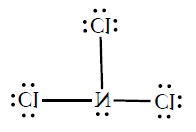
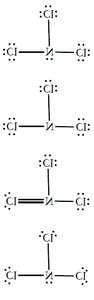
Q2. Identify the correct Lewis structure for NCl3.
Background
Topic: Lewis Structures & Valence Electrons
This question tests your ability to draw and interpret Lewis structures, accounting for all valence electrons and correct bonding/lone pairs.
Key Terms and Formulas:
Lewis structure: Shows how atoms are bonded and where lone pairs are located.
Valence electrons: For N: 5, for Cl: 7 each.
Formal charge:
Step-by-Step Guidance
Calculate the total number of valence electrons: .
Draw the N atom in the center, bonded to three Cl atoms.
Distribute the remaining electrons as lone pairs on Cl atoms and the central N atom.
Check that each atom has a complete octet and that the total number of electrons matches the calculated total.
Try solving on your own before revealing the answer!
Final Answer: Structure D is correct
Structure D shows three bonds, three lone pairs on each Cl, and one lone pair on N, totaling 26 electrons and zero formal charge on each atom.
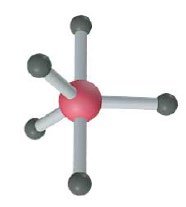
Q3. Which structure(s) have the most lone pairs around the central atom, and which have no lone pairs?
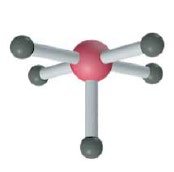
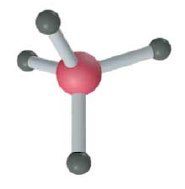
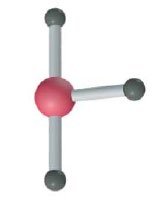
Background
Topic: VSEPR Theory & Molecular Geometry
This question tests your ability to identify molecular shapes and count lone pairs on the central atom using VSEPR theory.
Key Terms and Formulas:
VSEPR notation: AXnEm (A = central atom, X = bonded atoms, E = lone pairs)
Common shapes: Trigonal bipyramidal (AX5), Square pyramidal (AX5E), Tetrahedral (AX4), T-shaped (AX3E2)
Step-by-Step Guidance
Identify the VSEPR notation for each structure based on the number of bonded atoms and lone pairs.
Count the number of lone pairs on the central atom for each structure.
Compare the structures to determine which has the most lone pairs and which has none.
Recall that structures with no lone pairs are typically AXn (e.g., trigonal bipyramidal, tetrahedral).
Try solving on your own before revealing the answer!
Final Answer: IV has the most lone pairs; I and III have none
Structure IV (T-shaped, AX3E2) has two lone pairs. Structures I (trigonal bipyramidal, AX5) and III (tetrahedral, AX4) have zero lone pairs.
