 Back
BackGeneral Chemistry Exam & Worksheet Study Guidance
Study Guide - Smart Notes
 Tailored notes based on your materials, expanded with key definitions, examples, and context.
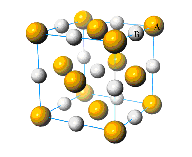
Q13. The space-filling representation provided below is an example of a _____ unit cell, which contains _____ atom(s).
Background
Topic: Crystal Structures and Unit Cells
This question tests your understanding of the different types of cubic unit cells (primitive, body-centered, face-centered) and how to determine the number of atoms per unit cell based on a space-filling model.

Key Terms and Concepts:
Unit Cell: The smallest repeating unit in a crystal lattice that shows the full symmetry of the arrangement of atoms.
Primitive Cubic (Simple Cubic): Atoms only at the corners.
Body-Centered Cubic (BCC): Atoms at the corners and one in the center.
Face-Centered Cubic (FCC): Atoms at the corners and at the centers of each face.
Atoms per Unit Cell: Calculated by considering the fraction of each atom inside the unit cell.
Step-by-Step Guidance
Examine the image and identify the positions of the atoms (corners, faces, center, etc.).
Recall that in a face-centered cubic (FCC) cell, there are atoms at each corner and at the center of each face.
Calculate the number of atoms per unit cell:
Each corner atom is shared by 8 unit cells, so each contributes 1/8 to the cell.
Each face-centered atom is shared by 2 unit cells, so each contributes 1/2 to the cell.
Sum the contributions from all atoms to find the total number of atoms in the unit cell.
Try solving on your own before revealing the answer!
Final Answer: face-centered cubic, 4 atoms
There are 8 corners (each contributes 1/8 atom) and 6 faces (each contributes 1/2 atom): atoms per unit cell.
This is characteristic of a face-centered cubic (FCC) structure.
Q15. What is the simplest formula of the compound represented by the unit cell provided below?
Background
Topic: Stoichiometry of Unit Cells
This question tests your ability to interpret a 3D model of a unit cell and determine the empirical formula based on the number and type of atoms present.
Key Terms and Concepts:
Empirical Formula: The simplest whole-number ratio of atoms in a compound.
Counting Atoms in a Unit Cell: Consider the positions (corners, faces, edges, body) and how much of each atom is inside the cell.
Step-by-Step Guidance
Identify the two types of atoms (often labeled A and B) in the unit cell.
Count the number of each type of atom within the unit cell, considering their positions and sharing with adjacent cells.
Determine the simplest whole-number ratio of A to B atoms in the unit cell.
Try solving on your own before revealing the answer!
Final Answer: AB
The unit cell contains one A atom and one B atom, giving the empirical formula AB.
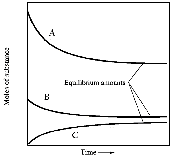
Q41. In one such reaction 3 moles of one reactant were combined with 1 mole of the other reactant in a fixed volume vessel and heated to 1200 K. Analysis of the reaction mixture at various times gave the results below. Which component of the reaction mixture is represented by curve B?
Background
Topic: Chemical Equilibrium and Reaction Progress
This question tests your ability to interpret a reaction progress diagram showing the change in moles of substances over time as equilibrium is approached.
Key Terms and Concepts:
Equilibrium: The state where the concentrations of reactants and products remain constant over time.
Reaction Progress Diagram: Shows how the amounts of reactants and products change as the reaction proceeds toward equilibrium.
Step-by-Step Guidance
Identify which curves represent reactants (decreasing) and which represent products (increasing).
Recall the stoichiometry of the reaction: CO(g) + 3H2(g) → CH4(g) + H2O(g).
Consider the initial amounts: 3 moles of one reactant and 1 mole of the other.
Match the curves to the substances based on their initial amounts and how they change over time.
Try solving on your own before revealing the answer!
Final Answer: Either methane or water
Curve B represents a product that starts at zero and increases to a constant value at equilibrium, which matches either CH4 or H2O.
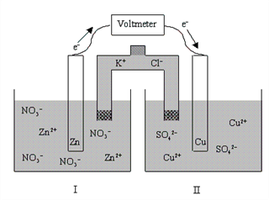
Q84. In the context of the diagram given below, which of the following statements is true concerning half-cell II?
Background
Topic: Electrochemistry – Galvanic (Voltaic) Cells
This question tests your understanding of the movement of ions and electrons in a galvanic cell and how concentrations change in each half-cell as the cell operates.
Key Terms and Concepts:
Half-Cell: One part of an electrochemical cell where either oxidation or reduction occurs.
Reduction/Oxidation: In the cathode compartment (half-cell II), reduction occurs and metal ions are converted to solid metal.
Salt Bridge: Maintains electrical neutrality by allowing ion flow between half-cells.
Step-by-Step Guidance
Identify which half-cell is the cathode (where reduction occurs) and which is the anode (where oxidation occurs).
Determine what happens to the concentration of Cu2+ ions in half-cell II as the cell operates.
Consider the movement of ions from the salt bridge to maintain charge balance.
Try solving on your own before revealing the answer!
Final Answer: [Cu2+] decreases with time, and [K+] increases with time.
As Cu2+ is reduced to Cu(s), its concentration decreases, and K+ from the salt bridge enters to balance the charge.
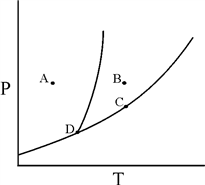
Q20. Which of the statements concerning the phase diagram is/are correct?
Background
Topic: Phase Diagrams
This question tests your ability to interpret a phase diagram and understand the meaning of different points (such as triple point, critical point, and phase boundaries).
Key Terms and Concepts:
Phase Diagram: A plot of pressure (P) versus temperature (T) showing the conditions under which different phases exist.
Critical Point: The end point of the phase equilibrium curve between liquid and gas, beyond which the substance is a supercritical fluid.
Triple Point: The unique set of conditions where all three phases coexist in equilibrium.
Step-by-Step Guidance
Identify the regions and lines on the phase diagram (solid, liquid, gas, and phase boundaries).
Locate the labeled points (A, B, C, D) and determine which phase(s) are present at each point.
Recall the definitions of equilibrium between phases and the critical point.
Try solving on your own before revealing the answer!
Final Answer: 1 only
At point A, only the solid phase exists. The other statements do not correctly describe the phase diagram at the indicated points.
