 Back
BackGeneral Chemistry Exam IV Study Guidance: Kinetics & Electrochemistry
Study Guide - Smart Notes
 Tailored notes based on your materials, expanded with key definitions, examples, and context.
Q1. Which of the following is consistent with the reaction below being third order overall?
2 A + B + C → D + E
Background
Topic: Reaction Order & Rate Laws
This question tests your understanding of how to determine the overall order of a reaction from its rate law and related properties.
Key Terms and Formulas:
Rate Law: An expression relating the rate of a reaction to the concentrations of reactants.
Overall Order: The sum of the exponents in the rate law.
Units of Rate Constant: Depend on the overall order.
Step-by-Step Guidance
Recall that the overall order is the sum of the exponents in the rate law. For example, Rate = k[A]^2[B][C] is third order overall (2+1+1).
Check the units of the rate constant for a third order reaction. For third order, k has units of M-2s-1.
Eliminate options that do not match the definition or units for a third order reaction.
Try solving on your own before revealing the answer!
Q2. What is the rate law expression for the reaction below, given the following data:
HgCl2(aq) + C2O42–(aq) → 2 Cl–(aq) + 2 CO2(g) + Hg2Cl2(s)
Background
Topic: Determining Rate Laws from Experimental Data
This question tests your ability to analyze experimental data to deduce the rate law for a reaction.
Key Terms and Formulas:
Rate Law: Rate = k[HgCl2]^x[C2O42–]^y
Initial Rate Method: Compare changes in concentration and rate to determine exponents.
Step-by-Step Guidance
Compare trials where only one reactant concentration changes to determine the order with respect to each reactant.
Calculate the ratio of rates and concentrations to solve for the exponents x and y.
Write the rate law using the determined exponents.
Try solving on your own before revealing the answer!
Q3. A reaction A + B → products has the following rate law: Rate = k [A]^m [B]^1
At a certain temperature, the rate is 4.78 × 10⁻² Ms–1 when [A] = 1.12 M and [B] = 0.87 M. The rate constant is 4.38 × 10⁻² M–2s–1. What is the order with respect to A?
Background
Topic: Rate Law and Reaction Order
This question tests your ability to use the rate law and given data to determine the reaction order with respect to a specific reactant.
Key Terms and Formulas:
Rate Law: Rate = k[A]^m[B]^1
Order with respect to A: The exponent m in the rate law.
Step-by-Step Guidance
Write the rate law with the given values: .
Plug in the values for Rate, k, [A], and [B].
Rearrange the equation to solve for m using logarithms if necessary.
Try solving on your own before revealing the answer!
Q18. Consider E°red(Fe3+/Fe2+) = +0.77 V and the following diagram of a standard galvanic cell:
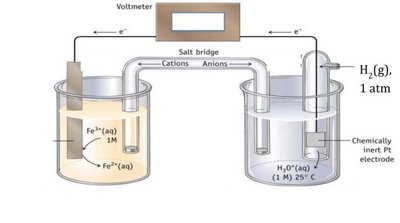
Background
Topic: Electrochemistry – Galvanic Cells
This question tests your understanding of standard cell notation, electrode processes, and the interpretation of cell diagrams.
Key Terms and Formulas:
Galvanic Cell: A device that generates electrical energy from spontaneous redox reactions.
Cathode: Electrode where reduction occurs.
Anode: Electrode where oxidation occurs.
Standard Reduction Potential (): The voltage associated with a reduction half-reaction at standard conditions.
Step-by-Step Guidance
Identify which electrode is the cathode and which is the anode based on the cell diagram and reduction potentials.
Recall that reduction occurs at the cathode and oxidation at the anode.
Determine which species are being oxidized and reduced in the cell.
Analyze the voltmeter reading and relate it to the standard reduction potential.
Check the material of the electrodes and the direction of electron flow.
Try solving on your own before revealing the answer!
