Back
BackGeneral Chemistry Exam Study Guidance (Chapters 1–3)
Study Guide - Smart Notes
 Tailored notes based on your materials, expanded with key definitions, examples, and context.
Q1. Which of the following is a chemical property?
Background
Topic: Physical vs. Chemical Properties
This question tests your understanding of the difference between physical and chemical properties of substances. Chemical properties describe a substance's ability to undergo a specific chemical change.
Key Terms:
Chemical Property: A characteristic that can only be observed during a chemical reaction, indicating the substance's ability to change into a different substance.
Physical Property: A characteristic that can be observed without changing the substance's identity.
Step-by-Step Guidance
Review the definitions of physical and chemical properties. Ask yourself: does the property involve a change in the substance's chemical identity?
Look at each answer choice and decide if it describes a change in composition (chemical) or just a physical change (physical).
Identify the property that involves a substance reacting or changing into something new.
Try solving on your own before revealing the answer!
Q2. Which of the following is a homogeneous mixture?
Background
Topic: Classification of Matter
This question tests your ability to distinguish between homogeneous and heterogeneous mixtures. Homogeneous mixtures have uniform composition throughout.
Key Terms:
Homogeneous Mixture: A mixture with the same composition throughout (also called a solution).
Heterogeneous Mixture: A mixture where the components are not uniformly distributed.
Step-by-Step Guidance
Recall the definitions of homogeneous and heterogeneous mixtures.
Examine each answer choice and consider whether you could see different parts or if it looks the same throughout.
Identify the mixture that is uniform in appearance and composition.
Try solving on your own before revealing the answer!
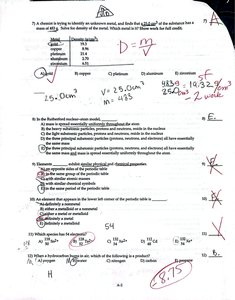
Q3. Calculate the density of a substance if a 25.0 cm3 sample has a mass of 48.3 g.
Background
Topic: Density Calculations
This question tests your ability to use the density formula to relate mass and volume.
Key Formula:
Mass should be in grams (g).
Volume should be in cubic centimeters (cm3).
Step-by-Step Guidance
Write down the given values: mass = 48.3 g, volume = 25.0 cm3.
Substitute these values into the density formula.
Set up the calculation, but do not compute the final value yet.
Try solving on your own before revealing the answer!
Q4. What is the empirical formula of a compound that contains 43.6% K, 56.4% S?
Background
Topic: Empirical Formula Determination
This question tests your ability to determine the simplest whole-number ratio of elements in a compound from percent composition data.
Key Steps:
Convert percentages to grams (assume 100 g sample).
Convert grams to moles using molar masses.
Divide by the smallest number of moles to get the simplest ratio.
Step-by-Step Guidance
Assume you have 100 g of the compound: K = 43.6 g, S = 56.4 g.
Find the molar mass of K and S from the periodic table.
Convert grams of each element to moles by dividing by their molar masses.
Set up the mole ratios, but do not simplify to the final empirical formula yet.
Try solving on your own before revealing the answer!
Q5. In a reaction, 2.5 g of Mg reacts with excess O2 to produce MgO. What is the percent yield if 3.1 g of MgO is actually produced?
Background
Topic: Percent Yield in Chemical Reactions
This question tests your ability to calculate percent yield from actual and theoretical yields.
Key Formula:
Actual yield: the amount of product actually obtained from the reaction.
Theoretical yield: the maximum amount of product that could be formed from the given reactants.
Step-by-Step Guidance
Write the balanced chemical equation for the reaction: .
Convert the mass of Mg to moles using its molar mass.
Use the stoichiometry of the reaction to find the moles of MgO that can be produced.
Convert moles of MgO to grams (theoretical yield), but do not calculate the percent yield yet.
Try solving on your own before revealing the answer!