 Back
BackGeneral Chemistry Final Exam Review: Key Concepts and Problem-Solving Guidance
Study Guide - Smart Notes
 Tailored notes based on your materials, expanded with key definitions, examples, and context.
Q1. Draw the Lewis structure for H2CO (formaldehyde).
Background
Topic: Lewis Structures and Covalent Bonding
This question tests your ability to represent molecules using Lewis structures, showing all valence electrons, bonds, and lone pairs. Understanding Lewis structures is essential for predicting molecular geometry, polarity, and reactivity.
Key Terms and Concepts:
Lewis Structure: A diagram showing the arrangement of valence electrons around atoms in a molecule.
Valence Electrons: Electrons in the outermost shell of an atom, involved in bonding.
Octet Rule: Atoms tend to form bonds to have eight electrons in their valence shell (except H, which wants 2).
Step-by-Step Guidance
Count the total number of valence electrons for all atoms in H2CO (H = 1 each, C = 4, O = 6).
Determine the central atom (usually the least electronegative, except H is never central). Place C in the center, with H and O around it.
Connect each atom to the central atom with single bonds. Subtract the electrons used from the total valence electrons.
Distribute remaining electrons to complete the octet for O first, then C, and ensure H has 2 electrons each.
If the central atom does not have a complete octet, consider forming double bonds as needed.
Try solving on your own before revealing the answer!
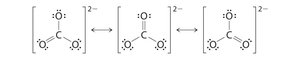
Q2. Draw all resonance structures for the carbonate ion, CO32−, and determine the formal charge on each atom.
Background
Topic: Resonance and Formal Charge
This question tests your understanding of resonance (delocalization of electrons) and how to assign formal charges to atoms in polyatomic ions.
Key Terms and Concepts:
Resonance Structures: Different Lewis structures for the same molecule/ion that show delocalization of electrons.
Formal Charge: Calculated as:
Step-by-Step Guidance
Count the total number of valence electrons for CO32− (C = 4, O = 6 each, plus 2 extra for the charge).
Draw a skeleton structure with C in the center and three O atoms around it, connected by single bonds.
Distribute remaining electrons to complete octets for the O atoms, then C if possible.
To minimize formal charges, move lone pairs from O to form double bonds with C, creating resonance structures where the double bond is with a different O each time.
Try solving on your own before revealing the answer!
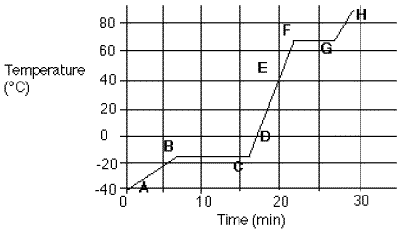
Q3. For the substance represented in this heating curve, identify the physical state(s) at each of these points: A, C, D, G, H. Also, determine the melting and boiling points.
Background
Topic: Heating Curves and Phase Changes
This question tests your ability to interpret a heating curve, which shows temperature changes as a substance is heated and undergoes phase changes (solid, liquid, gas).
Key Terms and Concepts:
Heating Curve: A plot of temperature vs. time as a substance is heated, showing plateaus at phase changes.
Melting Point: Temperature where solid turns to liquid.
Boiling Point: Temperature where liquid turns to gas.
Step-by-Step Guidance
Identify the regions (sloped lines) and plateaus (flat lines) on the graph. Sloped lines indicate temperature change within a single phase; plateaus indicate phase changes.
Label each point (A, C, D, G, H) with the corresponding physical state(s) based on their position on the curve.
Determine the melting point (temperature at the solid-liquid plateau) and boiling point (temperature at the liquid-gas plateau).
Try solving on your own before revealing the answer!
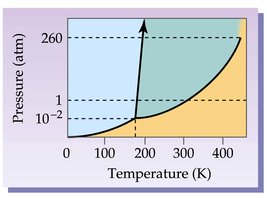
Q4. For the substance represented in this phase diagram, identify the solid, liquid, and gas regions. Also, locate the solid-liquid equilibrium line, the liquid-vapor equilibrium line, the triple point, the normal melting and boiling points, and the critical point.
Background
Topic: Phase Diagrams
This question tests your ability to interpret a phase diagram, which shows the states of matter of a substance at different temperatures and pressures, and the lines where phase changes occur.
Key Terms and Concepts:
Phase Diagram: A graph of pressure vs. temperature showing regions of solid, liquid, and gas, and lines of equilibrium between phases.
Triple Point: The unique set of conditions where all three phases coexist.
Critical Point: The end point of the liquid-gas equilibrium line, beyond which the liquid and gas phases are indistinguishable.
Step-by-Step Guidance
Identify the regions on the diagram corresponding to solid, liquid, and gas (usually color-coded or separated by lines).
Locate the lines separating the phases: solid-liquid, liquid-gas, and solid-gas equilibrium lines.
Find the triple point (where all three lines meet) and the critical point (end of the liquid-gas line).
Determine the normal melting and boiling points by finding the temperatures where the solid-liquid and liquid-gas lines intersect 1 atm pressure.
Try solving on your own before revealing the answer!
