 Back
General Chemistry Fundamentals: Matter, Measurement, Atoms, and Elements
Study Guide - Smart Notes
 Tailored notes based on your materials, expanded with key definitions, examples, and context.
Chapter 1: Matter, Measurement & Problem Solving
Introduction to Chemistry and Scientific Method
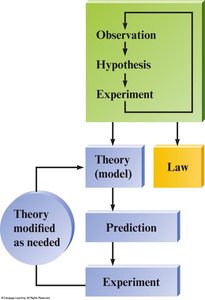
Chemistry is the study of matter, its properties, and the changes it undergoes. Understanding chemistry is essential for many scientific and practical applications, from medicine to environmental science. The scientific method is a systematic approach used by scientists to explore observations, answer questions, and solve problems.
Observation: Gathering data about phenomena.
Hypothesis: A tentative explanation or prediction that can be tested.
Experiment: A controlled procedure to test the hypothesis.
Theory (Model): A well-substantiated explanation of some aspect of the natural world.
Law: A statement that describes an observable occurrence in nature that appears to always be true.
Measurement and Units
Measurements in chemistry require both a number and a unit. The SI (International System of Units) is the standard system used in science. Common units include:
Mass: kilogram (kg)
Length: meter (m)
Time: second (s)
Temperature: kelvin (K)
Prefixes are used to indicate multiples or fractions of units (e.g., milli-, centi-, kilo-).
Uncertainty and Significant Figures
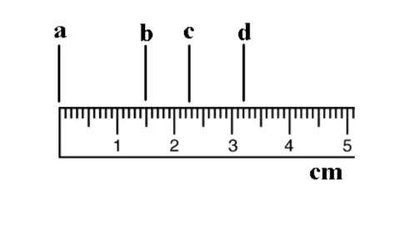
All measurements have some degree of uncertainty. Significant figures reflect the precision of a measurement. The rules for determining significant figures include:
All nonzero digits are significant.
Zeros between nonzero digits are significant.
Leading zeros are not significant.
Trailing zeros are significant only if there is a decimal point.
When performing calculations, the result should be reported with the correct number of significant figures based on the operation (multiplication/division: fewest sig figs; addition/subtraction: fewest decimal places).
Chapter 2: Atoms & Elements
Atomic Structure
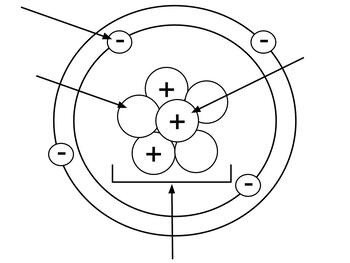
Atoms are composed of three main subatomic particles: protons, neutrons, and electrons. The nucleus contains protons and neutrons, while electrons occupy the space around the nucleus.
Protons: Positively charged, found in the nucleus.
Neutrons: Neutral, found in the nucleus.
Electrons: Negatively charged, found outside the nucleus.
Isotopes and Atomic Notation
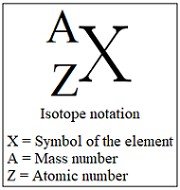
Isotopes are atoms of the same element with different numbers of neutrons. The atomic number (Z) is the number of protons, and the mass number (A) is the sum of protons and neutrons. Isotope notation is written as:
X: Element symbol
A: Mass number (protons + neutrons)
Z: Atomic number (protons)
Periodic Table and Element Families
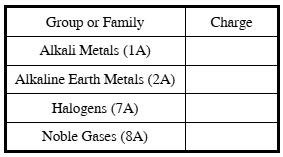
The periodic table organizes elements by increasing atomic number and similar chemical properties. Elements are grouped into families with characteristic charges when forming ions:
Group or Family | Charge |
|---|---|
Alkali Metals (1A) | +1 |
Alkaline Earth Metals (2A) | +2 |
Halogens (7A) | -1 |
Noble Gases (8A) | 0 (generally do not form ions) |
Chapter 3: Molecules and Compounds
States of Matter
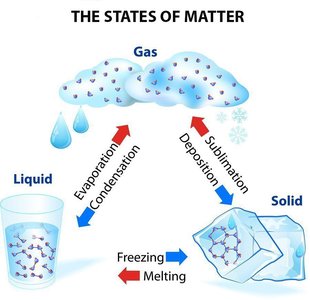
Matter exists in three primary states: solid, liquid, and gas. The state depends on temperature and pressure, and each state has distinct properties:
Solid: Definite shape and volume; particles are closely packed and vibrate in place.
Liquid: Definite volume but takes the shape of its container; particles are close but can move past each other.
Gas: No definite shape or volume; particles are far apart and move freely.
Classification of Matter
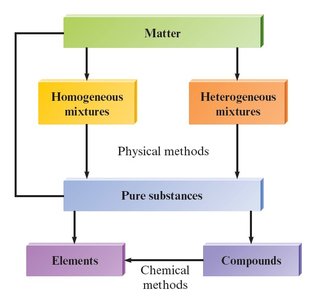
Matter can be classified as pure substances or mixtures. Pure substances include elements and compounds, while mixtures can be homogeneous (uniform composition) or heterogeneous (non-uniform composition).
Element: A substance made of only one kind of atom.
Compound: A substance made of two or more elements chemically combined.
Homogeneous mixture: Uniform composition throughout (solution).
Heterogeneous mixture: Non-uniform composition.
Appendix: Mathematical Operations and Measurement Tools
Reading Laboratory Instruments
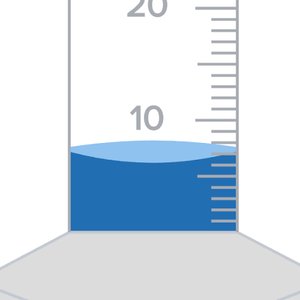
Accurate measurement is essential in chemistry. Graduated cylinders and rulers are common tools for measuring volume and length, respectively. Always read the bottom of the meniscus for liquids and estimate one digit beyond the smallest marking.
Additional info:
Images were included only when they directly reinforced the explanation of the adjacent paragraph.
All tables were recreated in HTML for clarity and accessibility.
