 Back
General Chemistry Gas Laws and Kinetic Molecular Theory Study Guide
Study Guide - Smart Notes
 Tailored notes based on your materials, expanded with key definitions, examples, and context.
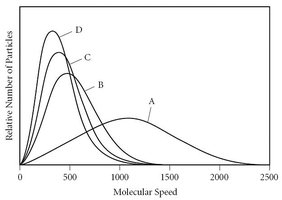
Q45. Which of the gases in the graph below has the largest molar mass?
Background
Topic: Kinetic Molecular Theory & Maxwell-Boltzmann Distribution
This question tests your understanding of how the distribution of molecular speeds relates to the molar mass of a gas. The Maxwell-Boltzmann distribution shows how the speeds of gas molecules are distributed at a given temperature.
Key Terms and Formulas
Molar mass (M): The mass of one mole of a substance, usually in g/mol.
Root mean square speed (): The typical speed of a molecule in a gas, given by:
Where:
= gas constant ()
= temperature in Kelvin
= molar mass in kg/mol
Step-by-Step Guidance
Examine the graph: Each curve represents a different gas, showing the distribution of molecular speeds.
Recall that heavier (higher molar mass) gases have lower average speeds, so their distribution peaks at lower molecular speeds.
Compare the position of the peaks: The curve with the peak furthest to the left (lowest speed) corresponds to the gas with the largest molar mass.
Identify which curve (A, B, C, or D) has its peak at the lowest molecular speed.
Try solving on your own before revealing the answer!
Final Answer: D
Curve D has its peak at the lowest molecular speed, indicating it represents the gas with the largest molar mass. According to the Maxwell-Boltzmann distribution, heavier gases move more slowly on average.
