 Back
BackGeneral Chemistry I: Comprehensive Study Guide
Study Guide - Smart Notes
 Tailored notes based on your materials, expanded with key definitions, examples, and context.
Chapter 1: Matter, Measurement & Problem Solving
Scientific Method
The scientific method is a systematic approach to research and discovery in science. It involves several key steps:
Observation: Gathering data and noticing phenomena.
Hypothesis: Proposing a tentative explanation for the observation.
Experiment: Testing the hypothesis through controlled investigation.
Theory: A well-substantiated explanation based on repeated experiments.
Law: A statement describing consistent natural phenomena, often mathematically.
Types of Matter
Matter can be classified based on its composition:
Element: Pure substance consisting of one type of atom (e.g., Silver).
Compound: Substance composed of two or more elements chemically combined (e.g., NaCl, Sucrose).
Homogeneous Mixture: Uniform composition throughout (e.g., Kool-aid, Bronze).
Heterogeneous Mixture: Non-uniform composition (e.g., Salad dressing).
Chemical Change: Alters the composition of matter (e.g., Iron rusts). Physical Change: Does not alter composition (e.g., Gasoline vaporizes).
Significant Figures
Significant figures reflect the precision of a measured quantity. Rules for counting significant figures:
All nonzero digits are significant.
Zeros between nonzero digits are significant.
Leading zeros are not significant.
Trailing zeros after a decimal point are significant.
When performing calculations, round the result to the correct number of significant figures based on the operation (multiplication/division: fewest sig figs; addition/subtraction: fewest decimal places).
Scientific Notation
Used to express very large or small numbers in the form a × 10n. It helps indicate the correct number of significant figures.
Units and Unit Conversions
Measurements use SI units (meter, kilogram, second, etc.). Conversion factors relate different units.
To convert between units, multiply by the appropriate conversion factor.
Density equation:
Example: The density of acetic acid is 1.035 g/mL. To find the volume for 35.00 g:
Chapter 2: Atoms & Elements
Atomic Structure
Atoms consist of protons (positive), neutrons (neutral), and electrons (negative). Isotopes are atoms of the same element with different numbers of neutrons.
Atomic number (Z): Number of protons.
Mass number (A): Protons + neutrons.
Average atomic mass: Weighted average based on isotopic abundance.
Example: Lithium-6 (3 protons, 3 neutrons, 3 electrons); Lithium-7 (3 protons, 4 neutrons, 3 electrons).
Naming Compounds
Compounds are named based on their composition:
Ionic compounds: Metal + nonmetal (e.g., CaO).
Binary molecular compounds: Nonmetal + nonmetal (e.g., PCl5).
Acids: Contain H+ (e.g., HNO3).
Cation: Positively charged ion; Anion: Negatively charged ion.
Mole and Molecular Weights
The mole is a counting unit (Avogadro's number: ). Molar mass is the mass of one mole of a substance.
To convert between mass, moles, and number of particles, use:
Empirical and Molecular Formulas
The empirical formula gives the simplest whole-number ratio of elements in a compound. The molecular formula is a multiple of the empirical formula based on molar mass.
Chapter 4: Chemical Reactions & Chemical Quantities
Balancing Equations
Chemical equations must be balanced to obey the law of conservation of mass. Adjust coefficients to ensure equal numbers of each atom on both sides.
Stoichiometry
Stoichiometry involves calculating quantities of reactants and products using balanced equations.
Convert given quantities to moles.
Use mole ratios from the balanced equation.
Convert moles to desired units (grams, liters, etc.).
Limiting Reactant, Theoretical and Percent Yield
The limiting reactant is used up first and determines the amount of product formed. Theoretical yield is the maximum possible amount of product. Percent yield compares actual yield to theoretical yield:
Chapter 5: Introduction to Solutions and Aqueous Reactions
Solution Calculations
Molarity (M) is the concentration of a solution:
Dilution equation:
Solution Chemistry
Types of reactions in solution:
Precipitation: Formation of an insoluble solid.
Acid-base: Transfer of H+ ions.
Oxidation-reduction (redox): Transfer of electrons.
Electrolytes: Substances that conduct electricity in solution. Strong electrolytes dissociate completely; weak electrolytes do not.
Ionic Theory of Solutions
Solubility rules determine if a compound is soluble or insoluble in water. Use these rules to predict precipitation reactions.
Ionic Equations
Three types of equations:
Molecular equation: Shows all reactants and products as compounds.
Complete ionic equation: Shows all strong electrolytes as ions.
Net ionic equation: Shows only species that change during the reaction.
Acid-Base Reactions
Acids produce H+ in solution; bases produce OH-. Strong acids/bases ionize completely; weak acids/bases do not. Neutralization produces water and a salt.
Oxidation-Reduction Reactions
Assign oxidation numbers to identify which species is oxidized (loses electrons) and which is reduced (gains electrons). The oxidizing agent is reduced; the reducing agent is oxidized.
Chapter 8: The Quantum-Mechanical Model of the Atom
Electromagnetic Radiation
Light has both wave and particle properties. Key relationships:
Speed of light: m/s
Wavelength and frequency:
Energy of a photon:
Example: To find the frequency of light with wavelength 408 nm, use .
Bohr Theory
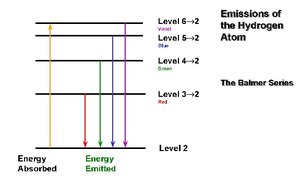
Electrons occupy specific energy levels. When an electron absorbs energy, it moves to a higher level; when it returns, it emits light of a specific wavelength. The Balmer series describes visible emissions for hydrogen.
Quantum Numbers
Quantum numbers describe the properties of atomic orbitals and electrons:
Principal (n): Energy level (1, 2, 3...)
Angular momentum (l): Shape (0 to n-1; s=0, p=1, d=2, f=3)
Magnetic (ml): Orientation (-l to +l)
Spin (ms): +1/2 or -1/2
Pauli Exclusion Principle: No two electrons in an atom can have the same set of four quantum numbers.
Chapter 9: Periodic Properties of the Elements
Electron Configuration and Periodic Trends
Electron configuration is determined by the Aufbau principle, Hund’s rule, and Pauli exclusion principle. The periodic table is arranged by increasing atomic number, and elements are grouped by similar properties.
Valence electrons: Electrons in the outermost shell, determine chemical reactivity.
Blocks: s, p, d, f blocks correspond to the type of orbital being filled.
Periodic Trends
Several properties change predictably across periods and down groups:
Property | Trend Moving Down a Column | Reason for Trend Moving Down | Trend Moving Across a Row | Reason for Trend Moving Across |
|---|---|---|---|---|
Atomic Radii | Increasing | Size of outermost occupied orbital increases | Decreasing | Effective nuclear charge increases |
First Ionization Energy | Decreasing | Outermost electrons farther from nucleus (easier to remove) | Increasing | Effective nuclear charge increases |
Electron Affinity | No definite trend | Becomes more negative | Effective nuclear charge increases | |
Metallic Character | Increasing | Ionization energy decreases | Decreasing | Ionization energy increases |

Chapter 10: Chemical Bonding I: The Lewis Model
Types of Bonds
Ionic bonds: Transfer of electrons from metal to nonmetal. Covalent bonds: Sharing of electrons between nonmetals. Metallic bonds: Delocalized electrons among metal atoms.
Lewis Dot Structures
Lewis structures represent valence electrons as dots. For molecules and polyatomic ions, draw all valence electrons, including lone pairs and multiple bonds as needed.
Electronegativity and Bond Polarity
Electronegativity is the ability of an atom to attract electrons in a bond. It increases across a period and decreases down a group. The difference in electronegativity determines bond polarity and dipole moment.
Formal Charge and Resonance
Formal charge helps determine the most stable Lewis structure. Calculate as:
Resonance structures are possible when more than one valid Lewis structure exists. The most stable form has the smallest formal charges.
Exceptions to the Octet Rule
Some elements (e.g., B, Al) can have fewer than 8 electrons; others (e.g., P, S, Br, I) can have expanded octets.
Chapter 11: Chemical Bonding II: Molecular Shapes, VSEPR & MO Theory
VSEPR Theory and Molecular Geometry
Valence Shell Electron Pair Repulsion (VSEPR) theory predicts molecular shapes based on repulsion between electron pairs. Lone pairs exert greater repulsion, distorting geometry. Electron geometry considers all electron pairs; molecular geometry considers only bonding pairs.
Valence Bond Theory and Hybridization
Atomic orbitals mix to form hybrid orbitals:
sp3: tetrahedral
sp2: trigonal planar
sp: linear
sp3d: trigonal bipyramidal
sp3d2: octahedral
σ (sigma) bonds are single bonds; π (pi) bonds are found in double and triple bonds.
Chapter 6: Gases
Gas Laws
Relationships between pressure, volume, temperature, and amount of gas are described by:
Boyle's Law: (constant T, n)
Charles' Law: (constant P, n)
Avogadro's Law: (constant P, T)
Dalton's Law of Partial Pressures:
Ideal Gas Law:
