 Back
BackGeneral Chemistry II (Chemistry 102) Syllabus and Course Structure
Study Guide - Smart Notes
 Tailored notes based on your materials, expanded with key definitions, examples, and context.
Course Overview
Introduction to General Chemistry II
This course, Chemistry 102: General Chemistry II, is designed to provide students with a qualitative and quantitative understanding of interconnected chemical concepts. The curriculum builds foundational knowledge for future courses such as organic chemistry, biochemistry, and analytical chemistry. Students are expected to master both conceptual explanations and mathematical problem-solving related to chemical systems.
Course Goals
Learning Objectives
Qualitative and Quantitative Understanding: Explain chemical concepts, identify variables, and analyze how changes affect systems both qualitatively and quantitatively.
Application: Apply mastered chemical concepts in novel contexts.
Preparation for Future Courses: Build a foundation for advanced chemistry courses.
Worldview: Develop an appreciation for chemical principles in everyday life.
Course Structure and Policies
Mastery-Based Learning
Multiple opportunities to demonstrate mastery of concepts.
Flexible policies for homework extensions and grade replacement.
Lowest ALEKS scores dropped at semester end.
Midterm grade replacement with final exam score if higher.
Required Materials
Textbook and Tools
ALEKS Access: Electronic homework and textbook access (Chemistry: Atoms First, 5th Edition by Burdge and Overby).
Scientific Calculator: Graphing or non-graphing calculator required for exams.
Resources for Success
Support and Study Tools
Textbook readings via ALEKS.
ALEKS modules and practice problems.
Supplemental Instructor (SI) office hours and study groups.
Chapter study guides and practice worksheets.
Instructor office hours for personalized help.
Grading Breakdown
Assessment Components
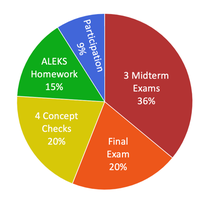
ALEKS Homework: 15% - Complete before next class.
Participation: 9% - Earned through in-class problem sets, office hours, and surveys.
Concept Checks: 20% - Four online quizzes graded pass/fail, with retake options.
Exams: 56% - Three midterms (36%) and a cumulative final (20%). Partial credit awarded.
Course Schedule
Weekly Topics and Exams
Chapters covered: 10, 12, 13, 14, 15, 16, 17, 18, 20
Midterm and final exam dates specified in the syllabus.
Concept checks indicated throughout the schedule.
Content Outline
Chapter Topics
Chapter 10: Energy Changes in Chemical Reactions (thermodynamics, enthalpy, calorimetry, Hess’s law, bond enthalpy)
Chapter 12: Liquids and Solids (properties, types, phase changes, diagrams)
Chapter 13: Physical Properties of Solutions (concentration, solubility, colligative properties)
Chapter 14: Chemical Kinetics (reaction rates, mechanisms, catalysis)
Chapter 15: Entropy and Gibbs Energy (spontaneity, entropy changes)
Chapter 16: Chemical Equilibrium (equilibrium constants, Le Châtelier’s principle)
Chapter 17: Acids, Bases, and Salts (Brønsted acids/bases, pH, acid/base strength)
Chapter 18: Acid-Base and Solubility Equilibria (buffers, titrations, solubility)
Chapter 20: Nuclear Chemistry (nuclear reactions, stability, radioactivity, fission/fusion)
Academic Integrity and Support
Honor Code and Student Wellbeing
Commitment to honesty, trust, fairness, respect, responsibility, and courage.
Support for students with documented disabilities and mental health resources.
Encouragement to seek help and avoid academic misconduct.
Summary Table: Grading Components
Component | Percentage |
|---|---|
3 Midterm Exams | 36% |
Final Exam | 20% |
4 Concept Checks | 20% |
ALEKS Homework | 15% |
Participation | 9% |
Additional Info
Course policies are designed to support mastery and student success.
Students are encouraged to use all available resources and seek help as needed.
Academic integrity is a core value of the course and institution.
