 Back
BackGeneral Chemistry II: Final Exam Study Guide & Formula Sheet
Study Guide - Smart Notes
 Tailored notes based on your materials, expanded with key definitions, examples, and context.
General Chemistry II: Final Exam Study Guide
Exam Structure and Coverage
This study guide summarizes the structure, topics, and key formulas relevant to a comprehensive General Chemistry II final examination. The exam is divided into three main sections: Multiple Choice, Visualizing Concepts, and Calculations. Each section assesses understanding of core chemical principles, problem-solving skills, and the ability to interpret and analyze chemical data and diagrams.
Exam Sections and Topics
Section I: Multiple Choice
Gas Laws: Relationships between volume (V), pressure (P), temperature (T), and moles (n); ideal vs. non-ideal gas behavior; effusion and diffusion rates.
Intermolecular Forces (IMF): Effects on boiling point, surface tension, capillary action, and structure.
Thermochemistry: Calculating heat of vaporization using Clausius-Clapeyron equation, exothermic/endothermic and exergonic/endergonic processes, work done by/on a system, specific heat capacity calculations.
Solid State Chemistry: Estimating number of atoms in unit cells (cubic, body-centered cubic, face-centered cubic), classification of alloys, semiconductor doping (n-type vs. p-type).
Section II: Visualizing Concepts
Kinetics: Interpreting integrated rate law plots to determine rate laws, rate constants, and initial concentrations.
Acid-Base Chemistry: Analyzing titration curves to determine pKa/Ka, acid strength, and concentration.
Phase Changes: Reading phase diagrams to identify triple/critical points, states of matter, and effects of pressure/temperature changes.
Thermochemistry/Phase Changes: Using heating curves to find heat of vaporization, specific heat capacity, melting/boiling points.
Thermodynamics: Interpreting free energy profile diagrams to label ΔG, equilibrium, spontaneity, and exo/endothermicity.
Electrochemistry: Labeling electrochemical cells, calculating emf, and determining electron flow direction.
Gas Laws (Advanced): Calculating moles, mass, molar mass, and partial pressures using diagrams and equations.
Section III: Calculations
Kinetics: Using initial rate tables to determine rate laws, rate constants, and rates for given concentrations.
Chemical Equilibrium: Using ICE tables to find equilibrium concentrations and equilibrium constants (Kc).
Thermochemistry: Calculating enthalpy changes (ΔHrxn) using enthalpies of formation, bond energies, and Hess's Law.
Buffers: Writing acid/base reactions, identifying conjugate pairs, calculating buffer pH (Henderson-Hasselbalch equation), and determining concentrations.
Electrochemistry: Writing balanced redox reactions, calculating standard emf, free energy, equilibrium constants, and non-standard emf using the Nernst equation.
Key Concepts and Definitions
Gas Laws
Ideal Gas Law:
Partial Pressure:
Effusion/Diffusion: Rate is inversely proportional to the square root of molar mass.
Thermochemistry
Heat (q):
Enthalpy Change:
First Law of Thermodynamics:
Clausius-Clapeyron Equation:
Kinetics
Rate Laws:
Integrated Rate Laws:
First Order:
Second Order:
Zero Order:
Arrhenius Equation:
Chemical Equilibrium
Equilibrium Constant (K): Relates concentrations of products and reactants at equilibrium.
ICE Table: Used to calculate equilibrium concentrations.
Acid-Base Equilibria and Buffers
pH and pOH:
Henderson-Hasselbalch Equation:
Conjugate Acid-Base Pairs: Differ by one proton (H+).
Thermodynamics
Gibbs Free Energy:
Relationship to Equilibrium:
Spontaneity: indicates a spontaneous process.
Electrochemistry
Standard Cell Potential:
Relationship to Free Energy:
Nernst Equation:
Solid State Chemistry
Unit Cells: Simple cubic, body-centered cubic (BCC), face-centered cubic (FCC).
Semiconductors: n-type (extra electrons), p-type (holes).
Formula Sheet
The following formulas and constants are provided for use during the exam:
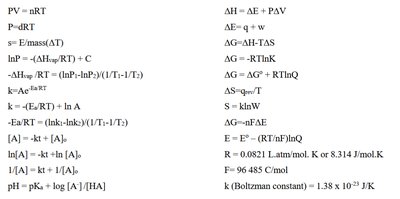
Gas Laws: ,
Thermochemistry: , ,
Kinetics: ,
Equilibrium:
Acid-Base:
Thermodynamics: ,
Electrochemistry: ,
Constants: L·atm/mol·K or J/mol·K, C/mol, (Boltzmann constant) J/K
Additional Information
Be familiar with interpreting and constructing graphs, diagrams, and tables related to chemical concepts.
Practice applying formulas to solve quantitative problems and explain conceptual relationships.
Review the relationships between thermodynamic quantities, equilibrium, and electrochemical cell potentials.
