 Back
BackGeneral Chemistry II: Matter, Measurements, Stoichiometry, and Gas Laws
Study Guide - Smart Notes
 Tailored notes based on your materials, expanded with key definitions, examples, and context.
General Chemistry II Overview
Introduction to Chemistry
Chemistry is the study of matter and its transformations, encompassing solids, liquids, gases, solutions, organic molecules, and biomolecules. This course focuses on understanding chemical reactions, thermodynamics, kinetics, and equilibria.
Matter: Anything that has mass and occupies space.
Transformations: Chemical reactions and changes in physical state.
Thermodynamics: Determines whether a reaction will proceed.
Kinetics: Describes how fast a reaction proceeds.
Equilibria: The balance between multiple simultaneous reactions.
Review of Key General Chemistry Skills
Stoichiometry and Balancing Chemical Equations
Stoichiometry is the calculation of reactants and products in chemical reactions. Balancing equations ensures the conservation of mass and atoms.
Balancing Equations: Adjust coefficients to ensure equal numbers of each atom on both sides.
Example: The synthesis of ammonia:
Unbalanced: _N2 (g) + _H2 (g) ⇌ _NH3 (g) + heat
Balanced: 1N2 (g) + 3H2 (g) ⇌ 2NH3 (g) + heat
Units and Dimensional Analysis
Quantifying matter requires understanding units and converting between them using dimensional analysis.
Basic Units: Volume, mass, temperature, pressure, length, number of things.
Composite Quantities: Density (mass/volume), concentration (#/volume or mass/volume).
Dimensional Analysis: A method to convert between units using conversion factors.
Example: Converting mass and volume to find density:
Given: 4.00 qt of antifreeze weighs 9.26 lb.
Conversions: 1 lb = 453.50 g, 1 L = 1.0567 qt.
Calculate density in g/mL.
Mathematical Operations and Functions
Unit Combinations and Conversions
Combining units and converting between them is essential for solving chemistry problems.
Example: Calculating density from mass and volume.
Practice: How much NaCl is needed to make 500 mL of 0.7 mol/L NaCl?
Gases and Their Properties
The Ideal Gas Law
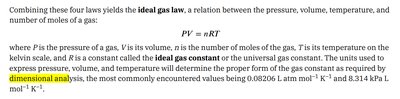
The ideal gas law relates the pressure, volume, temperature, and number of moles of a gas. It is a fundamental equation in chemistry for understanding gas behavior.
Equation:
P: Pressure (atm, kPa, bar)
V: Volume (L)
n: Number of moles
R: Ideal gas constant (0.08206 L atm mol-1 K-1 or 8.314 kPa L mol-1 K-1)
T: Temperature (K)
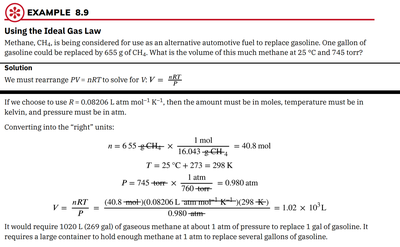
Example Problem: Methane as Automotive Fuel
Calculate the volume of methane (CH4) needed to replace one gallon of gasoline, given mass, temperature, and pressure.
Given: 655 g CH4, 25°C, 745 torr
Steps:
Convert mass to moles:
Convert temperature to Kelvin:
Convert pressure to atm:
Plug values into the ideal gas law to solve for volume:
Result: 1020 L (269 gal) of methane at these conditions is needed to replace one gallon of gasoline.
Practice Problem: Hydrogen Gas Storage
Calculate the pressure in bar of 2520 moles of hydrogen gas stored at 27°C in a 180-L tank.
Given: n = 2520 mol, T = 27°C = 300 K, V = 180 L
R: 0.08206 L atm mol-1 K-1 or 8.314 kPa L mol-1 K-1
Equation:
Convert pressure to bar if needed (1 atm = 1.01325 bar).
Additional Academic Context
Dimensional Analysis in Gas Law Calculations
Dimensional analysis is crucial for ensuring that units are consistent when applying the ideal gas law. Always convert quantities to the appropriate units before substituting into equations.
Pressure: Convert to atm, kPa, or bar as required by the value of R.
Volume: Use liters (L).
Temperature: Use Kelvin (K).
Moles: Use mol.
Summary Table: Key Quantities and Units
Quantity | Unit | Conversion Factor |
|---|---|---|
Mass | g, lb | 1 lb = 453.50 g |
Volume | L, qt | 1 L = 1.0567 qt |
Pressure | atm, torr, kPa, bar | 1 atm = 760 torr = 101.325 kPa = 1.01325 bar |
Temperature | K, °C | K = °C + 273 |
Moles | mol | n = mass (g) / molar mass (g/mol) |
Practice and Preparation
Review Chapter 8 (Gases and Their Properties) and Chapter 10 (Liquids, Solids, and Intermolecular Forces).
Register for ALEKS and complete the first homework assignment.
Keep an eye out for recitation section signups.
