Back
BackGeneral Chemistry II: Study Guide for Chapters 11–14
Study Guide - Smart Notes
 Tailored notes based on your materials, expanded with key definitions, examples, and context.
Liquids and Phase Changes
Intermolecular Forces and States of Matter
Understanding the relative strengths of intermolecular forces is essential for predicting the properties of solids, liquids, and gases.
Solids have the strongest intermolecular forces, followed by liquids, and then gases with the weakest.
Principal forces include hydrogen bonding, dipole-dipole interactions, and London dispersion forces.
Example: Water (H2O) exhibits strong hydrogen bonding, resulting in high boiling and melting points compared to similar-sized molecules.
Vapor Pressure and Boiling Point
Vapor pressure is the pressure exerted by a vapor in equilibrium with its liquid phase at a given temperature.
Boiling point is the temperature at which vapor pressure equals external pressure.
Boiling point decreases as external pressure decreases.
Clausius-Clapeyron Equation
The Clausius-Clapeyron equation relates vapor pressure and temperature, allowing calculation of enthalpy of vaporization.
Two-point form:
The slope of a plot of vs. is .
Use in units of J/(K·mol).
Phase Changes and Thermodynamic Quantities
Phase changes involve enthalpy () and entropy () changes.
Fusion (melting): solid to liquid
Freezing: liquid to solid
Vaporization: liquid to gas
Condensation: gas to liquid
Sublimation: solid to gas
Deposition: gas to solid
Signs: and are positive for melting, vaporization, and sublimation; negative for freezing, condensation, and deposition.
Entropy:
Gibbs Free Energy ()
Gibbs free energy determines spontaneity of processes.
for spontaneous processes, for nonspontaneous, at equilibrium.
Phase Diagrams
Phase diagrams show the state of a substance at various temperatures and pressures.
Can determine which phase is present at given conditions.
Solid-liquid coexistence curve slope indicates whether freezing point increases or decreases with pressure (water is unusual: freezing point decreases with pressure).
Triple point: all three phases coexist.
Critical point: marks the end of the liquid-gas boundary.
Solids and Solid-State Materials
Types of Solids
Solids are classified based on their structure and bonding.
Crystalline solids: have ordered, repeating structures.
Amorphous solids: lack long-range order.
Ionic solids: composed of cations and anions.
Molecular solids: held together by intermolecular forces.
Network covalent solids: atoms connected by covalent bonds (e.g., diamond).
Metallic solids: metal atoms with delocalized electrons.
X-ray Crystallography and Bragg's Law
X-ray crystallography is used to determine crystal structures. Bragg's law relates the angle of X-ray diffraction to the spacing between crystal planes.
Bragg's law:
Unit Cells and Packing
The unit cell is the smallest repeating unit in a crystal.
Simple cubic (scp): 1 atom per unit cell
Body-centered cubic (bcc): 2 atoms per unit cell
Face-centered cubic (fcc or ccp): 4 atoms per unit cell
Atoms at center contribute 1, face 1/2, edge 1/4, corner 1/8 to the unit cell.
ccp has the highest packing efficiency.
Ionic Solids and Crystal Structures
Ionic solids have alternating cations and anions. The formula can be determined by counting ions in the unit cell.
Oxidation numbers can be deduced from the arrangement.
Carbon Allotropes
Graphite, diamond, and fullerene (C60) are important carbon structures.
Graphite: layers of hexagonal carbon rings
Diamond: 3D network of covalent bonds
Fullerene: spherical structure of 60 carbon atoms
Metallic Bonding and Band Theory
Metallic bonding involves delocalized electrons ('electron sea' model), explaining malleability, ductility, and conductivity.
Band theory: molecular orbitals form bands; population of bands determines conductivity.
Transition metals: d electron count affects bonding strength and melting point.
Semiconductors and Superconductors
Semiconductors have a band gap between valence and conduction bands; conductivity increases with temperature.
n-type: extra electrons
p-type: holes (missing electrons)
Doping increases conductivity.
Diodes use p-n junctions.
"3-5 semiconductors" (e.g., GaAs) combine group 3 and 5 elements.
Superconductors have zero resistance below critical temperature (Tc).
Solutions and Their Properties
Definitions and Types
A solution is a homogeneous mixture of solute and solvent.
Types: solid-liquid, liquid-liquid, gas-gas, etc.
Solubility: maximum amount of solute that can dissolve.
Saturated solution: contains maximum solute.
Supersaturated solution: contains more solute than equilibrium allows.
Thermodynamics of Solution Formation
Enthalpy and entropy changes determine whether solution formation is exothermic or endothermic.
is usually positive.
Exothermic: ,
Endothermic: depends on and
Solubility Rules and Concentration Units
"Like dissolves like" predicts solubility based on polarity.
Molarity (M):
Molality (m):
Mole fraction (X):
Temperature Effects and Henry's Law
Solubility of solids generally increases with temperature; gases decrease.
Henry's law:
Colligative Properties
Colligative properties depend on the number of solute particles.
Raoult's law:
Boiling point elevation:
Freezing point depression:
van't Hoff factor (): number of particles formed from dissociation
Osmotic pressure:
Use in (L·atm)/(K·mol) for osmotic pressure.
Applications
Salts with higher are more effective for freezing point depression (e.g., CaCl2 vs. NaCl).
Osmotic pressure can determine molar mass of proteins.
Chemical Kinetics
Reaction Rates and Rate Laws
Chemical kinetics studies the speed of reactions and factors affecting them.
Spontaneous reactions () may not be fast.
Reaction rate: change in concentration per unit time (M/s).
For ,
Instantaneous rate: rate at a specific moment.
Differential rate law: relates rate to concentrations.
Order of reaction: exponent of concentration in rate law.
Units of rate constant (): vary with order (first-order: s-1, second-order: M-1s-1).
Determining Rate Laws
Initial rates method and integrated rate laws are used to determine reaction order and rate constants.
First-order:
Half-life:
Second-order:
For first-order, half-life is independent of initial concentration.
Temperature and Activation Energy
Reaction rates increase with temperature due to higher collision frequency and energy.
Arrhenius equation:
Arrhenius plot: vs. ; slope , intercept
Use in J/(K·mol).
Reaction Mechanisms and Catalysis
Mechanisms describe the sequence of elementary steps in a reaction.
Elementary step: single transition state.
Unimolecular and bimolecular steps are common; termolecular rare.
Rate-determining step: slowest step controls overall rate.
Intermediates: formed and consumed during mechanism.
Catalysts: increase rate, not consumed; distinguish from intermediates.
Homogeneous catalysts: same phase as reactants; heterogeneous: different phase.
Enzymes: biological catalysts.
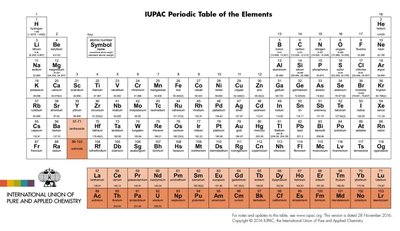
Appendix: Periodic Table of the Elements
The periodic table is a fundamental reference for chemical properties, atomic structure, and classification of elements. It is essential for understanding trends in bonding, reactivity, and material properties discussed throughout general chemistry.