Back
BackGeneral Chemistry Midterm Exam Study Guide
Study Guide - Smart Notes
 Tailored notes based on your materials, expanded with key definitions, examples, and context.
Gases and Gas Laws
Calculating Moles of Gas Using the Ideal Gas Law
The Ideal Gas Law relates the pressure, volume, temperature, and number of moles of a gas. It is commonly used to determine the amount of gas present in a sample.
Formula:
Variables: P = pressure (in kPa or atm), V = volume (in L), n = moles, R = gas constant (8.314 J/mol·K), T = temperature (in K)
Example: To find the moles of NO(g) in a 275.0 mL container at 32.5°C and 75 kPa, first convert volume to liters and temperature to Kelvin, then solve for n.
Partial Pressures in Gas Mixtures
In a mixture of gases, each gas exerts a pressure called its partial pressure. Dalton's Law states that the total pressure is the sum of the partial pressures of each gas.
Formula:
Example: For a vessel containing 2.0 mol H2 and 1.0 mol N2 in 22.4 L at 298 K, calculate each gas's partial pressure using the formula above.
Intermolecular Forces
Types of Intermolecular Interactions
Intermolecular forces are attractions between molecules that affect physical properties like boiling and melting points.
Hydrogen Bonding: Strong interaction when H is bonded to N, O, or F (e.g., H2O, NH2OH).
Dipole-Dipole: Occurs between polar molecules (e.g., NH2OH).
London Dispersion: Present in all molecules, especially nonpolar ones (e.g., CBr4).
Thermochemistry
Calculating Heat Required for Temperature Change
The amount of heat needed to change the temperature of a substance is calculated using its heat capacity.
Formula:
Variables: q = heat (J), m = mass (kg), C = heat capacity (J/kg·K), = change in temperature (K)
Example: To heat 300.0 g of water from 20.0°C to 100.0°C, use the formula above.
Enthalpy of Formation and Reaction Enthalpy
The enthalpy of formation is the heat change when one mole of a compound forms from its elements. The reaction enthalpy can be used to assess fuel efficiency.
Formula:
Application: Used to evaluate TNT as a rocket fuel.
Spontaneity and Thermodynamics
Criteria for Spontaneous Reactions
A reaction is spontaneous at constant pressure and temperature if the change in Gibbs free energy is negative.
Formula:
Criteria: for spontaneity
Estimating Temperature for Spontaneity
To determine the temperature at which a reaction becomes spontaneous, set and solve for T.
Formula:
Phase Changes and Vapor Pressure
Clapeyron-Clausius Equation
The Clapeyron-Clausius equation relates vapor pressure and temperature, useful for finding boiling points.
Formula:
Application: Used to estimate the boiling point of dimethyl ether at 1 atm.
Solutions and Solubility
Solvent Choice and Solubility
The solubility of a substance depends on the nature of the solvent. "Like dissolves like" is a guiding principle.
Water: Polar solvent, dissolves ionic and polar substances (e.g., KCl, CH3COOH).
Benzene: Nonpolar solvent, dissolves nonpolar substances (e.g., CCl4).
Molality Calculation
Molality is a concentration unit defined as moles of solute per kilogram of solvent.
Formula:
Example: Dissolving 25.0 g NaCl in 500.0 g water.
Bonus: Rocket Fuel Thermodynamics
Balancing Chemical Equations and Thermodynamic Feasibility
Balancing equations is essential for stoichiometric calculations. Thermodynamic data at high temperatures can be used to assess fuel viability.
Balance the equation: Ensure equal numbers of atoms on both sides.
Assess spontaneity: Use at 2000 K to determine if the reaction is spontaneous.
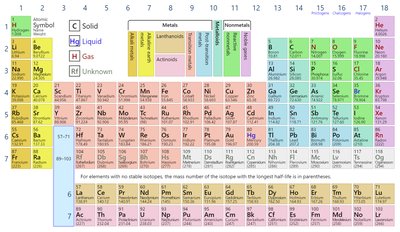
Reference: Periodic Table of the Elements
Periodic Table Overview
The periodic table organizes elements by atomic number, properties, and groups. It is essential for understanding chemical behavior and predicting reactions.
Groups: Columns with similar properties (e.g., alkali metals, halogens).
Periods: Rows indicating energy levels.
States: Elements are classified as solid, liquid, or gas at room temperature.