Back
BackGeneral Chemistry: Nomenclature and Formula Writing Practice
Study Guide - Smart Notes
 Tailored notes based on your materials, expanded with key definitions, examples, and context.
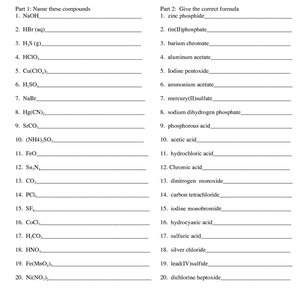
Q1. Name these compounds (e.g., NaOH, HBr, H2S, etc.)
Background
Topic: Chemical Nomenclature (Ionic and Molecular Compounds)
This section tests your ability to apply the rules for naming ionic and molecular compounds, including acids, hydrates, and compounds with polyatomic ions.
Key Terms and Formulas
Ionic Compounds: Name the cation (metal or ammonium) first, then the anion (nonmetal or polyatomic ion). For transition metals, use Roman numerals to indicate charge.
Molecular Compounds: Use prefixes (mono-, di-, tri-, etc.) to indicate the number of each atom. The more metallic element is named first.
Acids: Binary acids (H + nonmetal) use the prefix "hydro-" and suffix "-ic acid". Oxyacids (H + polyatomic ion) use "-ic" or "-ous" depending on the ion.
Hydrates: Name the compound, then add the prefix for the number of water molecules (e.g., "pentahydrate").
Step-by-Step Guidance
For each formula, identify whether it is ionic, molecular, or an acid. Look for metal/nonmetal combinations, polyatomic ions, or hydrogen at the start.
For ionic compounds, name the cation first (include Roman numeral if needed), then the anion. For polyatomic ions, use their standard names.
For molecular compounds, use prefixes to indicate the number of each atom (e.g., CO2 is carbon dioxide).
For acids, determine if it is binary (H + nonmetal) or oxyacid (H + polyatomic ion) and apply the correct naming convention.
For hydrates, name the compound, then add the appropriate prefix and "hydrate" (e.g., "pentahydrate" for 5 waters).
Try solving on your own before revealing the answer!
Q2. Give the correct formula for each compound name (e.g., zinc phosphide, barium chromate, etc.)
Background
Topic: Writing Chemical Formulas from Names
This section tests your ability to write chemical formulas for ionic and molecular compounds, acids, and hydrates based on their systematic names.
Key Terms and Formulas
Stock System: Roman numerals indicate the charge of transition metals.
Polyatomic Ions: Memorize common ions (e.g., SO42– is sulfate, NO3– is nitrate).
Prefixes: Indicate the number of atoms in molecular compounds (e.g., dinitrogen pentoxide is N2O5).
Acids: Recognize names ending in "acid" and write the corresponding formula.
Step-by-Step Guidance
Identify the type of compound (ionic, molecular, acid, or hydrate) based on the name.
For ionic compounds, write the symbols for the cation and anion, then balance charges to get the correct formula.
For molecular compounds, use prefixes to determine the number of each atom.
For acids, use the name to determine the anion and add the correct number of hydrogens to balance the charge.
For hydrates, write the formula for the compound, then add b7nH2O, where n is the number of water molecules.
Try solving on your own before revealing the answer!