 Back
General Chemistry Practice Exam Guidance
Study Guide - Smart Notes
 Tailored notes based on your materials, expanded with key definitions, examples, and context.
Q1. An instrument used to measure atmospheric pressure is called a:
Background
Topic: Gas Laws and Measurement
This question tests your knowledge of laboratory instruments used in chemistry, specifically those related to gas pressure.
Key Terms:
Barometer: Instrument for measuring atmospheric pressure.
Manometer: Instrument for measuring the pressure of gases in a container.
Step-by-Step Guidance
Recall the definitions of barometer and manometer.
Consider which instrument is specifically designed for atmospheric pressure, not just any gas.
Review the answer choices and match the correct instrument to the definition.
Try solving on your own before revealing the answer!
Final Answer: Barometer
A barometer is the instrument used to measure atmospheric pressure.
Q2. In Lhasa, Tibet, the elevation is 3,650 m. The atmospheric reading on an altimeter is 10.90 psi. This pressure is equal to:
Background
Topic: Pressure Unit Conversion
This question tests your ability to convert pressure units from psi to atm, mmHg, and kPa.
Key Terms and Formulas:
Pressure units: psi, atm, mmHg, kPa
Conversion factors:
Step-by-Step Guidance
Identify the given pressure: .
Use the conversion factor to convert psi to atm: .
Convert psi to mmHg and kPa using the appropriate conversion factors.
Try solving on your own before revealing the answer!
Final Answer: 0.74 atm
Pressure at Lhasa is approximately 0.74 atm.
Q3. The temperature 273 K is equivalent to:
Background
Topic: Temperature Conversion
This question tests your ability to convert between Kelvin and Celsius.
Key Formula:
Step-by-Step Guidance
Identify the given temperature in Kelvin: .
Use the formula to convert Kelvin to Celsius.
Try solving on your own before revealing the answer!
Final Answer: 0°C
273 K is equivalent to 0°C.
Q4. When a diver brings a bag of potato chips to the deepest region of the ocean, what happens to the bag?
Background
Topic: Gas Laws (Pressure and Volume)
This question tests your understanding of how pressure affects the volume of gases (Boyle's Law).
Key Terms:
Boyle's Law:
Pressure increases with depth.
Step-by-Step Guidance
Recall that as external pressure increases, the volume of a gas decreases.
Consider what happens to the bag of chips as it is taken deeper underwater.
Apply Boyle's Law to predict the change in volume.
Try solving on your own before revealing the answer!
Final Answer: The bag shrinks
As pressure increases, the volume of gas in the bag decreases, causing the bag to shrink.
Q5. Calculate the number of moles of gas in a volume of 200 mL at 300 K and 1.00 atm.
Background
Topic: Ideal Gas Law
This question tests your ability to use the ideal gas law to calculate the number of moles.
Key Formula:
Step-by-Step Guidance
Convert the volume from mL to L: .
Identify the known values: , , .
Plug these values into the ideal gas law and rearrange to solve for .
Try solving on your own before revealing the answer!
Final Answer: 0.0082 mol
The number of moles is approximately 0.0082 mol.
Q6. The following reaction is used to generate hydrogen gas in the laboratory. If 0.50 g of Zn is collected at 25°C and has a total pressure of 740 mm Hg, what mass of hydrogen is produced?
Background
Topic: Stoichiometry and Gas Laws
This question tests your ability to use stoichiometry and the ideal gas law to determine the mass of hydrogen produced.
Key Terms and Formulas:
Stoichiometry: Relating reactants to products using balanced equations.
Ideal Gas Law:
Molar mass of Zn:
Step-by-Step Guidance
Calculate moles of Zn used: .
Use the balanced equation to find moles of produced.
Use the ideal gas law to find the mass of produced.
Try solving on your own before revealing the answer!
Final Answer: 0.015 g
After calculations, the mass of hydrogen produced is approximately 0.015 g.
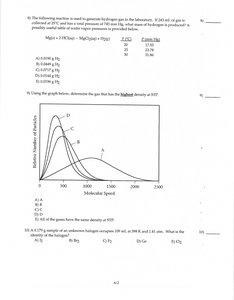
Q7. Using the graph below, determine the gas that has the highest density at STP.
Background
Topic: Kinetic Molecular Theory
This question tests your understanding of molecular speed distributions and their relationship to gas density.
Key Terms:
Density:
Heavier gases have lower average molecular speeds.
Step-by-Step Guidance
Examine the graph and identify which curve corresponds to the lowest molecular speed.
Recall that the gas with the lowest speed is the heaviest and thus has the highest density.
Match the curve to the correct gas based on molar mass.
Try solving on your own before revealing the answer!
Final Answer: Gas D (highest molar mass)
The gas with the lowest molecular speed (curve D) has the highest density at STP.
