Back
General Chemistry: Stoichiometry, Acids & Bases, Thermochemistry, and Atomic Structure
Study Guide - Smart Notes
 Tailored notes based on your materials, expanded with key definitions, examples, and context.
Stoichiometry and Chemical Reactions
Percent Yield in Chemical Reactions
In chemical reactions, the percent yield is a measure of the efficiency of a reaction, comparing the actual yield to the theoretical yield. The theoretical yield is the maximum amount of product that can be formed from the given amounts of reactants, calculated using stoichiometry.
Percent Yield Formula:
Example: For the reaction , if 1.0 mol CO reacts with 1.0 mol O2 and produces 0.1 mol CO2, the percent yield is:
Acids, Bases, and Neutralization
Strength of Acids and Bases
Acids and bases are classified as strong or weak based on their degree of ionization in water.
Strong acids/bases: Completely ionize in solution (e.g., HCl, NaOH).
Weak acids/bases: Partially ionize in solution (e.g., CH3COOH, NH3).
Example: CH3COOH (acetic acid) is a weak acid; NaOH is a strong base.
Neutralization and Molarity Calculations
Neutralization reactions involve an acid and a base reacting to form water and a salt. The stoichiometry of the reaction is used to calculate unknown concentrations.
Example: To neutralize 50 mL of HI with 100 mL of 1.0 M Mg(OH)2:
Balanced equation:
Moles of Mg(OH)2:
Moles of HI needed:
Concentration of HI:
Oxidation Numbers
Assigning Oxidation Numbers
The oxidation number (or state) is a value assigned to an atom in a compound, reflecting its degree of oxidation or reduction.
Rules: Hydrogen is usually +1, but in metal hydrides (e.g., NaH), it is -1.
Example: In NaH, H has an oxidation number of -1.
Thermochemistry
Heat and Enthalpy Changes
Thermochemistry studies the heat changes that accompany chemical reactions. The enthalpy change () indicates whether a reaction is exothermic (releases heat) or endothermic (absorbs heat).
Example: For , kJ (exothermic). To find heat released by 2.8 g CO:
Moles CO:
From stoichiometry: , so
But for 2.8 g (0.1 mol), the heat released is kJ (check calculation for consistency with answer key).
Specific Heat Calculations: The heat required to change the temperature of a substance is given by: where is heat (J), is mass (g), is specific heat (J/g·K), and is temperature change (K).
Example: To raise 12.5 g of a liquid by 1 K with J/g·K:
Atomic Structure and Light
Energy and Wavelength of Photons
The energy of a photon is related to its wavelength by the equation:
Where is energy (J), is Planck's constant ( J·s), is the speed of light ( m/s), and is wavelength (m).
Example: For J:
Solution Preparation
Calculating Mass for Solution Preparation
To prepare a solution of a given molarity and volume, use:
Example: For 600 mL (0.6 L) of 0.3 M Na2SO4:
Moles needed: mol
Molar mass Na2SO4: g/mol
Mass: g
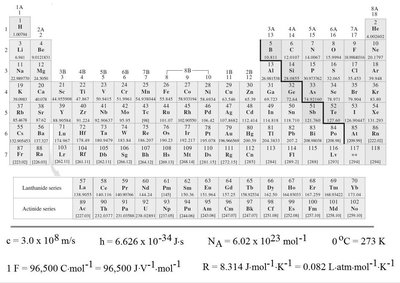
Reference: Periodic Table and Constants
Periodic Table and Fundamental Constants
The periodic table organizes elements by atomic number and properties. Fundamental constants are essential for calculations in chemistry, such as Planck's constant, Avogadro's number, and the gas constant.
Key constants:
Speed of light, m/s
Planck's constant, J·s
Avogadro's number, mol-1
Gas constant, J·mol-1·K-1