 Back
BackGeneral Chemistry Study Guidance: Atomic Radius, Electron Configurations, Lewis Structures, and Acids/Bases
Study Guide - Smart Notes
 Tailored notes based on your materials, expanded with key definitions, examples, and context.
Q1. Which element has the largest atomic radius?
Background
Topic: Periodic Trends
This question tests your understanding of how atomic radius changes across periods and down groups in the periodic table.
Key Terms and Concepts:
Atomic radius: The distance from the nucleus to the outermost electron shell.
Periodic trend: Atomic radius decreases across a period (left to right) and increases down a group (top to bottom).
Step-by-Step Guidance
Identify the elements in question and their positions on the periodic table.
Recall that atomic radius increases as you move down a group due to the addition of electron shells.
Recall that atomic radius decreases as you move across a period from left to right due to increased nuclear charge pulling electrons closer.
Compare the elements based on their group and period to determine which is expected to have the largest radius.
Try solving on your own before revealing the answer!
Q2. Which element has the highest first ionization energy?
Background
Topic: Periodic Trends
This question tests your understanding of ionization energy and how it varies across the periodic table.
Key Terms and Concepts:
Ionization energy: The energy required to remove the outermost electron from a neutral atom.
Periodic trend: Ionization energy increases across a period (left to right) and decreases down a group (top to bottom).
Step-by-Step Guidance
Identify the elements in question and their positions on the periodic table.
Recall that ionization energy increases across a period due to increased nuclear charge.
Recall that ionization energy decreases down a group due to increased distance from the nucleus.
Compare the elements based on their group and period to determine which is expected to have the highest ionization energy.
Try solving on your own before revealing the answer!
Q3. Name the following ions and identify their charges:
Background
Topic: Ionic Compounds and Nomenclature
This question tests your ability to name common ions and determine their charges.
Key Terms and Concepts:
Cation: A positively charged ion.
Anion: A negatively charged ion.
Charge: The number of electrons lost or gained relative to the neutral atom.
Step-by-Step Guidance
Identify the element or polyatomic ion given.
Recall the common charges for main group elements and polyatomic ions.
Write the name and charge for each ion.
Check your answers against a periodic table or list of polyatomic ions.
Try solving on your own before revealing the answer!
Q4. Complete the table of ions and their charges:
Background
Topic: Ionic Compounds and Nomenclature
This question tests your ability to match ions with their correct charges and names.
Key Terms and Concepts:
Ion: An atom or molecule with a net electric charge.
Charge: The difference between the number of protons and electrons.
Step-by-Step Guidance
Review the ions listed in the table.
Recall the typical charges for each ion based on their group or polyatomic nature.
Fill in the missing charges and names for each ion.
Double-check your answers for accuracy.
Try solving on your own before revealing the answer!
Q5. Write the formulas of the neutral compounds formed from the following ion pairs:
Background
Topic: Ionic Compounds and Formula Writing
This question tests your ability to combine ions to form neutral compounds and write their formulas.
Key Terms and Concepts:
Neutral compound: A compound in which the total positive and negative charges balance.
Formula: The chemical representation showing the ratio of ions.
Step-by-Step Guidance
Identify the charges of each ion in the pair.
Determine the ratio of ions needed to balance the charges.
Write the formula for the compound using subscripts to indicate the ratio.
Check that the total charge is zero.
Try solving on your own before revealing the answer!
Q6. Draw Lewis structures for each of the following molecules:
Background
Topic: Lewis Structures and Chemical Bonding
This question tests your ability to draw Lewis structures, showing all valence electrons and bonds for molecules.
Key Terms and Concepts:
Lewis structure: A diagram showing the arrangement of valence electrons around atoms in a molecule.
Valence electrons: Electrons in the outermost shell involved in bonding.
Step-by-Step Guidance
Count the total number of valence electrons for all atoms in the molecule.
Arrange the atoms, usually placing the least electronegative atom in the center.
Distribute electrons to form bonds and satisfy the octet rule for each atom.
Place remaining electrons as lone pairs to complete the structure.
Try solving on your own before revealing the answer!
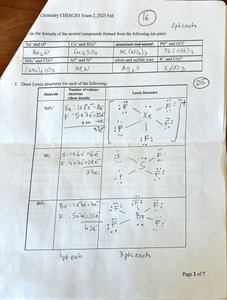
Q7. Acids and Bases: Fill in the following table with names and formulas for acids and their hydrogen chloride forms.
Background
Topic: Acids, Bases, and Nomenclature
This question tests your ability to name acids and write their formulas, including oxyacids and binary acids.
Key Terms and Concepts:
Acid: A substance that donates protons (H+) in solution.
Oxyacid: An acid containing oxygen, usually with a polyatomic ion.
Binary acid: An acid composed of hydrogen and one other element.
Step-by-Step Guidance
Identify the anion and its corresponding acid name.
Recall the rules for naming acids based on the anion (e.g., -ate becomes -ic acid, -ite becomes -ous acid).
Write the formula for each acid.
Check your answers for accuracy.
Try solving on your own before revealing the answer!
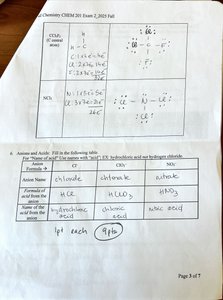
Q8. Draw resonance structures for NO2- and explain the bond lengths.
Background
Topic: Resonance and Bonding
This question tests your understanding of resonance structures and how they affect bond lengths in molecules.
Key Terms and Concepts:
Resonance structure: Different possible arrangements of electrons in a molecule that contribute to the overall structure.
Bond length: The distance between two bonded atoms; resonance can cause bond lengths to be intermediate between single and double bonds.
Step-by-Step Guidance
Draw all possible resonance structures for NO2-.
Show the movement of electrons using arrows.
Explain how resonance leads to equal bond lengths between the nitrogen and oxygen atoms.
Discuss why the bonds are not purely single or double bonds.
Try solving on your own before revealing the answer!
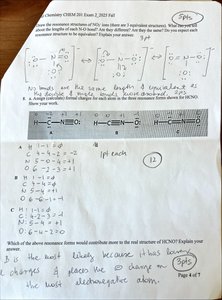
Q9. Which of the resonance forms would most contribute to the real structure of HCNOF? Explain your reasoning.
Background
Topic: Resonance and Formal Charge
This question tests your ability to evaluate resonance structures based on formal charge and electronegativity.
Key Terms and Concepts:
Formal charge: The charge assigned to an atom in a molecule, calculated by comparing the number of valence electrons in the free atom to those assigned in the molecule.
Electronegativity: The tendency of an atom to attract electrons; more electronegative atoms should carry negative formal charges.
Step-by-Step Guidance
Calculate the formal charge for each atom in the resonance structures.
Identify which structure places negative formal charge on the most electronegative atom.
Explain why this structure is most likely to contribute to the real structure.
Discuss the importance of minimizing formal charges and placing them appropriately.
Try solving on your own before revealing the answer!
