 Back
BackGeneral Chemistry Study Guidance: Reaction Types, Empirical Formulas, and Composition Problems
Study Guide - Smart Notes
 Tailored notes based on your materials, expanded with key definitions, examples, and context.
Q1. Identify each of the following chemical reactions as combination, combustion, or decomposition.
Background
Topic: Types of Chemical Reactions
This question tests your ability to classify reactions based on their reactants and products. Common types include combination (synthesis), decomposition, and combustion reactions.
Key Terms:
Combination (Synthesis): Two or more substances combine to form one product.
Decomposition: One substance breaks down into two or more products.
Combustion: A substance reacts with oxygen, often producing CO2 and H2O.
Step-by-Step Guidance
Examine the reactants and products for each equation. Look for patterns: does one compound break apart, or do two combine?
For combination, check if two or more reactants form a single product.
For decomposition, check if a single reactant forms two or more products.
For combustion, look for a hydrocarbon or element reacting with O2 to produce CO2 and H2O.
Try solving on your own before revealing the answer!
Q2. Phosphorus was a chemical warfare agent used in World War II. A 2.15 g sample of phosphate contains 0.94 g of phosphorus, 0.54 g of oxygen, and 0.67 g of fluorine. Calculate the empirical formula of phosphate.
Background
Topic: Empirical Formula Calculation
This question tests your ability to determine the simplest whole-number ratio of atoms in a compound based on mass data.
Key Terms and Formulas:
Empirical Formula: The simplest ratio of elements in a compound.
Mole Calculation:
Step-by-Step Guidance
Find the molar mass of each element: P, O, F.
Calculate the moles of each element using their masses and molar masses.
Write the mole values for each element.
Divide each mole value by the smallest number of moles to get the simplest ratio.
Try solving on your own before revealing the answer!
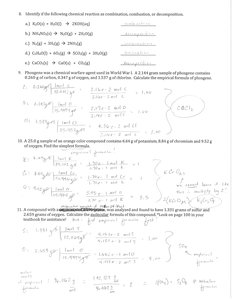
Q3. A 2.15 g sample of a compound contains 0.94 g of potassium, 0.48 g of chromium, and 0.73 g of oxygen. Find the empirical formula.
Background
Topic: Empirical Formula Calculation
This question is similar to Q2, but with different elements. It tests your ability to use mass data to determine the empirical formula.
Key Terms and Formulas:
Empirical Formula: The simplest ratio of elements in a compound.
Mole Calculation:
Step-by-Step Guidance
Find the molar mass of K, Cr, and O.
Calculate the moles of each element using their masses and molar masses.
Write the mole values for each element.
Divide each mole value by the smallest number of moles to get the simplest ratio.
Try solving on your own before revealing the answer!
Q4. A compound contains 1.38 g of silver and 0.21 g of oxygen. Find the empirical formula.
Background
Topic: Empirical Formula Calculation
This question tests your ability to use mass data to determine the empirical formula for a compound containing silver and oxygen.
Key Terms and Formulas:
Empirical Formula: The simplest ratio of elements in a compound.
Mole Calculation:
Step-by-Step Guidance
Find the molar mass of Ag and O.
Calculate the moles of each element using their masses and molar masses.
Write the mole values for each element.
Divide each mole value by the smallest number of moles to get the simplest ratio.
Try solving on your own before revealing the answer!
