 Back
BackGeneral Chemistry Study Guide: Atomic Structure, Bonding, and Molecular Geometry
Study Guide - Smart Notes
 Tailored notes based on your materials, expanded with key definitions, examples, and context.
Q1. Indicate which atom in each pair is larger: K vs Na, Li vs Na, H vs Cl, F vs I. Explain each choice.
Background
Topic: Atomic Radius and Periodic Trends
This question tests your understanding of how atomic size changes across periods and down groups in the periodic table.
Key Terms and Formulas:
Atomic radius: The distance from the nucleus to the outermost electron shell.
Periodic trend: Atomic radius increases down a group and decreases across a period.
Step-by-Step Guidance
Recall that atomic radius increases as you move down a group (column) due to the addition of electron shells.
Atomic radius decreases as you move across a period (row) because the nuclear charge increases, pulling electrons closer.
Compare each pair: For example, K vs Na are in the same group, so K is below Na and should be larger.
Apply the same reasoning to the other pairs, considering their positions in the periodic table.
Try solving on your own before revealing the answer!
Q2. What is the trend when the effective nuclear charge increases?
Background
Topic: Effective Nuclear Charge (Zeff)
This question tests your understanding of how the effective nuclear charge affects atomic properties.
Key Terms and Formulas:
Effective nuclear charge (): The net positive charge experienced by valence electrons.
where is the atomic number and is the shielding constant.
Step-by-Step Guidance
Understand that as increases, electrons are pulled closer to the nucleus.
Consider how this affects atomic radius, ionization energy, and electron affinity.
Think about the periodic trends: increases across a period.
Try solving on your own before revealing the answer!
Q3. Why does the atomic radius decrease moving along the 2nd and 3rd period of the periodic table?
Background
Topic: Periodic Trends in Atomic Radius
This question tests your understanding of how atomic radius changes across a period.
Key Terms and Formulas:
Atomic radius
Effective nuclear charge ()
Step-by-Step Guidance
Recall that as you move across a period, the number of protons increases, raising .
Electrons are added to the same shell, so shielding does not increase much.
Higher pulls electrons closer, decreasing atomic radius.
Try solving on your own before revealing the answer!
Q4. What is the force of attraction between ions called?
Background
Topic: Ionic Bonding
This question tests your understanding of the nature of ionic bonds and the forces involved.
Key Terms and Formulas:
Ionic bond: The electrostatic force between oppositely charged ions.
Coulomb's Law:
Step-by-Step Guidance
Recall that ionic bonds form between metals and nonmetals.
The force is due to electrostatic attraction between positive and negative ions.
Use Coulomb's Law to describe the strength of the force.
Try solving on your own before revealing the answer!
Q5. Indicate the polarity of each bond using arrows or partial charges: e.g., N-H, B-H, S-O, C-H.
Background
Topic: Bond Polarity and Electronegativity
This question tests your ability to determine bond polarity based on differences in electronegativity.
Key Terms and Formulas:
Electronegativity: The tendency of an atom to attract electrons in a bond.
Bond polarity: Arrows point toward the more electronegative atom.
Step-by-Step Guidance
Identify the electronegativity values for each atom in the bond.
Draw an arrow from the less electronegative atom to the more electronegative atom.
Assign partial charges ( and ) accordingly.
Try solving on your own before revealing the answer!
Q6. Indicate whether the bonds in each substance are ionic, covalent, or polar covalent: e.g., NaCl, HF, SO2, F2, SF6.
Background
Topic: Types of Chemical Bonds
This question tests your ability to classify bonds based on the elements involved and their electronegativity differences.
Key Terms and Formulas:
Ionic bond: Large difference in electronegativity, usually between metal and nonmetal.
Covalent bond: Small or no difference in electronegativity, usually between nonmetals.
Polar covalent bond: Moderate difference in electronegativity.
Step-by-Step Guidance
Identify the elements in each compound and their positions in the periodic table.
Determine the electronegativity difference for each pair.
Classify the bond as ionic, covalent, or polar covalent based on the difference.
Try solving on your own before revealing the answer!
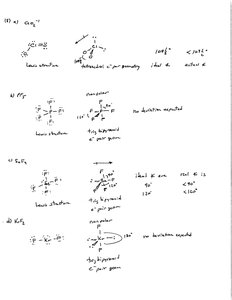
Q7. Draw Lewis resonance structures for the molecule OCS and indicate which one is the most stable.
Background
Topic: Lewis Structures and Resonance
This question tests your ability to draw resonance structures and evaluate their stability.
Key Terms and Formulas:
Lewis structure: A diagram showing the arrangement of atoms and electrons.
Resonance: Multiple valid Lewis structures for a molecule.
Stability: The most stable resonance structure minimizes formal charges.
Step-by-Step Guidance
Count the total number of valence electrons for OCS.
Draw all possible resonance structures, ensuring octet rule is satisfied.
Calculate formal charges for each structure to determine stability.
Try solving on your own before revealing the answer!
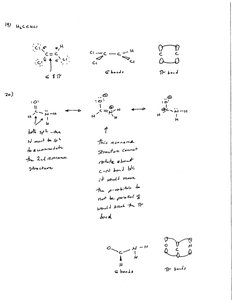
Q8. Draw Lewis structures for trichloromethylphosphine (P(CCl3)), which contains a trichloromethyl group attached to phosphorus. Indicate the hybridization of each central atom.
Background
Topic: Lewis Structures and Hybridization
This question tests your ability to draw complex Lewis structures and assign hybridization states.
Key Terms and Formulas:
Lewis structure
Hybridization: The mixing of atomic orbitals to form new hybrid orbitals (e.g., , , ).
Step-by-Step Guidance
Count the total number of valence electrons for P(CCl3).
Draw the trichloromethyl group (CCl3) and attach it to phosphorus.
Assign hybridization to each central atom based on the number of electron domains.
Try solving on your own before revealing the answer!
