 Back
General Chemistry Study Guide: Atoms, Molecules, Ions, and Chemical Reactions
Study Guide - Smart Notes
 Tailored notes based on your materials, expanded with key definitions, examples, and context.
Atoms, Molecules, and Ions
Atomic Theory of Matter
The concept of the atom as the fundamental building block of matter originated with ancient Greek philosophers and was formalized by John Dalton in the early 1800s. Dalton's atomic theory is based on several key laws:
Law of Constant Composition: Compounds have a definite composition; the relative number of atoms of each element in a compound is always the same. Example: H2O, CO, CO2.
Law of Conservation of Mass: The total mass of substances present before and after a chemical process remains unchanged.
Law of Multiple Proportions: If two elements form more than one compound, the masses of one element that combine with a fixed mass of the other are in ratios of small whole numbers.
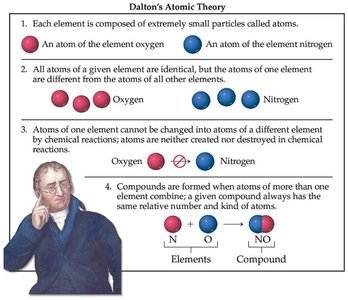
Dalton’s Atomic Theory
Dalton proposed four postulates to explain the behavior of atoms:
Postulate 1: Each element is composed of extremely small particles called atoms.
Postulate 2: All atoms of a given element are identical in mass and properties, but differ from atoms of other elements.
Postulate 3: Atoms cannot be created or destroyed in chemical reactions; they are rearranged.
Postulate 4: Compounds are formed when atoms of more than one element combine; a given compound always has the same relative number and kind of atoms.
Discovery of Subatomic Particles
Atoms are composed of smaller particles: electrons, protons, and neutrons. Key discoveries include:
Electrons: Discovered by J.J. Thomson via cathode rays; charge/mass ratio determined.
Protons and Neutrons: Found in the nucleus; protons are positively charged, neutrons are neutral.
Radioactivity: Spontaneous emission of radiation, discovered by Henri Becquerel and studied by the Curies.
Modern Atomic Structure
The atom consists of a dense nucleus containing protons and neutrons, surrounded by electrons. Most of the atom is empty space.
Atomic Number (Z): Number of protons in the nucleus; defines the element.
Mass Number (A): Total number of protons and neutrons.
Isotopes: Atoms of the same element with different numbers of neutrons.
Isotope | Protons | Neutrons | Electrons |
|---|---|---|---|
11C | 6 | 5 | 6 |
12C | 6 | 6 | 6 |
13C | 6 | 7 | 6 |
14C | 6 | 8 | 6 |
Atomic Mass and Atomic Weight
Atomic mass unit (amu) is used to express atomic and molecular masses. Atomic weight is the weighted average of the masses of all isotopes of an element.
Formula:
Chemical Reactions and Stoichiometry
Chemical Equations
Chemical equations represent reactions, showing reactants and products. Balancing equations ensures the law of conservation of mass is followed.
Symbols: (g) = gas, (l) = liquid, (s) = solid, (aq) = aqueous solution.
Example:
Types of Chemical Reactions
Combination: Two or more substances form one product.
Decomposition: One substance breaks down into two or more substances.
Combustion: Rapid reaction with oxygen producing a flame.
Stoichiometry and Mole Concept
Stoichiometry involves quantitative relationships between reactants and products. The mole bridges the molecular scale to the real-world scale.
Avogadro’s Number: particles per mole.
Molar Mass: Mass of 1 mole of a substance (g/mol).
Empirical and Molecular Formulas
Empirical formulas show the simplest ratio of elements; molecular formulas show the actual number of atoms.
Example: Empirical formula of glucose is CH2O; molecular formula is C6H12O6.
Limiting Reactants and Yield
The limiting reactant determines the maximum amount of product formed. Percent yield compares actual to theoretical yield.
Percent Yield Formula:
Reactions in Aqueous Solution
Electrolytes and Solution Types
Electrolytes dissociate into ions in water, conducting electricity. Strong electrolytes dissociate completely; weak electrolytes partially; nonelectrolytes do not dissociate.
Precipitation, Acid-Base, and Redox Reactions
Precipitation: Formation of an insoluble product (precipitate) from soluble reactants.
Acid-Base: Acids donate H+; bases accept H+ or produce OH-.
Redox: Oxidation is loss of electrons; reduction is gain of electrons.
Molarity and Solution Calculations
Molarity Formula:
Dilution Formula:
Thermochemistry
Energy and Thermodynamics
Energy is the ability to do work or transfer heat. Thermochemistry studies energy changes in chemical reactions.
First Law of Thermodynamics: Energy is conserved; it can be converted but not created or destroyed.
Internal Energy Change:
Relationship: (heat + work)
Enthalpy
Definition:
Change in Enthalpy:
At constant pressure:
Calorimetry
Calorimetry measures heat flow. Specific heat is the energy required to raise 1 g of a substance by 1 K.
Formula:
Hess’s Law and Enthalpy of Formation
Hess’s Law: for a reaction is the sum of $\Delta H$ for individual steps.
Standard Enthalpy of Formation: is the enthalpy change for forming 1 mole of a compound from its elements.
Calculation:
Bond Enthalpies
Bond enthalpy is the energy required to break one mole of a bond in the gas phase. It is always positive.
Formula:
Gases
Physical Properties of Gases
Gases expand to fill containers, are highly compressible, and have low densities. They form homogeneous mixtures.
Pressure and Units
Pressure Formula:
Common Units: atm, Pa, torr, mmHg, bar
Standard Pressure: 1 atm = 760 torr = 101.325 kPa
Gas Laws
Boyle’s Law:
Charles’s Law:
Avogadro’s Law:
Ideal Gas Law:
Gas Densities and Molar Mass
Density Formula:
Molar Mass Formula:
Partial Pressures and Dalton’s Law
Dalton’s Law:
Mole Fraction:
Partial Pressure:
Kinetic-Molecular Theory
Explains gas behavior based on molecular motion:
Gases consist of molecules in random motion.
Volume of molecules is negligible compared to container.
Collisions are elastic; average kinetic energy is proportional to temperature.
Molecular Speeds, Effusion, and Diffusion
Root-mean-square speed:
Graham’s Law:
Real Gases and Deviations
Real gases deviate from ideal behavior at high pressure and low temperature. The van der Waals equation corrects for these deviations:
Van der Waals Equation:
Substance | a (L2·atm/mol2) | b (L/mol) |
|---|---|---|
He | 0.0341 | 0.02370 |
Ne | 0.211 | 0.0171 |
Ar | 1.34 | 0.0322 |
H2O | 5.46 | 0.0305 |
