 Back
BackGeneral Chemistry Study Guide: Periodic Properties, Bonding, and Molecular Structure
Study Guide - Smart Notes
 Tailored notes based on your materials, expanded with key definitions, examples, and context.
Q1. Choose the ground state electron configuration for Ti2+.
Background
Topic: Electron Configuration of Transition Metal Ions
This question tests your understanding of how electrons are removed from transition metals to form cations, and how to write condensed electron configurations using the noble gas core notation.
Key Terms and Formulas:
Electron Configuration: The arrangement of electrons in an atom or ion.
Transition Metals: For cations, electrons are removed first from the 4s orbital, then from the 3d orbital.
Step-by-Step Guidance
Write the ground state electron configuration for neutral Ti (atomic number 22): .
When forming a cation, remove electrons first from the 4s orbital, then from the 3d orbital.
Remove two electrons to form Ti2+. Consider which orbitals lose electrons first.
Try solving on your own before revealing the answer!
Q2. Choose the ground state electron configuration for Cr3+.
Background
Topic: Electron Configuration of Transition Metal Ions
This question tests your ability to determine the electron configuration for a transition metal cation, considering the special stability of half-filled and fully-filled d subshells.
Key Terms and Formulas:
Electron Configuration: The arrangement of electrons in an atom or ion.
Cr (Chromium): Has an unusual configuration due to stability of half-filled d subshells.
Step-by-Step Guidance
Write the ground state electron configuration for neutral Cr (atomic number 24): .
Remove three electrons to form Cr3+. Remove from 4s first, then 3d.
Write the resulting configuration after removing the electrons.
Try solving on your own before revealing the answer!
Q3. Place the following elements in order of decreasing atomic radius: Cd, Rb, Xe.
Background
Topic: Periodic Trends – Atomic Radius
This question tests your understanding of how atomic radius changes across periods and down groups in the periodic table.
Key Terms and Concepts:
Atomic Radius: The size of an atom, typically increases down a group and decreases across a period.
Periodic Trend: Atomic radius decreases left to right, increases top to bottom.
Step-by-Step Guidance
Locate Cd, Rb, and Xe on the periodic table.
Recall that atomic radius increases down a group and decreases across a period.
Arrange the elements from largest to smallest atomic radius based on their positions.
Try solving on your own before revealing the answer!
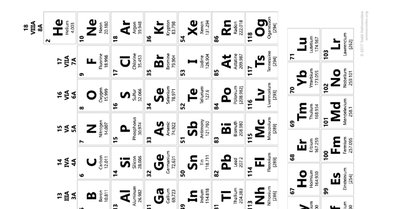
Q4. Place the following in order of increasing radius: Se2−, Mg2+, Na+.
Background
Topic: Ionic Radii and Isoelectronic Series
This question tests your understanding of how ionic size changes with charge and across isoelectronic ions (ions with the same number of electrons).
Key Terms and Concepts:
Ionic Radius: The size of an ion.
Isoelectronic Series: Ions with the same number of electrons but different nuclear charges.
Step-by-Step Guidance
Determine the number of electrons in each ion.
Recall that for isoelectronic ions, the more positive the charge, the smaller the radius.
Arrange the ions in order of increasing radius.
Try solving on your own before revealing the answer!
Q5. Place the following in order of increasing first ionization energy (IE1): N, F, As.
Background
Topic: Ionization Energy Trends
This question tests your understanding of periodic trends in ionization energy, which is the energy required to remove the outermost electron from a neutral atom.
Key Terms and Concepts:
Ionization Energy (IE): Increases across a period, decreases down a group.
Step-by-Step Guidance
Locate N, F, and As on the periodic table.
Recall the trend: IE increases left to right and decreases top to bottom.
Arrange the elements in order of increasing IE1.
Try solving on your own before revealing the answer!
Q6. Which reaction below represents the electron affinity of K?
Background
Topic: Electron Affinity
This question tests your understanding of electron affinity, which is the energy change when an atom in the gas phase gains an electron.
Key Terms and Concepts:
Electron Affinity: The process of adding an electron to a neutral atom in the gas phase to form an anion.
Step-by-Step Guidance
Recall the definition of electron affinity.
Identify which reaction shows a neutral K atom in the gas phase gaining an electron to form K−(g).
Try solving on your own before revealing the answer!
Q7. What period 3 element has the following ionization energies (all in kJ/mol)?
Background
Topic: Successive Ionization Energies
This question tests your ability to interpret patterns in ionization energies to identify an element based on large jumps between successive ionization energies.
Key Terms and Concepts:
Successive Ionization Energies: Large jumps indicate removal of electrons from a new shell (core electrons).
Step-by-Step Guidance
Look for the largest jump in ionization energy values.
Determine how many valence electrons the element has based on where the jump occurs.
Match the number of valence electrons to a period 3 element.
Try solving on your own before revealing the answer!
Q8. Place the following in order of decreasing magnitude of lattice energy: K2O, Rb2S, Li2O.
Background
Topic: Lattice Energy
This question tests your understanding of factors affecting lattice energy, including ionic charge and ionic radius.
Key Terms and Formulas:
Lattice Energy: The energy required to separate one mole of an ionic solid into gaseous ions.
Key Formula: (where and are the charges, is the distance between ions)
Step-by-Step Guidance
Compare the charges on the ions in each compound (all are +1 and -2).
Compare the sizes of the ions (smaller ions = higher lattice energy).
Arrange the compounds in order of decreasing lattice energy.
Try solving on your own before revealing the answer!
Q9. Identify the longest bond.
Background
Topic: Bond Order and Bond Length
This question tests your understanding of the relationship between bond order (single, double, triple) and bond length.
Key Terms and Concepts:
Bond Order: Single bond (1), double bond (2), triple bond (3).
Bond Length: Inversely related to bond order; single bonds are longest, triple bonds are shortest.
Step-by-Step Guidance
Recall the trend: single bond > double bond > triple bond in terms of length.
Identify which bond type is the longest.
Try solving on your own before revealing the answer!
Q10. Define electronegativity.
Background
Topic: Electronegativity
This question tests your understanding of the definition of electronegativity and its role in chemical bonding.
Key Terms and Concepts:
Electronegativity: The ability of an atom to attract electrons in a chemical bond.
Step-by-Step Guidance
Recall the definition of electronegativity.
Identify the correct choice that matches this definition.
Try solving on your own before revealing the answer!
Q11. Choose the best Lewis structure for BeF2.
Background
Topic: Lewis Structures
This question tests your ability to draw and evaluate Lewis structures for simple molecules, considering the octet rule and formal charges.
Key Terms and Concepts:
Lewis Structure: A diagram showing the arrangement of valence electrons among atoms in a molecule.
Octet Rule: Atoms tend to form bonds to have eight electrons in their valence shell (with exceptions).
Step-by-Step Guidance
Count the total number of valence electrons for BeF2.
Draw possible Lewis structures, ensuring Be and F have appropriate numbers of electrons.
Check for formal charges and octet rule satisfaction.
Try solving on your own before revealing the answer!
Q12. Give the number of valence electrons for IF5.
Background
Topic: Counting Valence Electrons
This question tests your ability to determine the total number of valence electrons in a molecule, which is essential for drawing Lewis structures.
Key Terms and Concepts:
Valence Electrons: Electrons in the outermost shell of an atom, involved in bonding.
Step-by-Step Guidance
Find the number of valence electrons for Iodine (I) and Fluorine (F) from the periodic table.
Multiply the number of F atoms by the number of valence electrons for F.
Add the valence electrons from I and F to get the total.
Try solving on your own before revealing the answer!
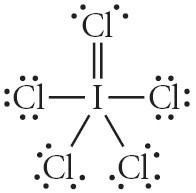
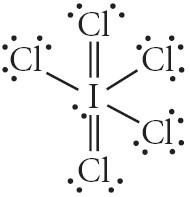
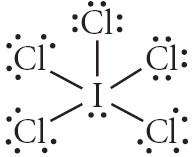
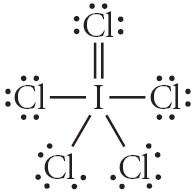
Q13. Choose the best Lewis structure for ICl5.
Background
Topic: Lewis Structures for Hypervalent Molecules
This question tests your ability to draw Lewis structures for molecules where the central atom can have more than eight electrons (expanded octet).
Key Terms and Concepts:
Lewis Structure: Shows bonding and lone pairs in a molecule.
Expanded Octet: Atoms in period 3 or higher can have more than 8 electrons.
Step-by-Step Guidance
Count the total number of valence electrons for ICl5.
Draw possible Lewis structures, ensuring Iodine can have more than 8 electrons.
Check for formal charges and octet rule satisfaction for Cl atoms.
Try solving on your own before revealing the answer!
Q14. Draw the Lewis structure for CO32− including any valid resonance structures. Describe one resonance structure of the carbonate ion.
Background
Topic: Resonance Structures
This question tests your understanding of resonance in polyatomic ions and how to describe the bonding in terms of single and double bonds.
Key Terms and Concepts:
Resonance Structures: Different valid Lewis structures for the same molecule, showing delocalization of electrons.
Bond Order: Average number of bonds between atoms in resonance structures.
Step-by-Step Guidance
Count the total number of valence electrons for CO32−.
Draw all possible resonance structures, distributing electrons to satisfy the octet rule.
Describe one resonance structure in terms of single and double bonds.
Try solving on your own before revealing the answer!
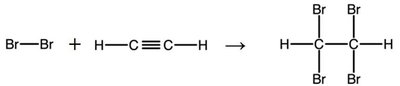
Q15. Use the bond energies provided to estimate ΔH°rxn for the reaction: 2 Br2(l) + C2H2(g) → C2H2Br4(l)
Background
Topic: Bond Energies and Enthalpy Calculations
This question tests your ability to use bond energies to estimate the enthalpy change of a reaction by considering bonds broken and formed.
Key Formula:
Step-by-Step Guidance
List all bonds broken in the reactants and sum their bond energies.
List all bonds formed in the products and sum their bond energies.
Plug the values into the formula above to set up the calculation.
Try solving on your own before revealing the answer!
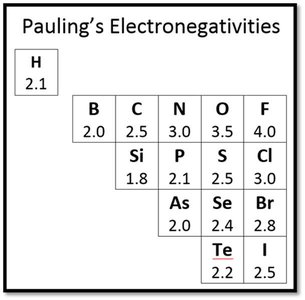
Q16. Choose the bond below that is most polar.
Background
Topic: Bond Polarity and Electronegativity
This question tests your understanding of how differences in electronegativity between two atoms affect bond polarity.
Key Terms and Concepts:
Bond Polarity: Determined by the difference in electronegativity between two atoms.
Electronegativity: Use the Pauling scale to compare values.
Step-by-Step Guidance
Look up the electronegativity values for each pair of atoms.
Calculate the difference for each bond.
The bond with the largest difference is the most polar.
Try solving on your own before revealing the answer!
Q17. In the best Lewis structure for XeF4, what is the formal charge on the F atom?
Background
Topic: Formal Charge Calculation
This question tests your ability to calculate formal charges in a Lewis structure, which helps determine the most stable structure.
Key Formula:
Step-by-Step Guidance
Draw the Lewis structure for XeF4.
Count the valence electrons, non-bonding electrons, and bonding electrons for F.
Plug these values into the formal charge formula for F.
Try solving on your own before revealing the answer!
Q18. Give the molecular geometry and number of electron groups for BrF3.
Background
Topic: VSEPR Theory
This question tests your ability to use VSEPR theory to predict molecular geometry and count electron groups around the central atom.
Key Terms and Concepts:
Electron Groups: Bonds and lone pairs around the central atom.
Molecular Geometry: The shape determined by the positions of atoms (not lone pairs).
Step-by-Step Guidance
Draw the Lewis structure for BrF3.
Count the number of electron groups (bonds and lone pairs) around Br.
Use VSEPR theory to determine the molecular geometry.
Try solving on your own before revealing the answer!
Q19. Identify the number of electron groups around a molecule with sp2 hybridization.
Background
Topic: Hybridization
This question tests your understanding of the relationship between hybridization and the number of electron groups around a central atom.
Key Terms and Concepts:
sp2 Hybridization: Involves mixing one s and two p orbitals.
Electron Groups: Each group can be a bond or a lone pair.
Step-by-Step Guidance
Recall the number of electron groups associated with sp2 hybridization.
Relate this to the geometry (trigonal planar).
Try solving on your own before revealing the answer!
Q20. Give the approximate bond angle for a molecule with a trigonal planar shape.
Background
Topic: Molecular Geometry and Bond Angles
This question tests your knowledge of the bond angles associated with different molecular geometries.
Key Terms and Concepts:
Trigonal Planar: Three electron groups around a central atom, all in one plane.
Bond Angle: The angle between adjacent bonds.
Step-by-Step Guidance
Recall the ideal bond angle for a trigonal planar geometry.
Try solving on your own before revealing the answer!
Q21. What is the molecular geometry of SCl4?
Background
Topic: VSEPR Theory and Molecular Geometry
This question tests your ability to predict the molecular geometry of a molecule with five electron groups (including lone pairs).
Key Terms and Concepts:
VSEPR Theory: Predicts shapes based on repulsion between electron groups.
Seesaw Geometry: Occurs with four bonds and one lone pair.
Step-by-Step Guidance
Draw the Lewis structure for SCl4.
Count the number of bonding pairs and lone pairs on S.
Use VSEPR to determine the geometry.
Try solving on your own before revealing the answer!
Q22. Choose the compound below that contains at least one polar covalent bond, but is nonpolar.
Background
Topic: Molecular Polarity
This question tests your understanding of the difference between bond polarity and molecular polarity, and how molecular geometry affects overall polarity.
Key Terms and Concepts:
Polar Covalent Bond: Bond between atoms with different electronegativities.
Nonpolar Molecule: Molecule with symmetrical geometry so dipoles cancel.
Step-by-Step Guidance
Identify which compounds have polar bonds (difference in electronegativity).
Determine if the molecular geometry allows for dipole cancellation (nonpolar overall).
Try solving on your own before revealing the answer!
Q23. Give the hybridization for the S in SCl6.
Background
Topic: Hybridization and Electron Geometry
This question tests your ability to determine the hybridization of the central atom based on the number of electron groups.
Key Terms and Concepts:
Hybridization: Mixing of atomic orbitals to form new hybrid orbitals.
sp3d2 Hybridization: Associated with six electron groups (octahedral geometry).
Step-by-Step Guidance
Draw the Lewis structure for SCl6.
Count the number of electron groups around S.
Match the number of groups to the correct hybridization scheme.
Try solving on your own before revealing the answer!
Q24. List the number of sigma bonds and pi bonds in a double bond.
Background
Topic: Sigma and Pi Bonds
This question tests your understanding of the types of bonds present in single, double, and triple bonds.
Key Terms and Concepts:
Sigma (σ) Bond: First bond formed between two atoms.
Pi (π) Bond: Additional bonds in double/triple bonds.
Step-by-Step Guidance
Recall that a single bond is always a sigma bond.
In a double bond, one is sigma and the other is pi.
Try solving on your own before revealing the answer!
Q25. Use MO theory to predict the bond order in He2+ ion. Is the He2+ bond a stronger or weaker bond than the He2 bond?
Background
Topic: Molecular Orbital Theory
This question tests your ability to use molecular orbital diagrams to calculate bond order and compare bond strengths.
Key Formula:
Step-by-Step Guidance
Draw the MO diagram for He2+ and He2.
Count the number of electrons in bonding and antibonding orbitals for each species.
Calculate the bond order for He2+ and compare to He2.
Try solving on your own before revealing the answer!
