 Back
BackGeneral Chemistry Study Guide: Physical & Chemical Changes, Properties, Density, and Water Displacement
Study Guide - Smart Notes
 Tailored notes based on your materials, expanded with key definitions, examples, and context.
Q1. What is a physical change? Give examples.
Background
Topic: Physical Changes
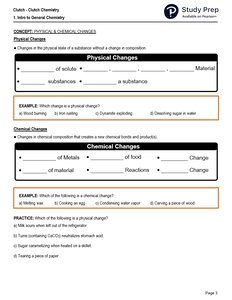
This question tests your understanding of physical changes, which are changes in the state or appearance of matter without altering its chemical composition.
Key Terms:
Physical Change: A change that affects the form of a chemical substance, but not its chemical composition.
Examples: Melting, freezing, dissolving, chopping, tearing.
Step-by-Step Guidance
Recall that physical changes do not create new substances; the material remains the same at the molecular level.
Think about common processes like melting ice or dissolving sugar in water—these do not change the chemical identity.
List examples of physical changes, such as cutting paper or mixing salt in water.
Try solving on your own before revealing the answer!
Final Answer:
Physical changes include melting, freezing, dissolving, chopping, tearing, and breaking. The substance remains chemically the same.
Q2. What is a chemical change? Give examples.
Background
Topic: Chemical Changes
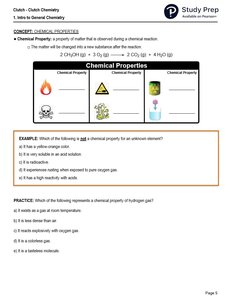
This question tests your understanding of chemical changes, which involve the formation of new substances through chemical reactions.
Key Terms:
Chemical Change: A change that results in the formation of new chemical substances.
Examples: Rusting, burning, metabolism.
Step-by-Step Guidance
Recall that chemical changes involve breaking and forming chemical bonds, resulting in new substances.
Think about processes like burning wood or rusting iron—these create new materials with different properties.
List examples of chemical changes, such as cooking, corrosion, and metabolism.
Try solving on your own before revealing the answer!
Final Answer:
Chemical changes include burning, rusting, metabolism, and corrosion. New substances are formed in these processes.
Q3. What is the difference between reversible and irreversible changes?
Background
Topic: Reversible and Irreversible Changes
This question tests your understanding of whether a change can be undone to restore the original substance.
Key Terms:
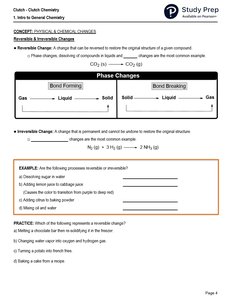
Reversible Change: A change that can be undone, such as phase changes (melting, freezing).
Irreversible Change: A change that cannot be undone, such as burning or rusting.
Step-by-Step Guidance
Identify if the process involves only a physical change (often reversible) or a chemical change (often irreversible).
Consider examples: melting ice (reversible), burning paper (irreversible).
Think about whether the original substance can be recovered after the change.
Try solving on your own before revealing the answer!
Final Answer:
Reversible changes include melting, freezing, and boiling. Irreversible changes include burning and rusting, where new substances are formed.
Q4. What is a chemical property? Give examples.
Background
Topic: Chemical Properties
This question tests your understanding of properties that describe how a substance reacts chemically.
Key Terms:
Chemical Property: A property that can only be observed during a chemical reaction.
Examples: Flammability, toxicity, reactivity.
Step-by-Step Guidance
Recall that chemical properties describe how a substance interacts with other substances.
Think about properties like flammability (ability to burn) or reactivity (ability to react with acids).
List examples of chemical properties, such as toxicity and radioactivity.
Try solving on your own before revealing the answer!
Final Answer:
Chemical properties include flammability, toxicity, reactivity, and radioactivity. These are observed during chemical reactions.
Q5. How do you calculate the mass of a cube given its density and side length?
Background
Topic: Density and Geometric Objects
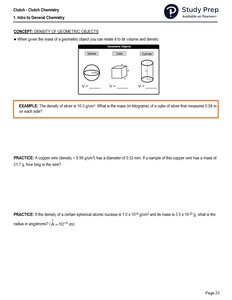
This question tests your ability to use density and volume formulas to find mass.
Key Formula:
(where is the side length)
Step-by-Step Guidance
Write down the density and the side length of the cube.
Calculate the volume using .
Rearrange the density formula to solve for mass: .
Plug in the values for density and volume.
Try solving on your own before revealing the answer!
Final Answer:
Calculate the volume, then multiply by density to get the mass in kilograms.
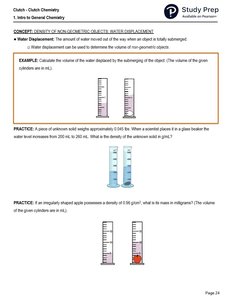
Q6. How do you calculate the volume of water displaced by an object?
Background
Topic: Water Displacement
This question tests your understanding of how to measure the volume of irregular objects using water displacement.
Key Formula:
Step-by-Step Guidance
Record the initial water level in the graduated cylinder.
Submerge the object and record the new water level.
Subtract the initial level from the final level to find the volume displaced.
Try solving on your own before revealing the answer!
Final Answer:
The volume displaced is the difference between the final and initial water levels, measured in mL.
