 Back
General Chemistry Study Guide: Solutions, Chemical Reactions, and Oxidation States
Study Guide - Smart Notes
 Tailored notes based on your materials, expanded with key definitions, examples, and context.
Solutions and Molarity
Calculating Molarity
Molarity (M) is a measure of the concentration of a solute in a solution, defined as moles of solute per liter of solution. It is a fundamental concept in solution chemistry and is used to quantify the amount of substance dissolved.
Formula:
Example: Dissolving 12.87 mg KI in 112.4 mL water: Convert mass to moles, then divide by volume in liters.
Application: Used to prepare solutions for reactions, titrations, and dilutions.
Solution Dilution
When a solution is diluted, the amount of solute remains constant, but the volume increases, decreasing the concentration.
Formula:
Example: Diluting 123 mL of 1.1 M glucose to 500 mL: Find new molarity using the formula.
Stoichiometry in Solutions
Stoichiometry allows calculation of reactant or product quantities in solution reactions, often using molarity and volume.
Example: Calculating the volume of a 0.540 M NaOH solution needed to contain 12.5 g NaOH.
Application: Used in titrations and yield calculations.
Solubility and Precipitation Reactions
Solubility Rules for Ionic Compounds
Solubility rules help predict whether a compound will dissolve in water or form a precipitate. These rules are essential for understanding precipitation reactions and ionic equations.
Compounds containing Li+, Na+, K+, or NH4+ are generally soluble.
Nitrates (NO3-) and acetates (C2H3O2-) are always soluble.
Exceptions: Some ions form insoluble compounds with Ag+, Pb2+, or Ca2+.
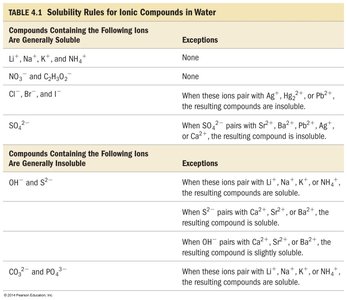
Example: Mixing CrBr2(aq) and Na2CO3(aq) results in a precipitation reaction due to insoluble carbonate.
Writing Ionic Equations
Chemical reactions in aqueous solutions can be represented as molecular, complete ionic, and net ionic equations. Net ionic equations show only the species that participate in the reaction.
Molecular equation: Shows all reactants and products as compounds.
Complete ionic equation: Shows all strong electrolytes as ions.
Net ionic equation: Shows only the ions and molecules directly involved in the reaction.
Example:
Stoichiometry and Yield Calculations
Balancing Chemical Equations
Balancing equations ensures the conservation of mass and atoms. Each side of the equation must have the same number of each atom.
Example:
Percent Yield
Percent yield compares the actual yield from an experiment to the theoretical yield calculated from stoichiometry.
Formula:
Example: Collecting 1.231 g Ca3(PO4)2 when the theoretical yield is 1.55 g gives a percent yield of 79.4%.
Oxidation States and Redox Reactions
Assigning Oxidation States
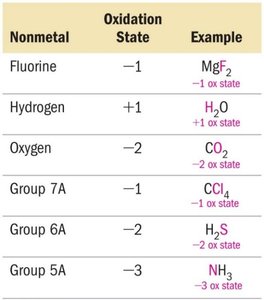
Oxidation states indicate the degree of oxidation of an atom in a compound. They are essential for identifying redox reactions and balancing them.
Rules: Fluorine is always -1, hydrogen is +1, oxygen is -2, Group 7A is -1, Group 6A is -2, Group 5A is -3.
Example: In Sn(SO4)2, Sn is +4.
Identifying Oxidation and Reduction
Oxidation is the loss of electrons, while reduction is the gain of electrons. The element that is oxidized increases its oxidation state, and the element that is reduced decreases its oxidation state.
Oxidizing agent: The species that causes oxidation by accepting electrons.
Example: In Ni(s) + 2 AgClO4(aq) → Ni(ClO4)2(aq) + 2 Ag(s), Ni is oxidized and Ag+ is reduced.
Periodic Table Reference
Periodic Table and Element Properties
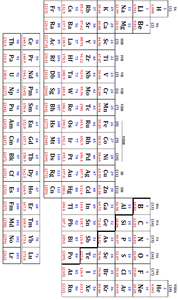
The periodic table organizes elements by increasing atomic number and groups elements with similar chemical properties. It is a fundamental tool for understanding element behavior, predicting compound formation, and assigning oxidation states.
Groups: Columns with similar properties (e.g., alkali metals, halogens).
Periods: Rows indicating energy levels.
Application: Used to predict solubility, reactivity, and oxidation states.
Summary Table: Solubility Rules
The following table summarizes the solubility rules for ionic compounds in water, which are essential for predicting precipitation reactions:
Ion | Solubility | Exceptions |
|---|---|---|
Li+, Na+, K+, NH4+ | Soluble | None |
NO3-, C2H3O2- | Soluble | None |
Cl-, Br-, I- | Soluble | Ag+, Pb2+, Hg22+ |
SO42- | Soluble | Sr2+, Ba2+, Pb2+, Ag+, Ca2+ |
OH-, S2- | Insoluble | Li+, Na+, K+, NH4+, Ca2+, Sr2+, Ba2+ |
CO32-, PO43- | Insoluble | Li+, Na+, K+, NH4+ |
Additional info: This table is inferred and expanded from the solubility rules image and exam content.
