 Back
BackGeneral Chemistry Study Guide: Solutions, Dilution, Reactions, and Titration
Study Guide - Smart Notes
 Tailored notes based on your materials, expanded with key definitions, examples, and context.
Q1. In each of the following mixtures, identify the solute and the solvent:
3% hydrogen peroxide (pharmacy)
5% acetic acid (vinegar bottle)
125 g/L hemoglobin (blood lab results)
0.243% sodium fluoride (toothpaste)
Background
Topic: Solutions and Concentration
This question tests your understanding of the definitions of solute and solvent in a mixture. The solute is the substance present in a smaller amount, while the solvent is present in a larger amount.
Key Terms:
Solute: The substance dissolved in the solvent.
Solvent: The substance in which the solute is dissolved, usually present in greater quantity.
Step-by-Step Guidance
For each mixture, identify which component is present in the smaller amount (solute) and which is present in the larger amount (solvent).
For solutions with a percentage, the solute is the compound listed with the percentage, and the solvent is typically water unless otherwise specified.
For the hemoglobin solution, hemoglobin is the solute and the solvent is likely plasma or water.
For toothpaste, sodium fluoride is the solute and the solvent is the base of the toothpaste (often water or another carrier).
Try solving on your own before revealing the answer!
Q2. Determine the mass (in g) of sodium hydroxide needed to prepare 50.00 mL of a 2.0 M solution.
Background
Topic: Molarity and Solution Preparation
This question tests your ability to use molarity to calculate the mass of solute required for a specific volume of solution.
Key formula:
Step-by-Step Guidance
Convert the volume from mL to L:
Calculate the moles of NaOH needed:
Find the molar mass of NaOH (Na: 22.99, O: 16.00, H: 1.01).
Calculate the mass required:
Try solving on your own before revealing the answer!
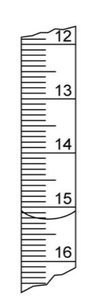
Q3. An aliquot containing 10.0 mL of nitric acid was titrated using a 0.15 M solution of NaOH. The volume required to reach the equivalence point is read on the burette below. What is the concentration of nitric acid?
Background
Topic: Acid-Base Titration
This question tests your ability to use titration data to calculate the concentration of an unknown acid solution.
Key formula:
Where:
= concentration of acid (unknown)
= volume of acid (10.0 mL)
= concentration of base (0.15 M)
= volume of base used (read from burette)
Step-by-Step Guidance
Read the volume of NaOH used from the burette image. The meniscus is at approximately 15.2 mL.
Write the balanced equation for the reaction:
Set up the titration equation:
Plug in the known values: , ,
Try solving on your own before revealing the answer!
Final Answer: The concentration of nitric acid is 0.23 M
The calculation uses the titration formula and the burette reading to find the concentration of the acid.
