 Back
BackGeneral Chemistry Study Guide: Solutions, Reactions, and Atomic Structure
Study Guide - Smart Notes
 Tailored notes based on your materials, expanded with key definitions, examples, and context.
Reactions in Aqueous Solution
Molarity and Solution Calculations
Molarity (M) is a fundamental concept in chemistry used to express the concentration of a solution. It is defined as the number of moles of solute per liter of solution.
Molarity formula:
Finding moles:
Calculating mass of solute:
Mass percent:
Example: To prepare 250 mL of 0.5 M NaCl, calculate the required mass using the molar mass and the above formula.
Calculating Amount of Solute
To determine the amount of solute in a given volume of solution with known molarity, use the formulas above. Solutions are homogeneous mixtures of two or more substances.
Example: How many grams of glucose are needed to prepare 1.50 L of 0.250 M solution? (Molar mass = 180.2 g/mol)
Dilution Calculations
When a solution is diluted, the amount of solute remains constant, but the volume increases, lowering the concentration. The dilution equation relates initial and final concentrations and volumes:
Dilution equation:
Key point: Dilutions add more solvent; volume increases, concentration decreases.
Electrolytes and Conductivity
Substances dissolved in water are classified based on their ability to conduct electricity:
Electrolytes: Dissociate to form ions; solutions conduct electricity.
Strong electrolytes: Completely dissociate (e.g., NaCl, HCl).
Weak electrolytes: Partially dissociate (e.g., CH3CO2H).
Nonelectrolytes: Do not dissociate; do not conduct electricity (e.g., sugar, ethanol).
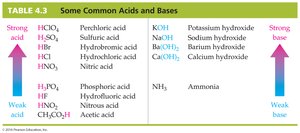
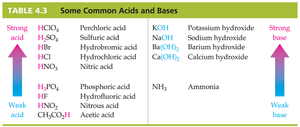
Table: Classification of Common Acids and Bases
This table compares various acids and bases, categorizing them as strong or weak.
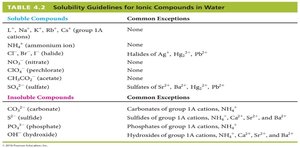
Solubility Guidelines for Ionic Compounds
Solubility rules help predict whether an ionic compound will dissolve in water. These guidelines are essential for identifying precipitation reactions.
Table: Solubility Guidelines
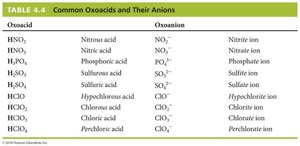
Oxoacids and Their Anions
Oxoacids are acids that contain oxygen, hydrogen, and another element. Their names and formulas are closely related to their corresponding anions.
Table: Common Oxoacids and Their Anions
Types of Aqueous Reactions
Reactions in aqueous solution can be classified as:
Precipitation Reaction: Forms an insoluble solid (precipitate).
Acid-Base Neutralization: Acid reacts with base to form water and a salt.
Redox Reaction: Involves transfer of electrons between species.
Writing Molecular, Total Ionic, and Net Ionic Equations
Three types of equations describe reactions in aqueous solution:
Molecular Equation: Shows all reactants and products as compounds.
Total Ionic Equation: Shows all strong electrolytes as separate ions.
Net Ionic Equation: Shows only the species that change during the reaction; spectator ions are omitted.
Example: Mixing NaCl(aq) and AgNO3(aq): Molecular: NaCl(aq) + AgNO3(aq) → NaNO3(aq) + AgCl(s) Total Ionic: Na+(aq) + Cl-(aq) + Ag+(aq) + NO3-(aq) → Na+(aq) + NO3-(aq) + AgCl(s) Net Ionic: Ag+(aq) + Cl-(aq) → AgCl(s)
Predicting Precipitation Reactions
Use solubility guidelines to determine if a precipitation reaction will occur and write the corresponding equations.
Arrhenius Theory of Acids and Bases
According to Arrhenius theory:
Acid: Produces H+ ions in aqueous solution; contains H in formula.
Base: Produces OH- ions in aqueous solution; contains OH- in formula.
Strong acids/bases: Completely dissociate in water.
Weak acids/bases: Partially dissociate.
Stoichiometry with Molarity
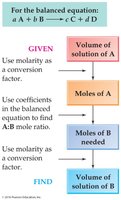
Stoichiometry calculations involving solutions require balancing the equation and using molarity as a conversion factor.
Balance the equation.
Use molarity and coefficients to calculate moles and volumes.
Titration and Determining Concentration
Titration is a process for determining the exact volume of a standard solution required to react with a certain amount of an unknown. Key terms:
Standard solution: Solution of accurately known concentration.
Standardization: Process of accurately determining concentration.
Equivalence Point: Point when stoichiometric amounts of both reactants have been added.
Indicator: Molecule that changes color depending on acidity.
End Point: Point when the indicator changes color.
Redox Reactions and Oxidation Numbers
Assigning oxidation numbers helps identify redox reactions, the species oxidized/reduced, and the oxidizing/reducing agents.
Oxidation: Increase in oxidation number (loss of electrons).
Reduction: Decrease in oxidation number (gain of electrons).
Example: In Zn + CuSO4 → ZnSO4 + Cu, Zn is oxidized, Cu2+ is reduced.
Periodicity & Electronic Structure of Atoms
Electromagnetic Radiation: Wavelength, Frequency, and Energy
Electromagnetic waves are characterized by their wavelength, frequency, and amplitude. The speed of light (c) relates wavelength (λ) and frequency (ν):
To find frequency:
To find wavelength:
The energy of a photon is given by:
Quantum Numbers and Atomic Orbitals
Quantum numbers describe the properties of electrons in atoms:
Principal (n): Energy level
Angular-momentum (l): Subshell shape
Magnetic (ml): Orientation
Spin (ms): Electron spin direction
Order of Subshell Filling
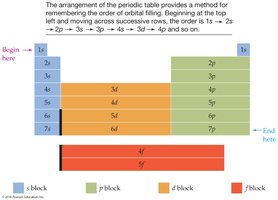
The arrangement of the periodic table provides a method for remembering the order of orbital filling. The order is: 1s → 2s → 2p → 3s → 3p → 4s → 3d → 4p → 5s → 4d → 5p → 6s → 4f → 5d → 6p → 7s → 5f → 6d → 7p.
Electron Configurations and Periodic Trends
Assign electron configurations: Use subshell designations and noble gas core.
Draw orbital filling diagrams: Determine number of unpaired electrons.
Atomic radii: Trend decreases across a period, increases down a group.
Relative size: Predict based on position in periodic table.
Ionic Compounds: Periodic Trends and Bonding Theory
Electron Configurations for Ions
Ground state configurations: Write for main group and transition metal ions.
Unpaired electrons: Determine for ions.
Relative size: Compare anions, cations, and neutral atoms.
Isoelectronic ions: Predict relative size.
Ionization Energy and Electron Affinity
Order elements: From lowest to highest ionization energy.
Periodic trend: Ionization energy increases across a period, decreases down a group.
Electron affinity: Compare values and explain trends.
Octet Rule and Ionic Compounds
Octet rule: Predict charges and electron configurations of main group ions.
Formulas: Write for ionic compounds.
Born-Haber Cycle and Lattice Energy
Born-Haber cycle: Draw and calculate energy change for formation of ionic compounds.
Lattice energy: Define and understand factors affecting lattice energy.
