 Back
General Chemistry Study Notes: Chemical Equilibria, Acids & Bases, Aqueous Equilibria, Thermodynamics, and Electrochemistry
Study Guide - Smart Notes
 Tailored notes based on your materials, expanded with key definitions, examples, and context.
Chemical Equilibria
What is Chemical Equilibrium?
Chemical equilibrium occurs when the rates of the forward and reverse reactions are equal, resulting in constant concentrations of reactants and products. At equilibrium, the system is dynamic, with ongoing reactions but no net change in composition.
Dynamic Equilibrium: Both forward and reverse reactions continue at equal rates.
Equilibrium Constant (K): Quantifies the ratio of product to reactant concentrations at equilibrium.
Magnitude of K: Indicates whether a reaction is product-favored (large K) or reactant-favored (small K).
Example: For , the reaction proceeds nearly to completion; for , it hardly proceeds.

Equilibrium Constant Expressions
The equilibrium constant expression depends on the physical states of the reactants and products:
For Gases: Use partial pressures ().
For Solutions: Use molar concentrations ().
For Solids and Liquids: Their concentrations are omitted from the expression.
Relating and : , where Δn is the change in moles of gas.

Manipulating Equilibrium Constants
Changing the stoichiometry or direction of a reaction affects the equilibrium constant:
Reversing the reaction:
Multiplying coefficients:
Adding reactions:

The Reaction Quotient (Q)
The reaction quotient, Q, is calculated like K but with current concentrations. Comparing Q to K predicts the direction of reaction:
Q < K: Forward reaction favored.
Q > K: Reverse reaction favored.
Q = K: System is at equilibrium.

Calculating Equilibrium Concentrations (ICE Tables)
ICE (Initial, Change, Equilibrium) tables help calculate equilibrium concentrations and constants:
Set up initial concentrations.
Define changes using stoichiometry.
Calculate equilibrium concentrations.
Example: For , use known equilibrium values to solve for K.

Disturbing Equilibrium (Le Chatelier's Principle)
Le Chatelier's Principle states that a system at equilibrium will adjust to counteract disturbances:
Adding/removing reactants/products: Shifts equilibrium to restore balance.
Changing volume (for gases): Affects concentrations and shifts equilibrium.
Changing temperature: Alters K and shifts equilibrium depending on reaction enthalpy.

Acids and Bases
Brønsted-Lowry Theory
Acids are proton donors; bases are proton acceptors. Substances that can donate or accept more than one proton are polyprotic.
Amines: Act as Brønsted-Lowry bases due to lone pairs on nitrogen.
Conjugate pairs: Acid and base differ by one proton.

Strength of Acids and Bases
Strong acids/bases dissociate completely; weak acids/bases only partially. The pH scale quantifies acidity/basicity.
pH:
Autoionization of water:
Ka and Kb: Acid and base dissociation constants.

Acid and Base Equilibrium Constants
Table of common acids and bases with their Ka and Kb values helps classify their strength.
Acid | Ka | Base | Kb |
|---|---|---|---|
HClO4 | Large | ClO4- | Very Small |
H2SO4 | Large | HSO4- | Very Small |
CH3COOH | 1.8 × 10⁻⁵ | CH3COO- | 5.6 × 10⁻¹⁰ |
NH4+ | 5.6 × 10⁻¹⁰ | NH3 | 1.8 × 10⁻⁵ |
H2O | 1.0 × 10⁻¹⁴ | OH- | 1.0 |
HCN | 4.0 × 10⁻¹⁰ | CN- | 2.5 × 10⁻⁵ |

Polyprotic Acids and pKa
Polyprotic acids can donate more than one proton. The pKa scale is logarithmic and helps compare acid strengths.
Lower pKa: Stronger acid.
Direction of acid-base reactions: Favors formation of weaker acid/base.

Calculating pH and Equilibrium Concentrations
Use Ka or Kb to calculate pH and percent ionization for acids and bases.
Example: Benzoic acid and HCl solutions compared for pH and ionization.
Percent ionization:

Acid-Base Properties of Salts
Salts can produce acidic, basic, or neutral solutions depending on their constituent ions.
Example: Ni(ClO4)2 (acidic), K3PO4 (basic), KHCO3 (basic), NaNO3 (neutral).

Aqueous Equilibria
Buffer Solutions
Buffers are solutions that resist changes in pH upon addition of small amounts of acid or base. They consist of a weak acid and its conjugate base (or vice versa).
Common Ion Effect: Addition of a common ion suppresses ionization.
Henderson-Hasselbalch Equation:
Buffer preparation: Choose acid/base pair with pKa near desired pH.
How Buffers Work
Buffers maintain pH by neutralizing added acid or base through equilibrium shifts.
Adding acid: Conjugate base neutralizes H+.
Adding base: Weak acid neutralizes OH-.
Acid-Base Titrations
Titrations determine the concentration of an acid or base by reacting it with a standard solution. The titration curve shows pH changes as titrant is added.
Strong acid-strong base: Sharp pH change at equivalence point.
Weak acid-strong base: Buffer region and higher equivalence point pH.
Polyprotic acids: Multiple equivalence points.
Solubility and Precipitation Reactions
Solubility Product (Ksp)
Ksp quantifies the equilibrium between a solid and its dissolved ions. Solubility depends on Ksp and the presence of common ions.
Example: CaCO3 (Ksp = 3.4 × 10⁻⁹), AgCl (Ksp = 1.8 × 10⁻¹⁰).
Solubility calculation: Use Ksp and stoichiometry to find ion concentrations.
Common Ion Effect
The presence of a common ion reduces the solubility of a salt.
Example: PbCrO4 solubility decreases in Pb(NO3)2 solution.
Precipitation Reactions
Precipitation occurs when Q > Ksp. If Q < Ksp, no precipitate forms; if Q = Ksp, the solution is saturated.
Example: BaSO4 precipitation depends on Ba2+ and SO42- concentrations.
Thermodynamics: Entropy and Free Energy
Spontaneity and Entropy
Spontaneous processes increase the entropy of the universe. Entropy (S) measures energy dispersal.
Second Law: ΔS(universe) > 0 for spontaneous processes.
Third Law: S = 0 for a perfect crystal at 0 K.
General trends: Gases > liquids > solids; larger, more complex molecules have higher entropy.
Calculating Entropy Changes
Entropy changes can be predicted for reactions and phase changes:
Phase change: ΔS = ΔHfus/T
Reaction: ΔSrxn = ΣSproducts - ΣSreactants
Gibbs Free Energy
Gibbs energy (G) determines spontaneity and equilibrium. ΔG < 0: spontaneous; ΔG = 0: equilibrium; ΔG > 0: non-spontaneous.
Equation:
Standard free energy change: Use tabulated values for ΔHf and So.
Electrochemistry
Voltaic Cells and Cell Potentials
Electrochemical cells convert chemical energy to electrical energy via redox reactions. The cell potential (Ecell) is determined by the difference in standard reduction potentials.
Standard Hydrogen Electrode (SHE): Reference for measuring potentials.
Cell notation: Anode | Anode solution || Cathode solution | Cathode
Standard Reduction Potentials
Table of standard reduction potentials helps predict redox reaction direction and cell voltage.
Half-Reaction | Eo (V) |
|---|---|
F2(g) + 2e- ⟶ 2F-(aq) | +2.870 |
Cl2(g) + 2e- ⟶ 2Cl-(aq) | +1.360 |
Ag+(aq) + e- ⟶ Ag(s) | +0.800 |
Zn2+(aq) + 2e- ⟶ Zn(s) | -0.763 |
Al3+(aq) + 3e- ⟶ Al(s) | -1.660 |
Linking Free Energy and Electrical Work
Free energy change relates to cell potential:
Equation:
Nernst Equation:
Electrolysis
Electrolysis uses electrical energy to drive non-spontaneous reactions. The amount of substance produced depends on current, time, and Faraday's constant.
Faraday's constant: 96,485 C/mol e-
Calculations: Mass deposited = (Current × Time × Molar mass) / (n × F)
Coordination Complexes and Lewis Acid-Base Theory
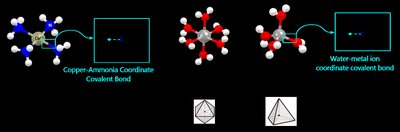
Lewis acids accept electron pairs; Lewis bases donate them. Coordination complexes are formed by metal ions and ligands via coordinate covalent bonds.
Example: Copper-ammonia and water-metal ion complexes.
Additional info: These notes cover key concepts from General Chemistry chapters on equilibrium, acids and bases, aqueous equilibria, thermodynamics, and electrochemistry, with relevant examples, equations, and tables for exam preparation.
