 Back
General Chemistry Study Notes: Periodic Trends, Bonding, and Gases
Study Guide - Smart Notes
 Tailored notes based on your materials, expanded with key definitions, examples, and context.
Periodic Properties of the Elements
Periodic Trends Overview
Periodic trends are recurring patterns in the properties of elements as a function of their atomic number and position on the periodic table. These trends help predict element behavior in chemical reactions and bonding.
Metallic Character: The tendency of an element to lose electrons and form positive ions (cations). Metallic character decreases from left to right across a period and increases down a group.
Atomic Radius: The distance from the nucleus to the outermost electron shell. Atomic radius decreases across a period (left to right) and increases down a group.
Ionic Radius: The radius of an ion, which changes depending on electron loss (cations are smaller) or gain (anions are larger).
Ionization Energy: The energy required to remove an electron from a gaseous atom. Increases across a period and decreases down a group.
Electron Affinity: The energy change when an electron is added to a gaseous atom. Generally becomes more exothermic across a period.
Electronegativity: The ability of an atom to attract electrons in a chemical bond. Increases across a period and decreases down a group.
Effective Nuclear Charge (Zeff): The net positive charge experienced by valence electrons, accounting for shielding by inner electrons.
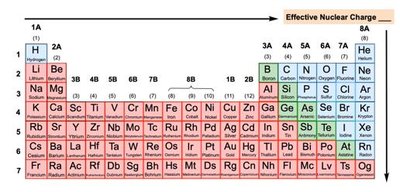
Effective Nuclear Charge and Slater's Rule
Effective nuclear charge (Zeff) is calculated as the difference between the atomic number (Z) and the shielding constant (S). Slater's Rule provides a method to estimate S based on electron configuration.
Formula:
Shielding: Inner electrons shield outer electrons from the full charge of the nucleus, reducing the effective nuclear charge.
Basic Concepts of Chemical Bonding
Types of Chemical Bonds
Chemical bonds are the attractive forces that hold atoms together in compounds. The main types are:
Ionic Bonds: Formed by the transfer of electrons from metals to nonmetals, resulting in cations and anions held together by electrostatic attraction.
Covalent Bonds: Formed by the sharing of electrons between nonmetals.
Metallic Bonds: Involve a 'sea' of delocalized electrons shared among a lattice of metal cations, giving rise to properties like conductivity and malleability.
Lewis Dot Structures
Lewis dot structures represent the valence electrons of atoms as dots around the element symbol. They are used to visualize bonding and lone pairs in molecules and ions.
Octet Rule: Atoms tend to form bonds to achieve eight electrons in their valence shell (exceptions exist for some elements).
Formal Charge: Used to determine the most stable Lewis structure. Calculated as:
Bond Polarity and Dipole Moments
Bond polarity arises from differences in electronegativity between bonded atoms. A dipole moment occurs when there is an uneven distribution of electron density.
Nonpolar Covalent: Electrons shared equally (ΔEN < 0.5).
Polar Covalent: Electrons shared unequally (0.5 < ΔEN < 1.7).
Ionic: Electrons transferred (ΔEN > 1.7).
Resonance and Bond Order
Some molecules have multiple valid Lewis structures (resonance). The actual structure is a resonance hybrid. Bond order is the average number of bonds between two atoms in all resonance forms.
Bond Order Formula:
Molecular Geometry and Bonding Theories
VSEPR Theory and Electron Geometry
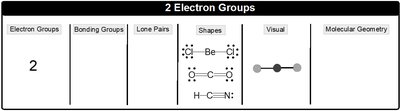
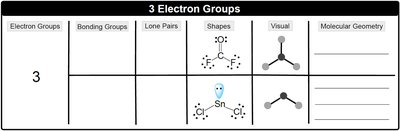
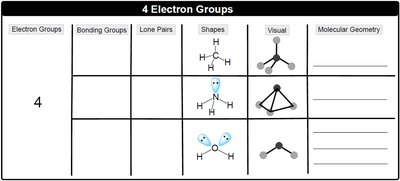
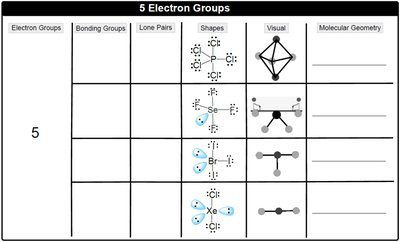
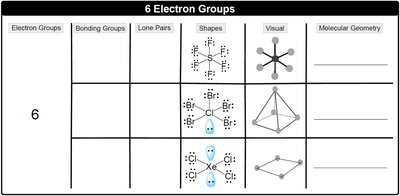
The Valence Shell Electron Pair Repulsion (VSEPR) theory predicts molecular shapes based on repulsion between electron groups around a central atom.
Electron Groups: Include bonding pairs and lone pairs.
Common Geometries:
Electron Groups | Geometry |
|---|---|
2 | Linear |
3 | Trigonal Planar |
4 | Tetrahedral |
5 | Trigonal Bipyramidal |
6 | Octahedral |
Gases and the Ideal Gas Law
Pressure and Its Measurement
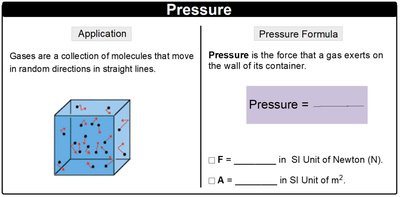
Pressure is the force exerted by gas molecules colliding with the walls of their container. It is measured in pascals (Pa), atmospheres (atm), or other units.
The Ideal Gas Law
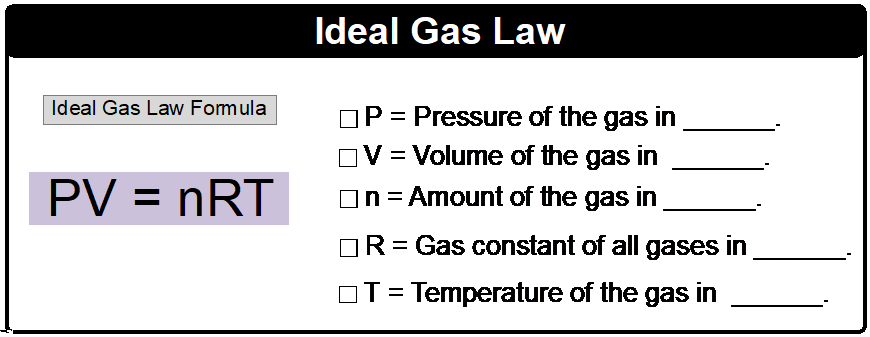
The Ideal Gas Law relates pressure, volume, temperature, and amount of gas:
P = Pressure (atm or Pa)
V = Volume (L or m3)
n = Moles of gas
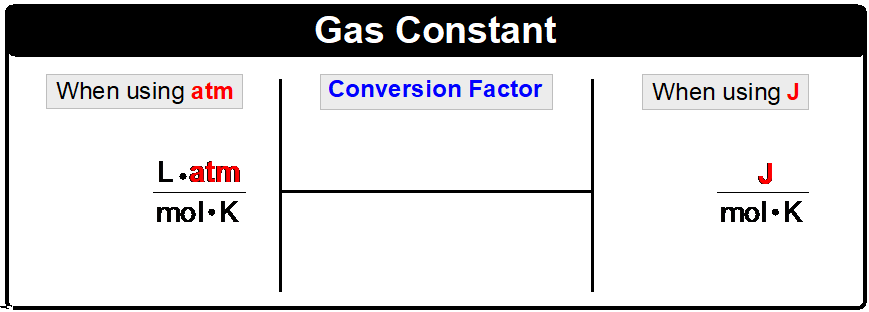
R = Gas constant (0.08206 L·atm/mol·K or 8.314 J/mol·K)
T = Temperature (K)
Relationships and Applications
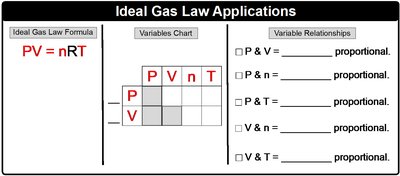
By rearranging the Ideal Gas Law, you can derive other gas laws and relationships:
Boyle's Law: (at constant n, T)
Charles's Law: (at constant n, P)
Avogadro's Law: (at constant P, T)
Gay-Lussac's Law: (at constant n, V)
Graphical Relationships
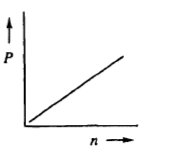
The relationship between pressure and moles (n) at constant volume and temperature is linear:
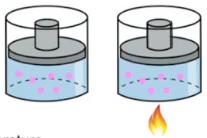
Gas Law Demonstrations
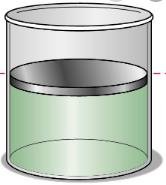
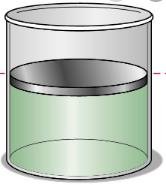
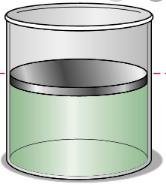
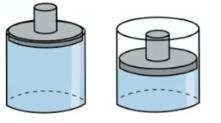
Changes in pressure, volume, and temperature can be visualized using piston diagrams:
Summary Table: Key Gas Laws
Law | Formula | Variables Held Constant |
|---|---|---|
Boyle's Law | n, T | |
Charles's Law | n, P | |
Avogadro's Law | P, T | |
Gay-Lussac's Law | n, V | |
Ideal Gas Law | None |
Additional info: The images of circles and clocks are not directly relevant to the chemical concepts and are omitted from the main content. Only images that directly reinforce the chemical explanations are included above.
