 Back
BackGeneral Chemistry Study Notes: Solutions and Acid-Base Equilibria
Study Guide - Smart Notes
 Tailored notes based on your materials, expanded with key definitions, examples, and context.
Solutions
Definition and Types of Solutions
Solutions are homogeneous mixtures composed of two or more substances in a single phase. The component present in the larger amount is called the solvent, while the component present in the smaller amount is the solute. Solutions can be classified based on the physical states of their components (gas, liquid, or solid).
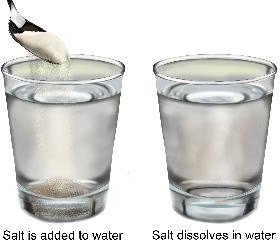
Homogeneous mixture: Uniform composition throughout (e.g., saltwater).
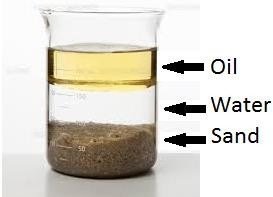
Heterogeneous mixture: Non-uniform composition (e.g., oil, water, and sand mixture).
Examples: Air (gas in gas), carbonated water (gas in liquid), alloys (solid in solid).
Ways of Expressing Concentration
The concentration of a solution describes the amount of solute dissolved in a given quantity of solvent or solution. Several units are commonly used:
Molarity (M): Moles of solute per liter of solution.
Normality (N): Gram equivalent weight of solute per liter of solution.
Molality (m): Moles of solute per kilogram of solvent.
Mole fraction (X): Moles of one component divided by total moles of all components.
Percent by weight (% w/w): Grams of solute per 100 g of solution.
Percent by volume (% v/v): mL of solute per 100 mL of solution.
Percent weight-in-volume (% w/v): Grams of solute per 100 mL of solution.
Milliequivalent (mEq): Used for ionic concentrations, especially in clinical settings.
Molarity and Calculations
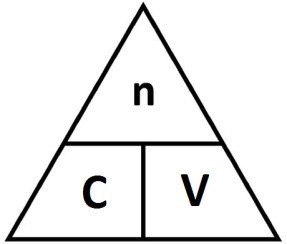
Molarity is a central concept in solution chemistry. It is calculated as:
, where n is the number of moles of solute and V is the volume of solution in liters.
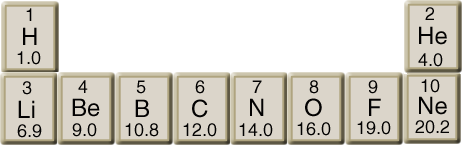
To find moles from mass: , where m is mass in grams and M_w is molar mass in g/mol.

Preparation and Dilution of Solutions
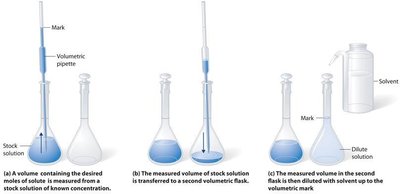
Solutions are often prepared by dissolving a known mass of solute in a solvent and diluting to a specific volume. Dilution involves adding solvent to decrease concentration while keeping the amount of solute constant.
Simple dilution equation:
Preparation steps: Weigh solute, dissolve in solvent, transfer to volumetric flask, dilute to mark.


Chemical Equations
Writing and Balancing Chemical Equations
Chemical equations symbolically represent chemical reactions. Reactants are written on the left, products on the right, and their physical states are indicated (g, l, s, aq). Balancing equations ensures the law of conservation of mass is obeyed.
Balance atoms of each element on both sides.
Use the smallest whole-number coefficients.
Indicate physical states for clarity.
Ionic Equations
For reactions in aqueous solution, equations can be written at three levels:
Molecular equation: All reactants and products as compounds.
Complete ionic equation: All strong electrolytes as ions.
Net ionic equation: Only species undergoing change; spectator ions are omitted.
Electrolytes and Ionic Theory
Electrolytes vs. Nonelectrolytes
Substances that conduct electricity in solution are called electrolytes. They dissociate into ions. Nonelectrolytes do not dissociate and do not conduct electricity.
Strong electrolytes: Nearly 100% dissociation (e.g., NaCl, HCl).
Weak electrolytes: Partially dissociate (e.g., acetic acid, ammonia).
Nonelectrolytes: Do not dissociate (e.g., sugar, urea).

Acids and Bases
Arrhenius and Brønsted-Lowry Concepts
Acids and bases can be defined in several ways:
Arrhenius acid: Produces H+ ions in water.
Arrhenius base: Produces OH- ions in water.
Brønsted-Lowry acid: Proton donor.
Brønsted-Lowry base: Proton acceptor.
Conjugate acid-base pairs: Differ by one proton.
Amphoteric substances: Can act as acid or base (e.g., water).
Self-Ionisation of Water and pH Scale
Water self-ionises to form hydronium and hydroxide ions. The product of their concentrations is constant at a given temperature:
at 25°C
pH:
pOH:
at 25°C
Strong and Weak Acids/Bases
Strong acids and bases are completely ionised in solution, while weak acids and bases are only partially ionised. The strength is quantified by the acid dissociation constant () or base dissociation constant ():
Lower or indicates a stronger acid or base, respectively.
Polyprotic Acids and Bases
Polyprotic acids can donate more than one proton (e.g., phosphoric acid). Each ionisation step has its own and value. Similarly, polyprotic bases can accept more than one proton.
Salts and Their Solutions
Salts are ionic compounds formed from acid-base reactions. Their solutions can be neutral, acidic, or basic depending on the strengths of the parent acid and base.
Neutral salt: Strong acid + strong base (e.g., NaCl)
Acidic salt: Strong acid + weak base (e.g., NH4Cl)
Basic salt: Weak acid + strong base (e.g., CH3COONa)
Percentage Ionisation
The percentage ionisation of a weak electrolyte is the ratio of ionised molecules to the initial concentration, expressed as a percentage:
For acids:
For bases:
Essential Operational Skills
Calculate molar mass/molecular weight of a substance.
Convert between moles, grams, and concentration units.
Calculate the concentration of diluted solutions.
Write and balance chemical equations, including net ionic equations.
Calculate pH, , , and percentage ionisation.
