 Back
BackGuidance for Question 9: Identifying Atomic Orbitals
Study Guide - Smart Notes
 Tailored notes based on your materials, expanded with key definitions, examples, and context.
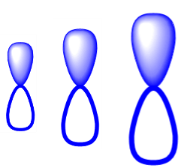
Q9. Which labels, in the order they are written, best describe the orbitals in the order shown to the right?
Background
Topic: Atomic Orbitals and Quantum Numbers
This question tests your understanding of how atomic orbitals are labeled based on their principal quantum number (n) and their shape (subshell type, such as s, p, d, f). The image shows three orbitals, each with a similar shape but different sizes, which is characteristic of orbitals with the same subshell type but different principal quantum numbers.
Key Terms and Formulas
Principal Quantum Number (n): Indicates the energy level and size of the orbital.
Subshell Type: Describes the shape of the orbital (s, p, d, f).
Orbital Label: Written as "n(subshell type)", e.g., 2p, 3d.
Step-by-Step Guidance
Observe the shapes in the image: All three orbitals have a similar shape, which is characteristic of a particular subshell type (for example, d orbitals have a distinct shape).
Notice the increasing size from left to right: This suggests increasing principal quantum number (n), as orbitals get larger with higher n.
Determine the subshell type: The shape shown is not spherical (s) or dumbbell-shaped (p), but rather a more complex shape, likely a d orbital.
Assign labels based on increasing n: The smallest is the lowest n, the largest is the highest n. For example, if these are d orbitals, the labels would be 3d, 4d, 5d (in order of increasing size).
Try solving on your own before revealing the answer!
