 Back
Heat Capacities of an Ideal Gas: Isochoric and Isobaric Processes
Study Guide - Smart Notes
 Tailored notes based on your materials, expanded with key definitions, examples, and context.
Heat Capacities of an Ideal Gas
Introduction to Heat Capacity in Gases
The heat capacity of a substance is a measure of the amount of heat required to change its temperature by a given amount. For gases, heat capacity depends on the process conditions, such as whether the volume or pressure is held constant. This section explores the heat capacities of ideal gases under constant volume (isochoric) and constant pressure (isobaric) conditions, and explains the relationship between these two quantities.
Isochoric Process (Constant Volume)
In an isochoric process, the volume of the gas remains constant. Since the gas does not expand or contract, it does no work on its surroundings. The heat added to the system increases only the internal energy of the gas.
First Law of Thermodynamics:
At constant volume, , so
The heat added at constant volume is
Therefore,
Key Point: The change in internal energy of an ideal gas depends only on the temperature change, not on the process path.
Isobaric Process (Constant Pressure)
In an isobaric process, the pressure of the gas remains constant. When heat is added, the gas expands and does work against the external pressure. The heat added increases both the internal energy and the work done by the gas.
The heat added at constant pressure is
The work done by the gas is
From the ideal gas law,
Applying the first law:
Key Point: The heat capacity at constant pressure () is always greater than at constant volume () because some energy goes into doing work as the gas expands.
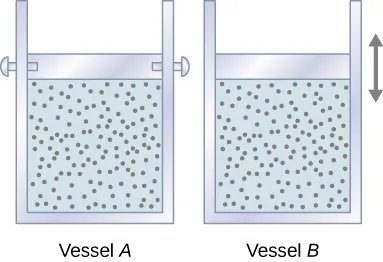
Relationship Between and
Since the internal energy change for a given temperature change is the same for both processes, we can relate the two heat capacities:
From above:
Therefore,
This relationship is valid for all ideal gases and is a direct consequence of the ideal gas law.
Molar Heat Capacities and Degrees of Freedom
The molar heat capacity of an ideal gas depends on the number of degrees of freedom (d) of its molecules:
At constant volume:
At constant pressure:
Where:
Monatomic gases (e.g., He):
Diatomic gases (e.g., O2): (at room temperature, rotational modes are active)
Polyatomic gases (e.g., CO2, NH3): or more (vibrational modes may contribute at higher temperatures)
Table: Molar Heat Capacities of Dilute Ideal Gases at Room Temperature
Type of Molecule | (J/mol·K) | (J/mol·K) |
|---|---|---|
Monatomic | ||
Diatomic | ||
Polyatomic |
Heat Capacities of Real Gases
For real gases, the measured heat capacities are often slightly higher than those predicted for ideal gases, especially for polyatomic molecules. This is due to the contribution of vibrational motion, which becomes significant at room temperature and above. However, the difference remains very close to for most gases.
Summary of Key Equations
First Law of Thermodynamics:
Isochoric process:
Isobaric process:
Relationship:
Molar heat capacity (degrees of freedom):
