 Back
Heat Capacity and Equipartition of Energy: Study Notes for General Chemistry
Study Guide - Smart Notes
 Tailored notes based on your materials, expanded with key definitions, examples, and context.
Heat Capacity and Equipartition of Energy
Heat Capacity of Ideal Gases
The heat capacity of a substance is a measure of the amount of heat required to change its temperature by a given amount. For ideal gases, heat capacity is often discussed in terms of molar heat capacity at constant volume (CV), which is defined as the heat required to raise the temperature of one mole of gas by one degree Celsius (or Kelvin) while keeping the volume constant.
Molar Heat Capacity at Constant Volume (CV): For a monatomic ideal gas, CV = \frac{3}{2} R, where R is the universal gas constant.
Heat Transfer Equation:
Internal Energy Change: (at constant volume)
Example: Heating xenon gas at constant volume: Given mass, initial temperature, and heat added, use molar mass to find moles, then solve for final temperature using .
Degrees of Freedom and Equipartition Theorem
The concept of degrees of freedom refers to the independent ways in which a molecule can store energy. For gases, these include translational, rotational, and vibrational motions. The equipartition theorem states that energy is distributed equally among all active degrees of freedom in a system at thermal equilibrium.
Degree of Freedom (d): Each independent motion (e.g., x, y, z translation, rotation, vibration) counts as one degree.
Equipartition Theorem: The molar heat capacity at constant volume is , where d is the number of degrees of freedom.
Monatomic Gases: d = 3 (translational only), so .
Diatomic Gases: At room temperature, d = 5 (3 translational + 2 rotational), so .
Polyatomic Gases: Typically d = 6 at room temperature (3 translational + 3 rotational).
Temperature Dependence: At low temperatures, fewer degrees of freedom are active due to quantum effects; at high temperatures, vibrational modes become active.
Example: Mixing helium and krypton gases at different temperatures in a calorimeter: Use the number of moles and heat capacities to solve for final equilibrium temperature.
Experimental Values and Comparison
Experimental values of molar heat capacities for various gases generally agree with theoretical predictions based on degrees of freedom, especially for monatomic and diatomic gases. Triatomic gases show only fair agreement due to additional molecular interactions.
Gas | CV/R at 25°C |
|---|---|
Ar | 1.50 |
He | 1.50 |
Ne | 1.50 |
CO | 2.50 |
H2 | 2.47 |
N2 | 2.50 |
O2 | 2.53 |
F2 | 2.8 |
CO2 | 3.48 |
H2S | 3.13 |
N2O | 3.66 |
Molar Heat Capacity of Solid Elements
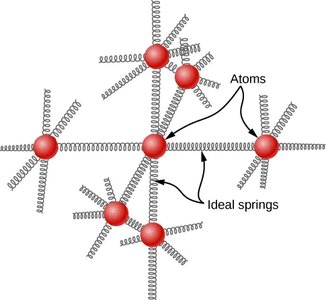
For solid elements, the equipartition theorem can be used to estimate the molar heat capacity. Atoms in a solid are modeled as being connected by springs, allowing for both kinetic and potential energy in each spatial direction.
Degrees of Freedom in Solids: Each atom has 6 degrees of freedom (3 kinetic + 3 potential).
Law of Dulong and Petit: The molar heat capacity of a metal is approximately 3R at room temperature.
Limitations: The law fails at low temperatures due to quantum effects and for some light elements even at room temperature.
Problem-Solving Strategy: Heat Capacity and Equipartition
To solve problems involving heat capacity and equipartition:
Determine if the system is an ideal gas at constant volume or a solid element.
Identify the number of degrees of freedom (d) based on molecular structure and temperature.
Use to calculate heat capacity.
Apply to solve for unknowns such as final temperature or heat transferred.
For solids, use the Law of Dulong and Petit for quick estimates, but consult experimental values for accuracy.
Example: Calorimetry with an ideal gas and a solid: Use the heat lost by the gas and the heat gained by the solid to solve for latent heat or equilibrium temperature.
Additional info: Quantum effects limit the activation of rotational and vibrational degrees of freedom at low temperatures, leading to deviations from classical predictions.
