 Back
Historical Models of the Atom and Key Experiments
Study Guide - Smart Notes
 Tailored notes based on your materials, expanded with key definitions, examples, and context.
Atomic Structure: Historical Models and Experiments
Early Models of the Atom
The concept of the atom has evolved through several key scientific models and experiments. Each model contributed to our understanding of atomic structure, leading to the modern view of the atom.
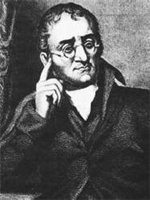
Dalton's Billiard Ball Model
John Dalton proposed that atoms are indivisible, solid spheres, much like billiard balls.
Atoms of different elements have different masses and properties.
This model could not explain electrical phenomena or the existence of subatomic particles.
Example: Dalton's model was foundational for the law of multiple proportions and the conservation of mass.

Thomson's Plum Pudding Model
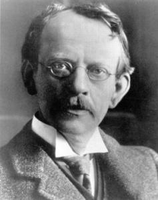
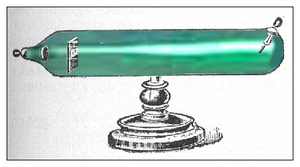
J.J. Thomson discovered the electron using cathode ray experiments.
He proposed that atoms are composed of a positively charged 'pudding' with negatively charged electrons embedded within.
This model explained the existence of electrons but not the arrangement of positive charge.
Example: The plum pudding model was the first to incorporate subatomic particles.

Millikan's Oil Drop Experiment
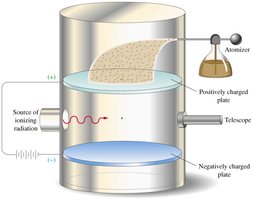
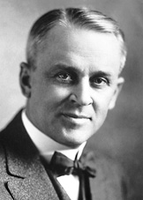
Robert Millikan measured the charge of the electron using the oil drop experiment.
By balancing the gravitational and electrical forces on tiny charged oil droplets, Millikan determined the fundamental unit of electric charge.
This experiment confirmed the quantization of electric charge.
Example: Millikan's work allowed for the calculation of the electron's mass when combined with Thomson's charge-to-mass ratio.
Rutherford's Nuclear Model
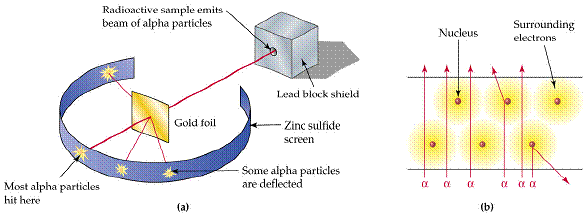
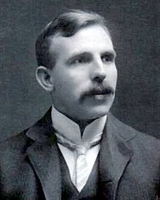
Ernest Rutherford's gold foil experiment revolutionized the understanding of atomic structure by demonstrating the existence of a dense, positively charged nucleus.
Gold Foil Experiment: Alpha particles were directed at a thin sheet of gold foil. Most passed through, but some were deflected at large angles.
Conclusion: Atoms consist of a small, dense nucleus containing protons (and later, neutrons), surrounded by electrons in mostly empty space.
This model replaced the plum pudding model and laid the foundation for modern atomic theory.
Example: The nuclear model explains why most alpha particles pass through the atom, but a few are deflected by the nucleus.
Summary Table: Key Atomic Models and Experiments
Scientist | Model/Experiment | Main Contribution |
|---|---|---|
John Dalton | Billiard Ball Model | Atoms are indivisible spheres |
J.J. Thomson | Plum Pudding Model, Cathode Ray Tube | Discovery of the electron |
Robert Millikan | Oil Drop Experiment | Measurement of electron charge |
Ernest Rutherford | Gold Foil Experiment | Discovery of the atomic nucleus |
Key Terms and Concepts
Atom: The smallest unit of an element, retaining its chemical properties.
Electron: Negatively charged subatomic particle discovered by Thomson.
Nucleus: Dense, positively charged center of the atom, discovered by Rutherford.
Alpha Particle: Helium nucleus used in Rutherford's experiment.
Quantization: The concept that certain properties, such as charge, exist in discrete units.
Additional info: These models and experiments are foundational for understanding later developments in quantum mechanics and the electronic structure of atoms.
