 Back
Honors Chemistry Test 2 Study Guide: Quantum Mechanics, Atomic Structure, Periodic Trends, and Chemical Nomenclature
Study Guide - Smart Notes
 Tailored notes based on your materials, expanded with key definitions, examples, and context.
Nature of Light and the Photoelectric Effect
Wavelength and Frequency
The study of light is fundamental to understanding atomic structure and quantum mechanics. Wavelength (\( \lambda \)) is the distance between two consecutive peaks of a wave, measured in meters (m) or nanometers (nm). Frequency (\( \nu \)) is the number of wave cycles that pass a given point per second, measured in Hertz (Hz or s-1).
Relationship: The speed of light (\( c \)) relates wavelength and frequency: where \( c = 3.00 \times 10^8 \) m/s.
Unit Conversion: 1 nm = \( 1 \times 10^{-9} \) m.
The Photoelectric Effect
The photoelectric effect occurs when light of sufficient frequency strikes a metal surface, causing the release of electrons. The effect depends on the frequency (not amplitude) of the light.
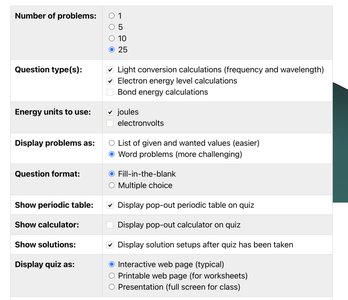
Energy Calculation: The energy of a photon is given by: or where \( h \) is Planck's constant (\( 6.626 \times 10^{-34} \) J·s).
Application: Calculate the energy of an ejected electron or the wavelength/frequency of a photon using these formulas.
Bohr Model of the Atom
Bohr Model Description
The Bohr model extends the Rutherford model by introducing quantized energy levels for electrons. As the principal quantum number (\( n \)) increases, energy levels get closer together. Transitions between lower energy levels (e.g., n=2 to n=1) release more energy than transitions between higher levels (e.g., n=5 to n=4).
Energy Change: The energy change for an electron transition is:
Wavelength Relation: Higher energy transitions correspond to shorter wavelengths of emitted light.
Atomic Emission Spectra
Each element emits light at characteristic wavelengths. By analyzing an atomic emission spectrum, the elements present in a sample can be identified.
Quantum Mechanical Model Updates and Orbital Shapes
Quantum Numbers
Quantum numbers describe the properties of atomic orbitals and electrons:
n: Principal quantum number (energy level)
l: Angular momentum quantum number (orbital shape)
ms: Spin quantum number (electron spin direction)
Each sublevel can hold a specific number of electrons: s (2), p (6), d (10), f (14).
Electron Configurations
Core vs. Valence Electrons
Core electrons are those in inner shells, while valence electrons are in the outermost shell and determine chemical reactivity. The number of valence electrons depends on the element's group in the periodic table.
Writing Electron Configurations
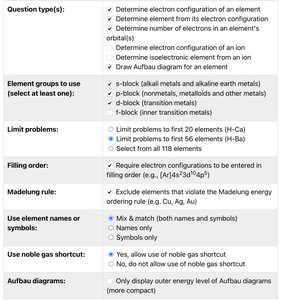
Write electron configurations for elements up to barium (Ba).
Identify elements from their electron configurations.
Predict ions formed based on electron configuration.
Correct errors in orbital diagrams using Hund's rule, Pauli exclusion principle, and Aufbau principle.
Periodic Table and Trends
Periodic Trends
The periodic table reveals trends in atomic properties:
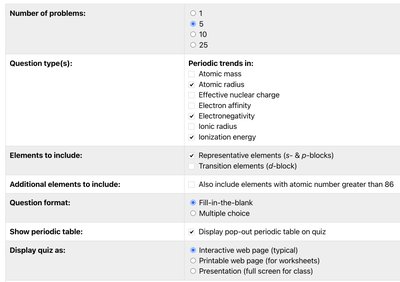
Ionization Energy: Increases across a period, decreases down a group.
Electronegativity: Increases across a period, decreases down a group.
Atomic Radius: Decreases across a period, increases down a group.
These trends allow qualitative comparison between elements.
Elements and Compounds
Atomic vs. Molecular Elements
Atomic elements exist as single atoms (e.g., Ne, Ar). Molecular elements exist as molecules, often as diatomic species (e.g., H2, N2, F2, O2, I2, Cl2, Br2).
Ionic vs. Covalent Compounds
Ionic compounds: Formed from metals and nonmetals; involve transfer of electrons.
Covalent compounds: Formed from nonmetals; involve sharing of electrons.
Ionic Compounds
Formation and Nomenclature
Predict ions formed by main group elements using the octet rule.
Anion: Negatively charged ion; Cation: Positively charged ion.
Predict formulas for ionic compounds from metal and nonmetal pairs.
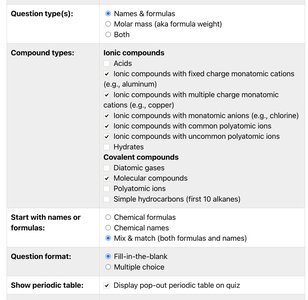
Name ionic compounds and write formulas from names.
Differentiate between Type 1 (fixed charge) and Type 2 (variable charge) ionic compounds.
Use polyatomic ions in compound formation and naming.
Covalent Compounds
Naming Binary Molecular Compounds
Use prefixes (mono-, di-, tri-, etc.) and order elements by electronegativity.
Determine molecular formulas from compound names.
Acids
Naming Acids
Name binary acids (e.g., HCl: hydrochloric acid).
Name oxyacids (e.g., HNO3: nitric acid).
Summary Table: Common Polyatomic Ions
Ion | Formula | Name |
|---|---|---|
Phosphate | PO43- | Phosphate |
Sulfate | SO42- | Sulfate |
Nitrate | NO3- | Nitrate |
Carbonate | CO32- | Carbonate |
Ammonium | NH4+ | Ammonium |
Hydroxide | OH- | Hydroxide |
Cyanide | CN- | Cyanide |
Peroxide | O22- | Peroxide |
Additional info: The screenshots provided are directly relevant to electron configuration, light and energy calculations, periodic trends, and chemical nomenclature, reinforcing the study guide topics.
