 Back
Hydrogen Bonding and Covalent Bonds in Water
Study Guide - Smart Notes
 Tailored notes based on your materials, expanded with key definitions, examples, and context.
Hydrogen Bonding and Covalent Bonds
Hydrogen Bonds: Definition and Formation
Hydrogen bonds are a type of intermolecular force that occurs when a hydrogen atom, covalently bonded to a highly electronegative atom (such as oxygen, nitrogen, or fluorine), interacts with another electronegative atom in a nearby molecule. This interaction is crucial in determining the physical properties of many substances, especially water.
Hydrogen Bond: An attractive force between a hydrogen atom (attached to an electronegative atom) and another electronegative atom or group.
Electronegative Atoms: Atoms such as oxygen, nitrogen, and fluorine are common participants in hydrogen bonding due to their high electronegativity.
Importance: Hydrogen bonds are responsible for many unique properties of water, such as its high boiling point, surface tension, and its role as a universal solvent.
Example: In water (H2O), hydrogen bonds form between the hydrogen atom of one water molecule and the oxygen atom of another water molecule.
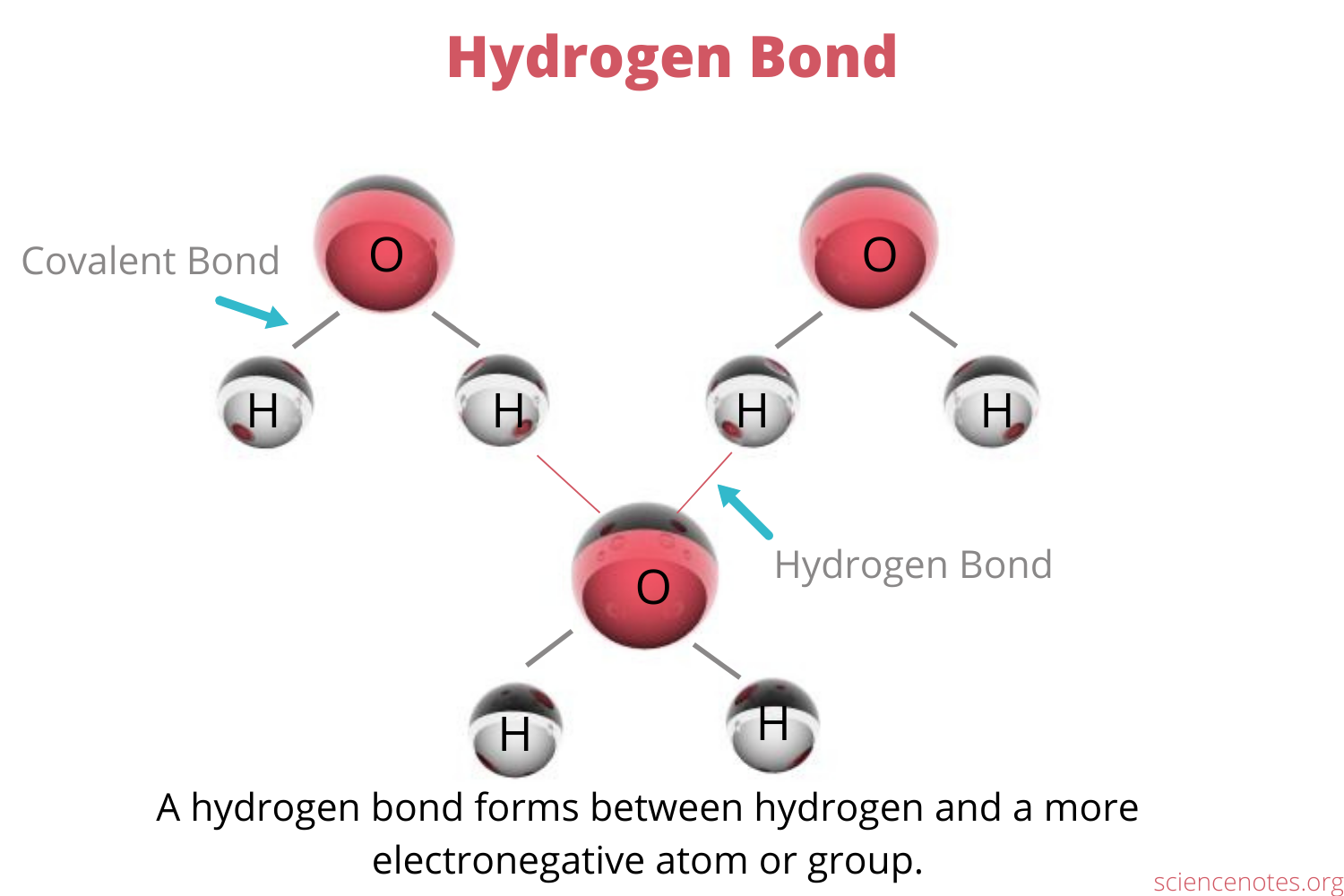
Covalent Bonds: Definition and Role in Water
Covalent bonds are strong intramolecular forces formed by the sharing of electron pairs between atoms. In water, covalent bonds hold the hydrogen and oxygen atoms together within a single molecule.
Covalent Bond: A chemical bond formed by the sharing of electrons between two atoms.
Water Molecule Structure: Each water molecule consists of two hydrogen atoms covalently bonded to one oxygen atom.
Bond Angle: The bond angle in water is approximately 104.5°, giving it a bent molecular geometry.
Example: The O-H bonds within a water molecule are covalent bonds.
Comparison of Hydrogen Bonds and Covalent Bonds
Hydrogen bonds and covalent bonds differ in strength, function, and location:
Type of Bond | Strength | Location | Function |
|---|---|---|---|
Covalent Bond | Strong | Within molecules | Holds atoms together in a molecule |
Hydrogen Bond | Weaker | Between molecules | Attracts molecules to each other |
Key Equations and Concepts
Electronegativity: The tendency of an atom to attract electrons in a bond. Oxygen is highly electronegative, which is why it forms strong hydrogen bonds with hydrogen.
Bond Polarity: Water is a polar molecule due to the difference in electronegativity between hydrogen and oxygen.
Hydrogen Bonding Equation: While hydrogen bonds are not represented by a specific equation, the partial charges can be shown as:
Applications: Hydrogen bonding is essential in biological systems (e.g., DNA base pairing), affects boiling and melting points, and influences solubility.
Key Take Aways:
Hydrogen bonds are intermolecular forces that occur when H (covalently bonded to a highly electronegative atom) is attracted to an electronegative atom in a nearby molecule.
Hydrogen bonding typically involves highly electronegative atoms: O, N, and F.
In water (H2O), hydrogen bonds form between the H of one water molecule and the O of another.
Hydrogen bonds help explain water’s unique properties, including high boiling point, surface tension, and its role as a universal solvent.
Covalent bonds are strong intramolecular forces formed by sharing electron pairs between atoms.
Within a single water molecule, the O–H bonds are covalent and hold the atoms together.
Water’s structure: two hydrogen atoms are covalently bonded to one oxygen atom.
Water has a bent geometry with a bond angle of approximately 104.5°.
Covalent vs. hydrogen bonds (big picture):
Covalent bonds: strong, within molecules, hold atoms together.
Hydrogen bonds: weaker, between molecules, attract molecules to each other.
Electronegativity is an atom’s tendency to attract electrons; oxygen is highly electronegative, supporting strong hydrogen bonding in water.
Water is polar because of the electronegativity difference between O and H (this contributes to hydrogen bonding behavior).
Partial-charge depiction of hydrogen bonding:
Hydrogen bonding matters in applications such as DNA base pairing, and it affects boiling/melting points and solubility.
