 Back
6 Ideal Gas Law, Gas Mixtures, and Vapor Pressure
Study Guide - Smart Notes
 Tailored notes based on your materials, expanded with key definitions, examples, and context.
Ideal Gas Law and Simple Gas Laws
Simple Gas Laws
The behavior of gases can be described by several simple relationships, each holding when two variables are kept constant. These relationships are foundational to understanding the ideal gas law.
Boyle's Law: For a fixed amount of gas at constant temperature, the gas volume is inversely proportional to the gas pressure.

Charles's Law: The volume of a fixed amount of gas at constant pressure is directly proportional to the Kelvin (absolute) temperature.

Avogadro's Law: At a fixed temperature and pressure, the volume of a gas is directly proportional to the amount of gas (in moles).

Combined Gas Law: These relationships can be combined into a single equation, which forms the basis for the ideal gas law.
Ideal Gas Law
The ideal gas law combines the simple gas laws into one equation that relates pressure (P), volume (V), temperature (T), and amount of gas (n):
P: Pressure (in Pascals, Pa)
V: Volume (in cubic meters, m3)
n: Amount of substance (in moles, mol)
R: Universal gas constant ()
T: Temperature (in Kelvin, K)
The ideal gas law allows calculation of any one property if the other three are known. It is an approximation that works well for many gases under typical laboratory conditions.
Specific Gas Constant and Molecular Quantities
Specific Gas Constant (): , where M is the molar mass of the gas.
Boltzmann Constant (): , where is Avogadro's number.
Alternate Form: , where N is the number of molecules.
Gas Mixtures and Dalton's Law of Partial Pressures
Gas Mixtures
When two or more gases are mixed, each gas behaves independently, as if it were alone in the container. The total pressure exerted by the mixture is the sum of the partial pressures of each component gas.
Partial Pressure: The pressure that a gas in a mixture would exert if it occupied the entire volume alone at the same temperature.
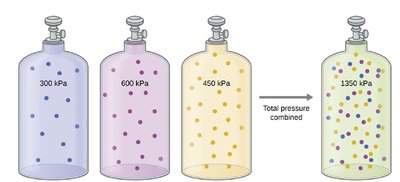
Dalton's Law of Partial Pressures:
Mole Fraction and Partial Properties
The mole fraction () of a component in a gas mixture is the ratio of the number of moles of that component to the total number of moles in the mixture. It relates to partial pressure and volume as follows:
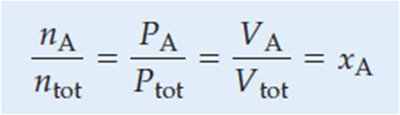
The sum of all mole fractions in a mixture is 1.
Vapor Pressure, Humidity, and Dew Point
Vapor Pressure
Vapor pressure is the pressure exerted by a vapor in equilibrium with its liquid (or solid) phase at a given temperature. It is a key concept in understanding humidity and condensation.
At a given temperature, the partial pressure of water vapor in air cannot exceed the vapor pressure of water at that temperature.
When the partial pressure of water vapor equals the vapor pressure, the air is saturated, and condensation occurs (dew forms).

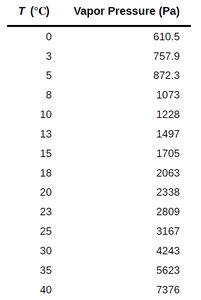
Vapor Pressure of Water at Different Temperatures
The vapor pressure of water increases with temperature. This relationship is important for understanding evaporation, boiling, and humidity.
T (°C) | Vapor Pressure (Pa) |
|---|---|
0 | 610.5 |
3 | 757.9 |
5 | 872.3 |
8 | 1073 |
10 | 1228 |
13 | 1497 |
15 | 1705 |
18 | 2063 |
20 | 2338 |
23 | 2809 |
25 | 3167 |
30 | 4243 |
35 | 5623 |
40 | 7376 |
Relative Humidity
Relative humidity (R.H.) is the ratio of the partial pressure of water vapor in the air to the vapor pressure of water at the same temperature, expressed as a percentage:

Relative humidity indicates how close the air is to being saturated with water vapor.
When relative humidity reaches 100%, condensation (dew) occurs if the temperature drops further.
Dew Point
The dew point is the temperature at which air becomes saturated with water vapor and condensation begins. It depends on the current air temperature and relative humidity.
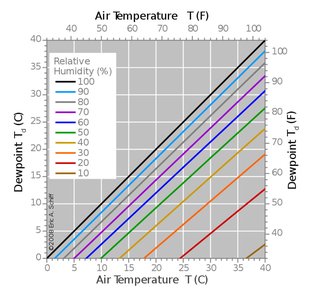
Higher relative humidity means the dew point is closer to the current air temperature.
Laboratory Application: Collecting Gases Over Water
Gas Collection by Water Displacement
In laboratory settings, gases are often collected over water. The total pressure in the collection flask is the sum of the pressure of the collected gas and the vapor pressure of water at the collection temperature.
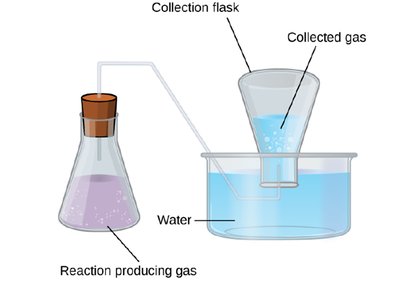
To find the pressure of the collected gas, subtract the vapor pressure of water from the total atmospheric pressure.
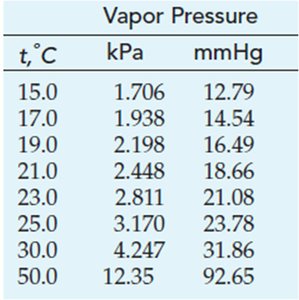
Vapor Pressure Data for Calculations
t, °C | Vapor Pressure (kPa) | Vapor Pressure (mmHg) |
|---|---|---|
15.0 | 1.706 | 12.79 |
17.0 | 1.938 | 14.54 |
19.0 | 2.198 | 16.49 |
21.0 | 2.448 | 18.66 |
23.0 | 2.811 | 21.08 |
25.0 | 3.170 | 23.78 |
30.0 | 4.247 | 31.86 |
50.0 | 12.35 | 92.65 |
Example Application
Example: If 81.2 mL of O2 is collected over water at 23°C and 100.1 kPa, the pressure of O2 is found by subtracting the vapor pressure of water at 23°C from the total pressure.
Additional info: These concepts are essential for understanding the behavior of gases in chemical reactions, atmospheric science, and laboratory measurements. Mastery of the ideal gas law and related properties is foundational for further studies in chemistry and engineering.
