 Back
BackIntegrated Rate Laws and Half-Life in Chemical Kinetics
Study Guide - Smart Notes
 Tailored notes based on your materials, expanded with key definitions, examples, and context.
Integrated Rate Laws in Chemical Kinetics
Overview of Integrated Rate Laws
Chemical kinetics studies the rates at which chemical reactions occur and the factors that affect these rates. Integrated rate laws describe how the concentration of a reactant changes with time for reactions of different orders. These laws are derived from the differential rate laws using calculus and are essential for predicting reaction progress and calculating half-lives.
First Order Reactions
First order reactions are characterized by a rate that is directly proportional to the concentration of a single reactant.
Rate Law:
Integrated Rate Law:
Linear Plot: A plot of versus time yields a straight line with slope .
Half-Life Expression:
Characteristics:
If the concentration is doubled, the rate doubles.
Half-life is independent of initial concentration.
The unit for is (e.g., s-1).
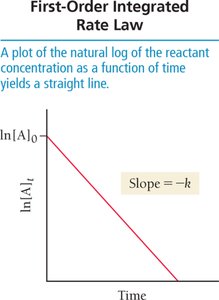
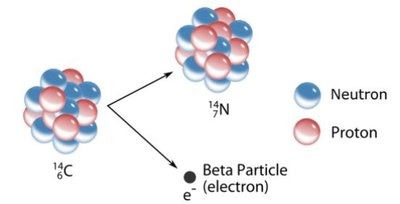
Example: Radioactive decay (e.g., radiocarbon dating) and ozone decomposition are important first order reactions. In radiocarbon dating, the decay of carbon-14 to nitrogen-14 follows first order kinetics.
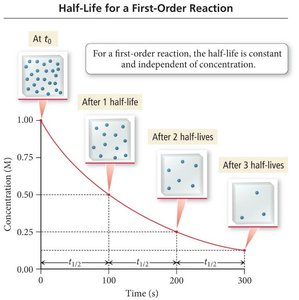
Half-Life for First Order Reaction: The half-life remains constant regardless of the initial concentration, and after each half-life, the concentration is halved.
Second Order Reactions
Second order reactions have a rate proportional to the square of the concentration of a single reactant.
Rate Law:
Integrated Rate Law:
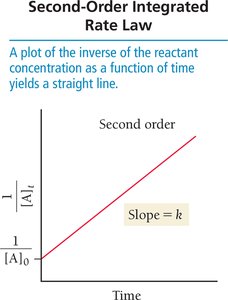
Linear Plot: A plot of versus time yields a straight line with slope .
Half-Life Expression:
Characteristics:
If the concentration is doubled, the rate quadruples.
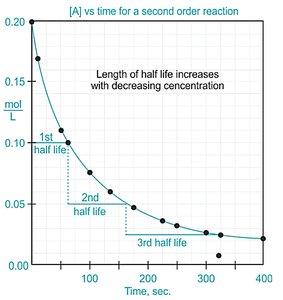
Half-life is inversely proportional to initial concentration.
The unit for is (e.g., M-1s-1).
Half-Life for Second Order Reaction: As the reaction proceeds, each subsequent half-life becomes longer than the previous one due to decreasing concentration.
Zeroth Order Reactions
Zeroth order reactions have a rate that is independent of the concentration of the reactant.
Rate Law:
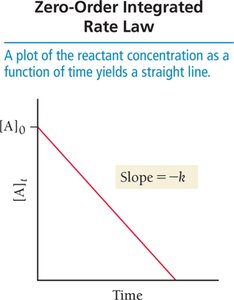
Integrated Rate Law:
Linear Plot: A plot of versus time yields a straight line with slope .
Half-Life Expression:
Characteristics:
If the concentration is doubled, the rate remains the same.
Half-life is directly proportional to initial concentration.
The unit for is (e.g., M·s-1).
Summary Table: Rate Laws, Units, Plots, and Half-Life Expressions
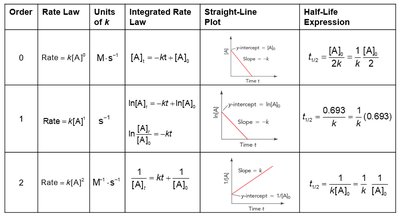
The following table summarizes the key features of zeroth, first, and second order reactions, including their rate laws, units, integrated rate laws, diagnostic plots, and half-life expressions.
Order | Rate Law | Units of k | Integrated Rate Law | Straight-Line Plot | Half-Life Expression |
|---|---|---|---|---|---|
0 | Rate = k[A]0 | M·s-1 | [A]t = -kt + [A]0 | y-intercept = [A]0, Slope = -k | |
1 | Rate = k[A] | s-1 | ln[A]t = -kt + ln[A]0 | y-intercept = ln[A]0, Slope = -k | |
2 | Rate = k[A]2 | M-1·s-1 | y-intercept = , Slope = k |
Applications and Diagnostic Tests
Plots of concentration versus time (or transformed concentration) are used to diagnose reaction order.
Half-life calculations are essential for understanding reaction progress and for applications such as radiocarbon dating and pharmaceutical kinetics.
Additional info: Integrated rate laws are fundamental for predicting how much reactant remains after a given time, determining reaction order, and calculating rate constants from experimental data.
