Back
BackChapter 15 Lecture 2
Study Guide - Smart Notes
 Tailored notes based on your materials, expanded with key definitions, examples, and context.
Integrated Rate Laws in Chemical Kinetics
Overview of Integrated Rate Laws
Chemical kinetics studies the rates of chemical reactions and the factors that affect them. Integrated rate laws describe how the concentration of a reactant changes over time for reactions of different orders. These laws are derived from differential rate laws using calculus and are essential for predicting reaction behavior and calculating important quantities such as half-life.
Integrated rate laws relate reactant concentration to time for zeroth, first, and second order reactions.
They allow calculation of how long it takes for a reactant to be consumed or its concentration at a specific time.
Each reaction order has a unique mathematical form and diagnostic plot.
First Order Reactions
Integrated Rate Law and Half-Life
For a first order reaction, the rate depends linearly on the concentration of a single reactant. The integrated rate law is:
General reaction: A → products
Differential rate law:
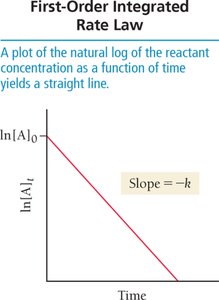
Integrated rate law:
Linear plot: A plot of vs. time yields a straight line with slope .
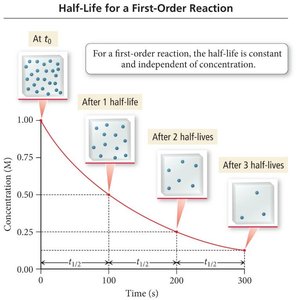
The half-life () is the time required for the concentration of the reactant to decrease to half its initial value. For first order reactions:
The half-life is independent of the initial concentration.
Each successive half-life is the same duration.
Characteristics and Applications
If concentration is doubled, the rate doubles.
Units for are (e.g., s-1).
Diagnostic test: Only first order reactions yield a straight line in vs. time plots.
Applications:
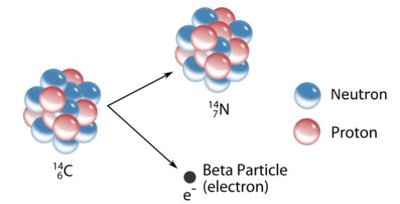
Radioactive decay (e.g., radiocarbon dating): , years
Decomposition of ozone in the atmosphere
Second Order Reactions
Integrated Rate Law and Half-Life
For a second order reaction, the rate depends on the square of the concentration of a single reactant. The integrated rate law is:
General reaction: A → products
Differential rate law:
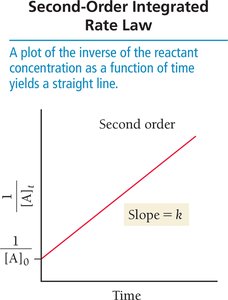
Integrated rate law:
Linear plot: A plot of vs. time yields a straight line with slope .
The half-life () for second order reactions is:
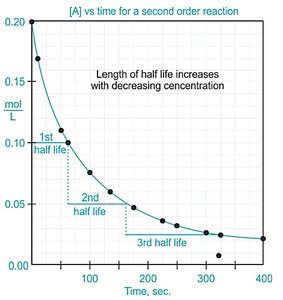
The half-life is inversely proportional to the initial concentration.
Each successive half-life is longer than the previous one.
Characteristics and Applications
If concentration is doubled, the rate quadruples.
Units for are (e.g., M-1s-1).
Diagnostic test: Only second order reactions yield a straight line in vs. time plots.
Zeroth Order Reactions
Integrated Rate Law and Half-Life
For a zeroth order reaction, the rate is independent of the concentration of the reactant. The integrated rate law is:
General reaction: A → products
Differential rate law:
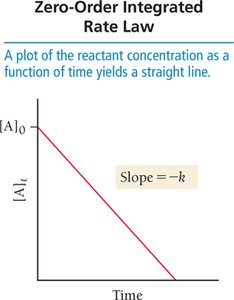
Integrated rate law:
Linear plot: A plot of vs. time yields a straight line with slope .
The half-life () for zeroth order reactions is:
The half-life is directly proportional to the initial concentration.
Each successive half-life is shorter than the previous one.
Characteristics and Applications
If concentration is doubled, the rate remains the same.
Units for are (e.g., M·s-1).
Diagnostic test: Only zeroth order reactions yield a straight line in vs. time plots.
Summary Table: Rate Laws and Half-Life Expressions
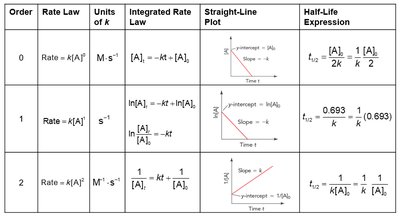
The following table summarizes the key features of zeroth, first, and second order reactions, including their rate laws, units, integrated rate laws, diagnostic plots, and half-life expressions.
Order | Rate Law | Units of k | Integrated Rate Law | Straight-Line Plot | Half-Life Expression |
|---|---|---|---|---|---|
0 | Rate = k[A]^0 | M·s-1 | [A]_t = -kt + [A]_0 | [A]_t vs. time (slope = -k) | |
1 | Rate = k[A] | s-1 | ln([A]_t) = -kt + ln([A]_0) | ln([A]_t) vs. time (slope = -k) | |
2 | Rate = k[A]^2 | M-1·s-1 | 1/[A]_t = kt + 1/[A]_0 | 1/[A]_t vs. time (slope = k) |