Back
BackIntermolecular Forces and Properties of Substances & Mixtures
Study Guide - Smart Notes
 Tailored notes based on your materials, expanded with key definitions, examples, and context.
Unit 3: Properties of Substances and Mixtures
Overview
This unit explores the relationship between the chemical structures of molecules and the relative strength of their intermolecular forces. It covers the classification of substances, the nature of solids, liquids, and gases, and the types of intermolecular forces that govern their properties.
3.1 Intermolecular & Interparticle Forces
Types of Intermolecular Forces
Intermolecular forces (IMFs) are the forces of attraction or repulsion between neighboring particles (atoms, molecules, or ions). They are weaker than intramolecular (bonding) forces but crucial in determining the physical properties of substances.
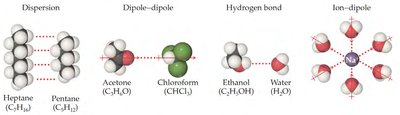
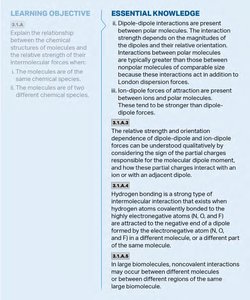
London Dispersion Forces: Temporary dipoles created by the movement of electrons in atoms or molecules. Present in all substances, but most significant in nonpolar molecules and larger atoms/molecules.
Dipole-Dipole Forces: Attractions between permanent dipoles in polar molecules. The strength depends on the magnitude and orientation of the dipoles.
Hydrogen Bonding: A special type of dipole-dipole interaction occurring when hydrogen is bonded to highly electronegative atoms (N, O, F). Responsible for unique properties in water and biological molecules.
Ion-Dipole Forces: Attractions between ions and polar molecules, important in the dissolution of ionic compounds in water.
Learning Objectives & Essential Knowledge
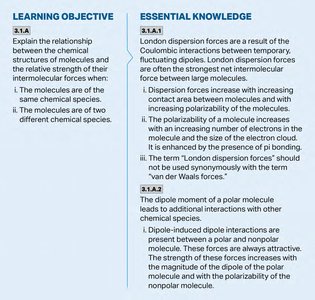
London dispersion forces increase with molecular size and polarizability.
Dipole-dipole interactions are stronger than dispersion forces in equivalent molecules.
Hydrogen bonding is the strongest intermolecular force among neutral molecules.
Ion-dipole forces are stronger than dipole-dipole forces.
3.2 Properties of Solids
Classification of Solids
Solids are classified based on the nature of their bonding and structure:
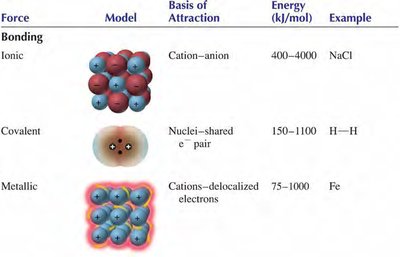
Ionic Solids: Composed of cations and anions held together by strong electrostatic forces. High melting points, brittle, and conduct electricity when molten or dissolved.
Covalent Solids: Atoms connected by covalent bonds in a network. Very high melting points, hard, and usually non-conductive.
Metallic Solids: Positive metal ions surrounded by a sea of delocalized electrons. Malleable, ductile, and good conductors.
3.3 Solids, Liquids, and Gases
States of Matter and Intermolecular Forces
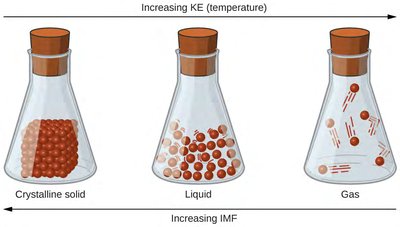
The physical state of a substance depends on the balance between kinetic energy (temperature) and intermolecular forces:
Solids: Particles are closely packed in a regular arrangement; strong IMFs.
Liquids: Particles are close but can move past each other; moderate IMFs.
Gases: Particles are far apart and move freely; weak IMFs.
3.1A Coulomb's Law and Charge Interactions
Coulomb's Law
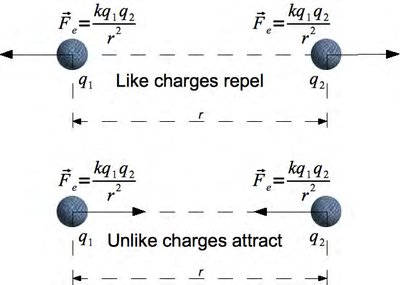
Coulomb's Law describes the force between two charged particles:
Equation:
Like charges repel, unlike charges attract.
Full charges (ions) and partial charges (dipoles) both follow this law, but partial charges are weaker.
3.1B London Dispersion Forces
Origin and Strength
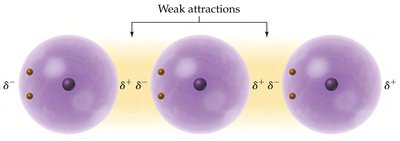
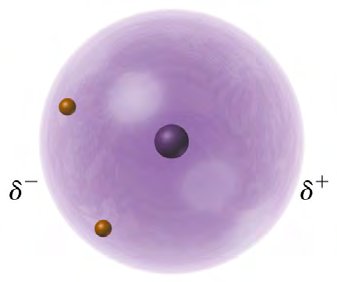
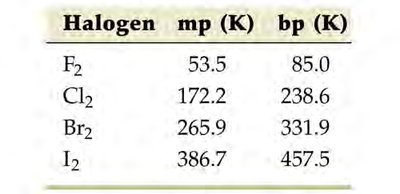
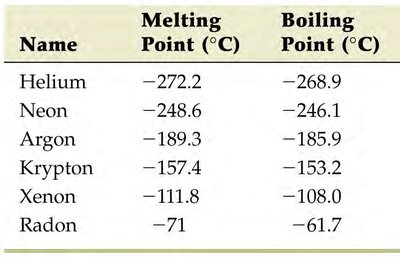
London dispersion forces arise from temporary fluctuations in electron distribution, creating instantaneous dipoles. These forces are present in all molecules but are most significant in large, nonpolar molecules.
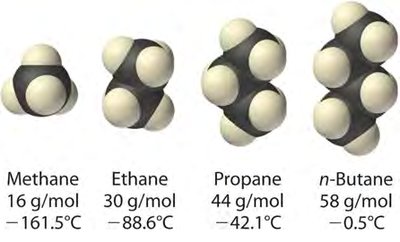
Strength increases with molecular size and number of electrons.
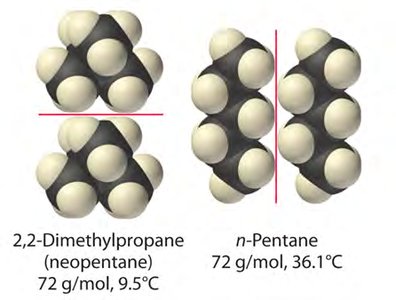
Branching reduces surface area and weakens dispersion forces.
3.1C Dipole-Dipole Forces
Permanent Dipoles
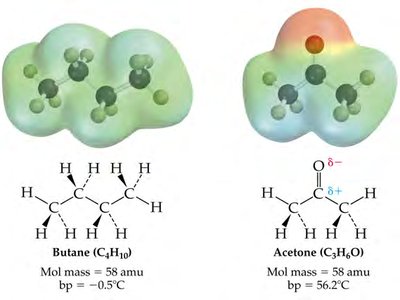
Dipole-dipole forces occur between polar molecules with permanent dipoles. The strength depends on the magnitude of the dipole and the molecular orientation.
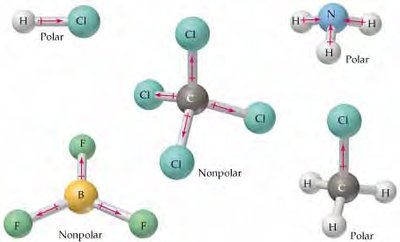
Polar molecules have uneven charge distribution due to differences in electronegativity.
Shape determines whether a molecule is polar or nonpolar.
3.1D Hydrogen Bonding
Special Case of Dipole-Dipole
Hydrogen bonding is a strong dipole-dipole interaction occurring when hydrogen is bonded to N, O, or F. It is responsible for high boiling points and unique properties in water, alcohols, and biological molecules.
Hydrogen bonds are directional and require specific geometry.
They play a crucial role in the structure of proteins and DNA.
Summary Table: Types of Intermolecular Forces
Type | Basis of Attraction | Relative Strength | Example |
|---|---|---|---|
London Dispersion | Temporary dipoles | Weakest | Heptane, Pentane |
Dipole-Dipole | Permanent dipoles | Moderate | Acetone, Chloroform |
Hydrogen Bond | H bonded to N, O, F | Strong | Ethanol, Water |
Ion-Dipole | Ion and polar molecule | Strongest | Na+ in water |
Science Practices
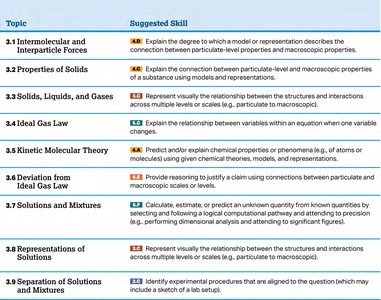
Students are expected to explain, predict, calculate, and visually represent the relationships between structure, properties, and interactions of substances.

References and Licensing
Content is licensed under CC BY-NC-SA 4.0. Credit must be given to the creator, noncommercial use only, and adaptations must be shared under the same terms.