Back
BackIntermolecular Forces and Their Effects on Physical Properties
Study Guide - Smart Notes
 Tailored notes based on your materials, expanded with key definitions, examples, and context.
Intermolecular Forces
Introduction to Intermolecular Forces
Intermolecular forces are the attractive forces that exist between molecules, influencing the physical properties of substances such as boiling point, melting point, viscosity, and surface tension. These forces are generally weaker than intramolecular (covalent or ionic) bonds but are crucial in determining the behavior of liquids and solids.
Hydrogen Bonding
Definition and Nature of Hydrogen Bonds
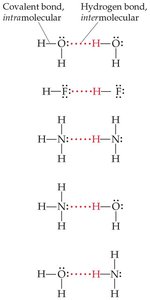
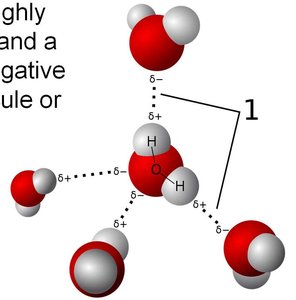
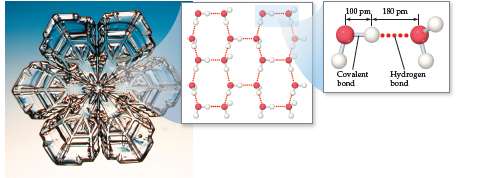
Hydrogen bonding is a special type of dipole–dipole interaction that occurs when hydrogen is covalently bonded to highly electronegative atoms such as nitrogen (N), oxygen (O), or fluorine (F). The hydrogen atom, having no inner electrons, interacts strongly with a lone pair of electrons on a nearby electronegative atom in another molecule or chemical group.
Hydrogen bond: Attraction between a hydrogen atom attached to N, O, or F and a lone pair on another N, O, or F atom.
Hydrogen bonds are much stronger than typical dipole–dipole interactions but weaker than covalent bonds.
What Forms Hydrogen Bonds?
Hydrogen bonding arises due to the high electronegativity of N, O, and F, which creates a significant partial positive charge on the hydrogen atom. This nearly bare proton is attracted to lone pairs on electronegative atoms in neighboring molecules.
Hydrogen bonds are found in molecules such as H2O, NH3, and HF.
Hydrogen bonding is not present in molecules like CH4 or H2S, where hydrogen is not bonded to N, O, or F.

Examples and Applications of Hydrogen Bonding
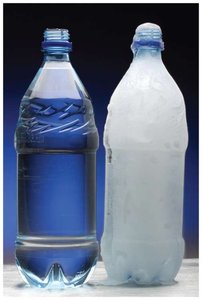
Water (H2O): Extensive hydrogen bonding leads to high boiling and melting points, and unique properties such as ice being less dense than liquid water.
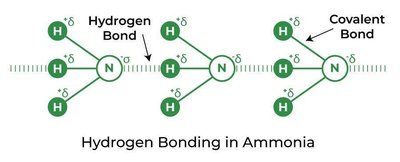
Ammonia (NH3): Hydrogen bonds between NH3 molecules increase its boiling point compared to similar-sized molecules without hydrogen bonding.
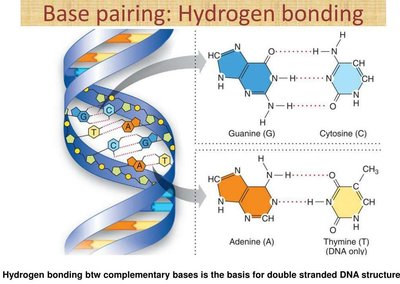
DNA: Hydrogen bonds between base pairs (A-T and G-C) stabilize the double helix structure, ensuring accurate genetic information transfer.
Identifying Substances Capable of Hydrogen Bonding
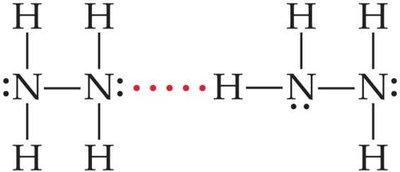
To determine if a substance can form hydrogen bonds, check for the presence of H bonded directly to N, O, or F, and the availability of lone pairs on these atoms in neighboring molecules.
Example: Hydrazine (H2NNH2) can form hydrogen bonds due to N–H bonds and lone pairs on nitrogen.
Ion–Dipole Interactions
Definition and Importance
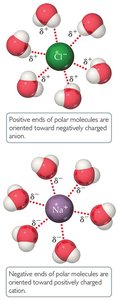
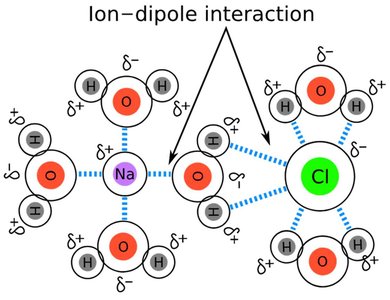
Ion–dipole interactions occur between an ion and a polar molecule. These are especially important in solutions of ionic compounds in polar solvents, such as salts dissolving in water. The strength of these interactions helps overcome the lattice energy of ionic solids, allowing them to dissolve.
Essential for the dissolution of ionic compounds in water.
Strength depends on the charge and size of the ion and the magnitude of the dipole moment.
Types and Strengths of Intermolecular Forces
Classification of Intermolecular Forces
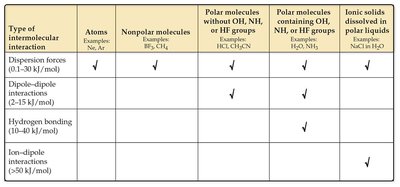
There are several types of intermolecular forces, each with different strengths and characteristics:
Type of Intermolecular Interaction | Atoms | Nonpolar Molecules | Polar Molecules (no OH, NH, or HF) | Polar Molecules (with OH, NH, or HF) | Ionic Solids in Polar Liquids |
|---|---|---|---|---|---|
Dispersion Forces (0.1–30 kJ/mol) | ✓ | ✓ | ✓ | ✓ | |
Dipole–Dipole Interactions (2–15 kJ/mol) | ✓ | ✓ | |||
Hydrogen Bonding (10–40 kJ/mol) | ✓ | ||||
Ion–Dipole Interactions (>50 kJ/mol) | ✓ |
Generalizations about Relative Strengths
Dispersion forces are present in all substances.
The strongest intermolecular force present determines the substance's physical properties.
For molecules with similar molar masses and shapes, dispersion forces are comparable.
For molecules with very different molar masses, dispersion forces dominate if no hydrogen bonding is present.
Physical Properties Affected by Intermolecular Forces
Boiling and Melting Points
The boiling and melting points of substances are directly related to the strength of intermolecular forces. Stronger forces result in higher boiling and melting points.
Ionic compounds have the highest boiling points, followed by substances with hydrogen bonding, then dipole–dipole, and finally dispersion forces.
Example order: H2 < Ne < CO < HF < BaCl2
Viscosity
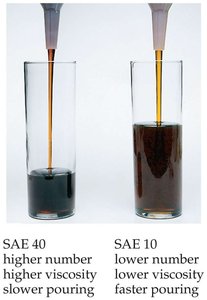
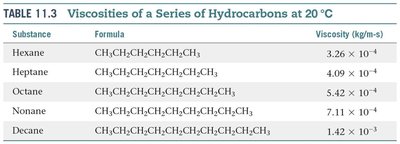
Viscosity is the resistance of a liquid to flow. It increases with stronger intermolecular forces and decreases with higher temperature. Longer molecular chains also increase viscosity due to greater surface area and entanglement.
Measured by timing flow through a tube or the rate at which objects fall through the liquid.
Viscosity decreases as temperature increases because higher kinetic energy overcomes attractive forces.
Substance | Formula | Viscosity (kg/m·s) |
|---|---|---|
Hexane | CH3(CH2)4CH3 | 3.26 × 10⁻⁴ |
Heptane | CH3(CH2)5CH3 | 4.09 × 10⁻⁴ |
Octane | CH3(CH2)6CH3 | 5.42 × 10⁻⁴ |
Nonane | CH3(CH2)7CH3 | 7.11 × 10⁻⁴ |
Decane | CH3(CH2)8CH3 | 1.42 × 10⁻³ |
Surface Tension
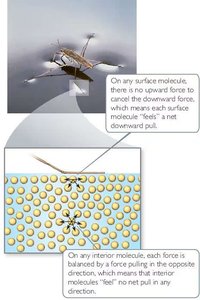
Surface tension is the energy required to increase the surface area of a liquid. It results from extra inward forces on surface molecules, causing liquids like water to bead up on nonpolar surfaces.
Cohesion and Adhesion
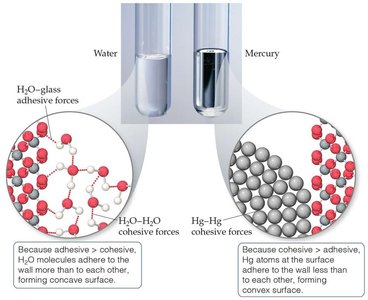
Cohesive forces bind similar molecules together, while adhesive forces bind molecules to different substances. These forces are important in phenomena such as capillary action.
Capillary Action
Capillary action is the rise of liquids in narrow tubes due to adhesive and cohesive forces. Water rises in glass due to stronger adhesive forces, while mercury forms a convex meniscus due to stronger cohesive forces.
Phase Changes
Types of Phase Changes
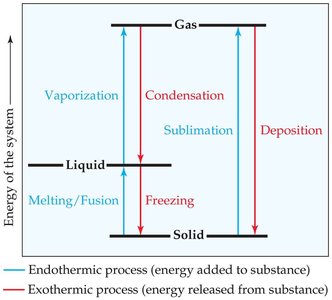
A phase change is the conversion from one state of matter to another, involving energy transfer. Common phase changes include melting, freezing, vaporization, condensation, sublimation, and deposition.
Energy Changes in Phase Transitions
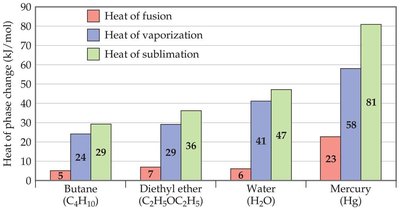
Heat of fusion (ΔHfus): Energy required to melt a solid at its melting point.
Heat of vaporization (ΔHvap): Energy required to vaporize a liquid at its boiling point.
Heat of sublimation (ΔHsub): Energy required to convert a solid directly to a gas.
Heating Curves
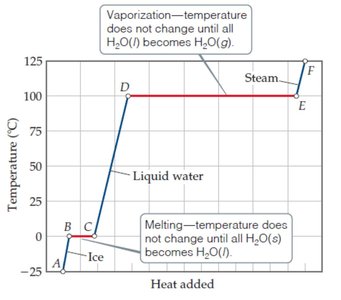
A heating curve shows the temperature of a substance as heat is added. Plateaus represent phase changes where temperature remains constant as energy is used to change state.
Critical Temperature and Pressure; Supercritical Fluids
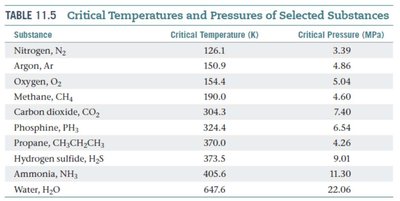
Substances have characteristic critical temperatures and critical pressures. Above these values, the liquid and gas phases become indistinguishable, forming a supercritical fluid with unique solvent properties.
Substance | Critical Temperature (K) | Critical Pressure (MPa) |
|---|---|---|
Nitrogen, N2 | 126.1 | 3.39 |
Argon, Ar | 150.9 | 4.86 |
Oxygen, O2 | 154.4 | 5.04 |
Methane, CH4 | 190.0 | 4.60 |
Carbon dioxide, CO2 | 304.3 | 7.40 |
Phosphine, PH3 | 324.4 | 6.54 |
Propane, C3H8 | 370.0 | 4.26 |
Hydrogen sulfide, H2S | 373.5 | 9.01 |
Ammonia, NH3 | 405.6 | 11.30 |
Water, H2O | 647.6 | 22.06 |
Vapour Pressure
Definition and Temperature Dependence
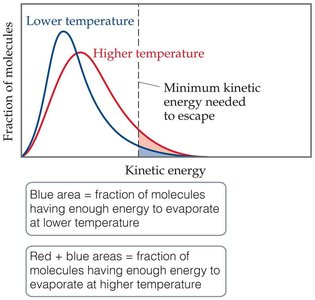
Vapour pressure is the pressure exerted by a vapor in equilibrium with its liquid at a given temperature. As temperature increases, more molecules have enough kinetic energy to escape the liquid phase, increasing vapor pressure.
Dynamic Equilibrium
When the rate of evaporation equals the rate of condensation, the system is at dynamic equilibrium and the vapor pressure remains constant.
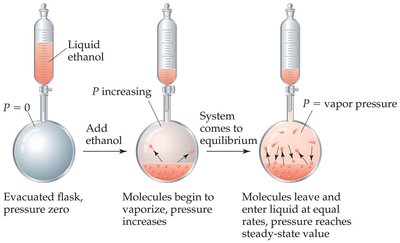
Boiling Point and Vapor Pressure
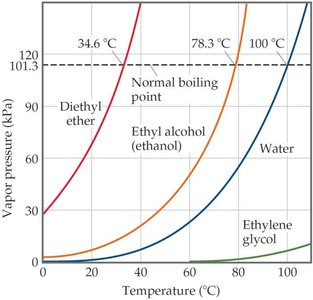
The boiling point of a liquid is the temperature at which its vapor pressure equals the external (atmospheric) pressure. The normal boiling point is defined at 760 torr (101.3 kPa). Substances with weaker intermolecular forces have higher vapor pressures and lower boiling points.
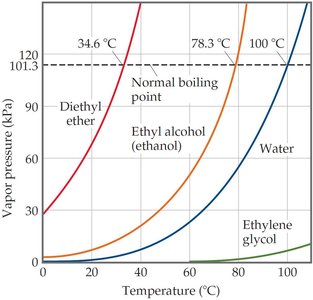
Estimating Boiling Point from Vapor Pressure Curves
To estimate the boiling point at a given pressure, locate the pressure on the vapor pressure curve and find the corresponding temperature. For example, diethyl ether boils at about 27°C under 0.80 atm (81 kPa) pressure.