 Back
BackIntermolecular Forces and Their Role in Solids, Liquids, Gases, and Solutions
Study Guide - Smart Notes
 Tailored notes based on your materials, expanded with key definitions, examples, and context.
Structure Determines Properties
Phases of Matter and Molecular Arrangement
The physical properties of solids, liquids, and gases are determined by the arrangement and movement of their constituent particles, as well as the strength of intermolecular forces (IMFs) between them. The magnitude of IMFs and available thermal energy dictate whether a substance exists as a solid, liquid, or gas.
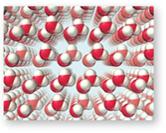
Solids: Particles are closely packed and fixed in position, resulting in incompressibility and strong IMFs.
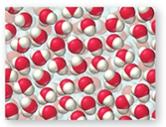
Liquids: Particles are closely packed but can move around, making liquids incompressible and allowing them to flow. IMFs are stronger than in gases but weaker than in solids.
Gases: Particles have complete freedom of motion, are far apart, and IMFs are very weak, making gases compressible.
Example: Water molecules in different phases:
Intermolecular Forces (IMFs)
Definition and Importance
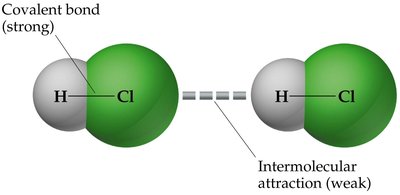
Intermolecular forces are the attractions and repulsions between atoms and molecules, distinct from chemical bonds. IMFs are much weaker than covalent or ionic bonds but are crucial for determining melting points, boiling points, solubility, and the structure of biological molecules.
IMFs are NOT chemical bonds: Chemical bonds (e.g., covalent bonds) are much stronger than IMFs.

Types of Intermolecular Forces
The type and strength of IMFs depend on three properties:
Charge (ion or not)
Polarity (molecular shape, dipoles)
Molar mass (size of molecule)
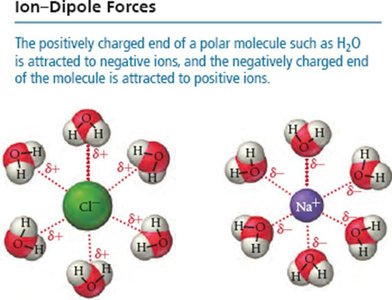
Ion-Dipole Forces
Occur between ions and polar molecules. The strength of ion-dipole attraction is a major factor in the solubility of ionic compounds in water.
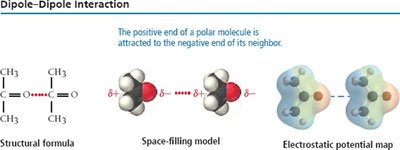
Dipole-Dipole Forces
Present in polar molecules with permanent dipoles. The positive end of one molecule is attracted to the negative end of another, raising boiling and melting points relative to nonpolar molecules of similar size.
Hydrogen Bonding
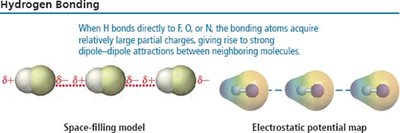
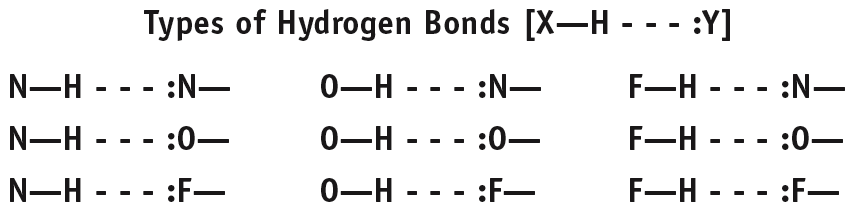
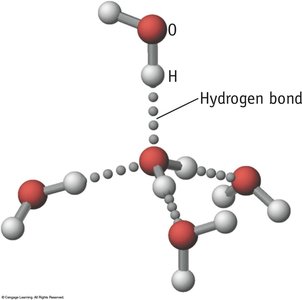
A particularly strong type of dipole-dipole interaction, occurring when hydrogen is bonded to N, O, or F. Hydrogen bonding is responsible for unique properties of water, such as high surface tension, capillary action, and the flotation of ice.
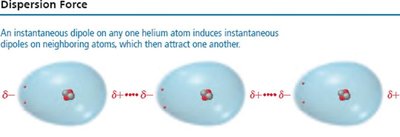
London Dispersion Forces
Present in all molecules and atoms, caused by temporary fluctuations in electron distribution. Dispersion forces are the only IMFs in nonpolar molecules and increase with molar mass and polarizability.
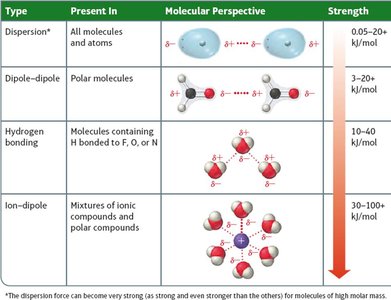
Summary Table of Intermolecular Forces
Type | Present In | Molecular Perspective | Strength |
|---|---|---|---|
Dispersion | All molecules and atoms | Temporary dipoles | 0.05–20 kJ/mol |
Dipole–Dipole | Polar molecules | Permanent dipoles | 3–20 kJ/mol |
Hydrogen Bonding | Molecules with H bonded to F, O, or N | Strong dipole–dipole | 10–40 kJ/mol |
Ion–Dipole | Mixtures of ions and polar compounds | Ion and dipole interaction | 30–100+ kJ/mol |
IMFs and Physical Properties
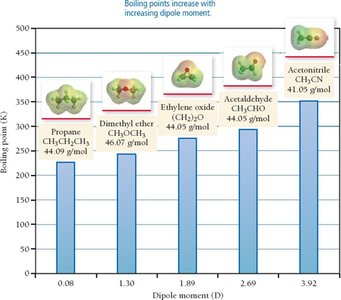
Boiling and Melting Points
The strength of IMFs directly affects boiling and melting points. Stronger IMFs result in higher boiling and melting points. For example, hydrogen bonding in water leads to a higher boiling point compared to similar molecules without hydrogen bonding.
Solubility and Miscibility
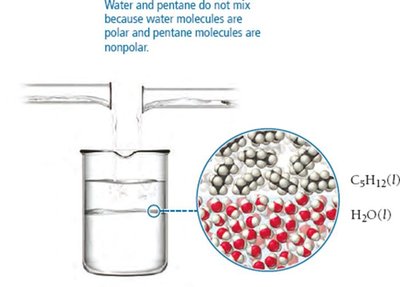
Solubility depends on the compatibility of IMFs between solute and solvent. "Like dissolves like": polar substances dissolve in polar solvents, nonpolar substances in nonpolar solvents. Miscible liquids mix without separating, while immiscible liquids do not mix.
IMFs in Action: Surface Tension, Viscosity, and Capillary Action
Surface Tension
Surface tension is the tendency of liquids to minimize their surface area, resulting from cohesive IMFs. Stronger IMFs lead to higher surface tension.
Viscosity
Viscosity is the resistance of a liquid to flow. It increases with stronger IMFs, higher molar mass, and decreases with increasing temperature.
Capillary Action
Capillary action is the movement of a liquid up a thin tube, caused by adhesive forces (attraction to the tube) and cohesive forces (attraction between liquid molecules).
IMFs and Solution Formation
Induced Dipole Forces
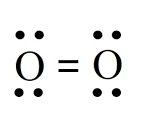
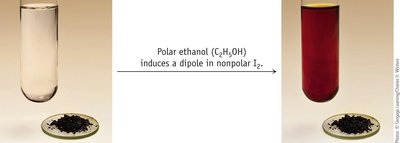
When a polar molecule interacts with a nonpolar molecule, it can induce a temporary dipole in the nonpolar molecule, allowing them to mix. This explains how oxygen (O2) dissolves in water and how iodine (I2) dissolves in ethanol.
Comparing Intermolecular Forces
Examples and Applications
Boiling Point Comparison: NH3 (hydrogen bonding) has a higher boiling point than PH3 (no hydrogen bonding).
Hydrogen Bonding: Molecules with N–H, O–H, or F–H bonds can form hydrogen bonds, leading to higher boiling and melting points.
Summary
Intermolecular forces are fundamental to understanding the properties and behaviors of solids, liquids, gases, and solutions. Their strength and type determine phase, solubility, boiling and melting points, and many other physical properties. Recognizing and comparing IMFs is essential for predicting chemical behavior in various contexts.
