 Back
BackIntermolecular Forces, Liquids, and Solids: Structure and Properties
Study Guide - Smart Notes
 Tailored notes based on your materials, expanded with key definitions, examples, and context.
States of Matter
Properties of Gases, Liquids, and Solids
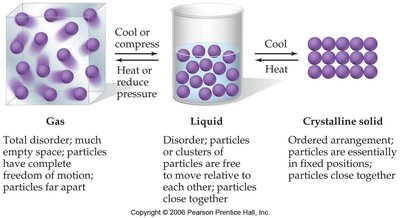
The three primary states of matter—gas, liquid, and solid—differ in the arrangement and movement of their particles. These differences are a result of the balance between kinetic energy and intermolecular forces.
Gas: Particles are far apart, move freely, and have little interaction. Gases have no fixed shape or volume.
Liquid: Particles are close together but can move past one another. Liquids have a definite volume but take the shape of their container.
Crystalline Solid: Particles are closely packed in a fixed, ordered arrangement. Solids have a definite shape and volume.
Intermolecular Forces (van der Waals Forces)
Types of Intermolecular Forces
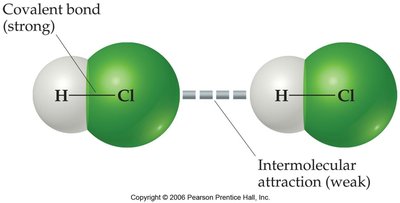
Intermolecular forces are the attractions between molecules, which are generally much weaker than the intramolecular forces (covalent or ionic bonds) holding atoms together within a molecule. However, they are strong enough to influence physical properties such as melting point, boiling point, and viscosity.
Dipole-Dipole Interactions: Occur between polar molecules due to the attraction of partial positive and negative charges.
London Dispersion Forces: Present in all molecules, these arise from temporary fluctuations in electron distribution, creating instantaneous dipoles.
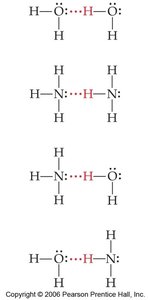
Hydrogen Bonding: A special, strong type of dipole-dipole interaction involving hydrogen bonded to N, O, or F.
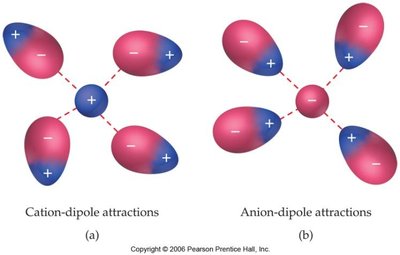
Ion-Dipole Interactions: Occur between ions and polar molecules, important in solutions of ionic compounds.
Dipole-Dipole Interactions
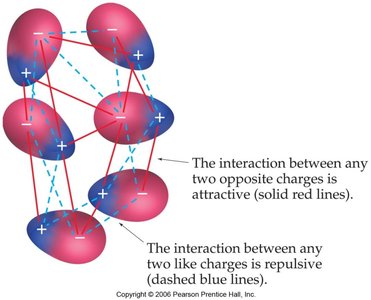
These forces are significant only when molecules are close together. The interaction between opposite charges is attractive, while like charges repel each other.
Effect of Dipole Moment on Boiling Point
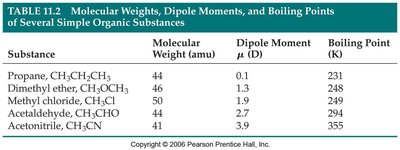
The strength of dipole-dipole interactions increases with the dipole moment, often resulting in higher boiling points for substances with larger dipole moments, assuming similar molecular weights.
Substance | Molecular Weight (amu) | Dipole Moment (D) | Boiling Point (K) |
|---|---|---|---|
Propane, CH3CH2CH3 | 44 | 0.1 | 231 |
Dimethyl ether, CH3OCH3 | 46 | 1.3 | 248 |
Methyl chloride, CH3Cl | 50 | 1.9 | 249 |
Acetaldehyde, CH3CHO | 44 | 2.7 | 294 |
Acetonitrile, CH3CN | 41 | 3.9 | 355 |
London Dispersion Forces
London dispersion forces are weak attractions that arise from temporary, instantaneous dipoles in atoms or molecules. These forces are present in all substances, but are the only intermolecular force in nonpolar molecules and noble gases. The ease with which the electron cloud can be distorted to form a dipole is called polarizability.
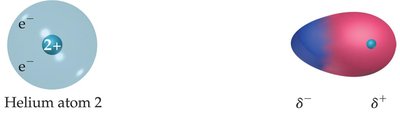
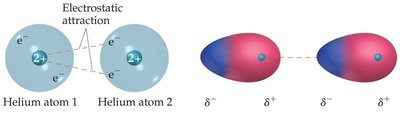
Factors Affecting London Dispersion Forces
Molecular Size: Larger atoms or molecules have more electrons and are more polarizable, leading to stronger dispersion forces.
Molecular Shape: Long, linear molecules have greater surface area for contact, increasing dispersion forces compared to compact, spherical molecules.
Boiling Points of Halogens and Noble Gases
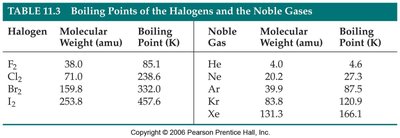
Boiling points increase with molecular weight due to stronger dispersion forces.
Halogen | Molecular Weight (amu) | Boiling Point (K) | Noble Gas | Molecular Weight (amu) | Boiling Point (K) |
|---|---|---|---|---|---|
F2 | 38.0 | 85.1 | He | 4.0 | 4.6 |
Cl2 | 71.0 | 238.6 | Ne | 20.2 | 27.3 |
Br2 | 159.8 | 332.0 | Ar | 39.9 | 87.5 |
I2 | 253.8 | 457.6 | Kr | 83.8 | 120.9 |
Xe | 131.3 | 166.1 |
Trends in Boiling Points
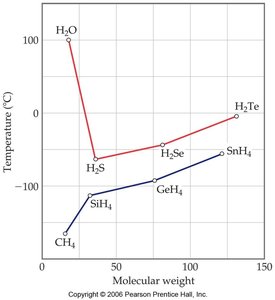
For nonpolar molecules, boiling points increase smoothly with molecular weight. For polar molecules, hydrogen bonding can cause significant deviations from this trend, as seen with water (H2O).
Hydrogen Bonding
Hydrogen bonds are especially strong dipole-dipole attractions that occur when hydrogen is bonded to highly electronegative atoms (N, O, or F). These bonds are responsible for many unique properties of water and other compounds.
Physical Properties Affected by Intermolecular Forces
Intermolecular forces influence many physical properties, including melting point, boiling point, viscosity, and surface tension.
Ion-Dipole Interactions
Ion-dipole forces are important in solutions where ionic compounds dissolve in polar solvents. The strength of these interactions helps explain the solubility of salts in water.
Viscosity and Surface Tension
Viscosity
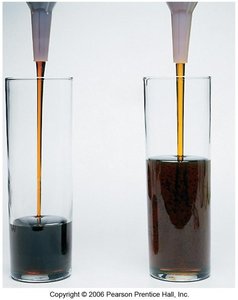
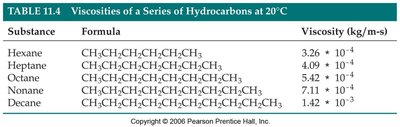
Viscosity is the resistance of a liquid to flow. It depends on the strength of intermolecular forces and the molecular structure of the liquid. Stronger intermolecular forces and longer molecular chains generally increase viscosity.
Substance | Formula | Viscosity (kg/m·s) |
|---|---|---|
Hexane | CH3(CH2)4CH3 | 3.26 × 10⁻⁴ |
Heptane | CH3(CH2)5CH3 | 4.09 × 10⁻⁴ |
Octane | CH3(CH2)6CH3 | 5.42 × 10⁻⁴ |
Nonane | CH3(CH2)7CH3 | 7.11 × 10⁻⁴ |
Decane | CH3(CH2)8CH3 | 1.42 × 10⁻³ |
Surface Tension
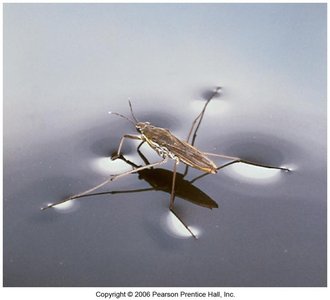
Surface tension is the energy required to increase the surface area of a liquid. It results from the net inward force experienced by molecules at the surface, due to stronger attractions to molecules within the liquid than to those in the air.
Types of Solids
Classification of Solids
Solids can be classified based on the nature of the forces holding their particles together:
Ionic Solids: Composed of ions held together by electrostatic forces (e.g., NaCl).
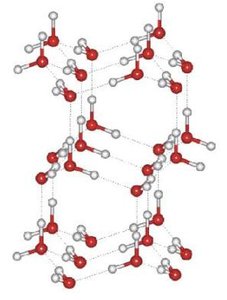
Molecular Solids: Composed of molecules held together by intermolecular forces (e.g., ice, CO2).
Metallic Solids: Composed of metal atoms with delocalized electrons (e.g., copper, iron).
Covalent Network Solids: Atoms connected by covalent bonds in a continuous network (e.g., diamond, quartz).
Crystalline vs. Amorphous Solids
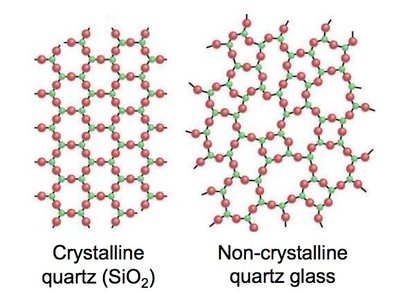
Crystalline solids have a well-ordered, repeating arrangement of particles, while amorphous solids lack long-range order.
Allotropes
Allotropes are different structural forms of the same element in the same physical state. For example, carbon exists as diamond, graphite, fullerenes, and nanotubes.
Phase Changes and Phase Diagrams
Phase Changes
Phase changes are transformations between solid, liquid, and gas states. Common phase changes include melting, freezing, vaporization, condensation, sublimation, and deposition.
Energy Changes Associated with Changes of State
Energy is absorbed or released during phase changes. For example, melting and vaporization require energy input, while freezing and condensation release energy.
Vapor Pressure
Vapor pressure is the pressure exerted by a vapor in equilibrium with its liquid at a given temperature. As more molecules escape the liquid, the vapor pressure increases until dynamic equilibrium is reached.
Phase Diagrams
A phase diagram shows the state of a substance at various temperatures and pressures. Key features include the triple point (where all three phases coexist) and the critical point (beyond which the liquid and gas phases are indistinguishable).
Water: Has a high critical temperature and pressure due to strong hydrogen bonding. The solid–liquid line has a negative slope, meaning ice melts under pressure.
Carbon Dioxide: Sublimes at normal pressures; cannot exist as a liquid below 5.11 atm.
*Additional info: This guide covers the essential concepts of intermolecular forces, their effects on physical properties, and the structure and classification of solids, as well as phase changes and diagrams, as relevant to a general chemistry curriculum.*
