 Back
BackIntermolecular Forces, Liquids, and Solids: Structure, Properties, and Phase Changes
Study Guide - Smart Notes
 Tailored notes based on your materials, expanded with key definitions, examples, and context.
Intermolecular Forces, Liquids, and Solids
11.1 A Molecular Comparison of the States of Matter
The three primary states of matter—gas, liquid, and solid—differ fundamentally in the arrangement and energy of their particles. These differences are governed by the strength of intermolecular forces and the kinetic energy of the particles.
Gas: Particles are far apart, move freely, and have minimal intermolecular attractions.
Liquid: Particles are closer together, allowing for intermolecular attractions but still able to move past one another.
Solid: Particles are closely packed in an ordered arrangement, with strong intermolecular forces holding them in fixed positions.
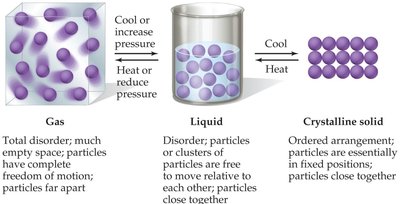
The state of a substance at a given temperature and pressure depends on the competition between the kinetic energy of the particles and the strength of the intermolecular attractions.
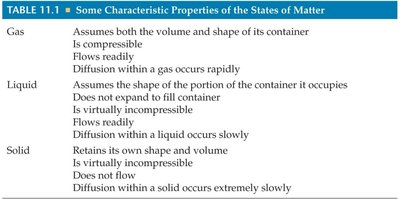
Characteristic Properties of the States of Matter
Gas | Liquid | Solid | |
|---|---|---|---|
Shape & Volume | Assumes both the volume and shape of its container | Assumes the shape of the portion of the container it occupies | Retains its own shape and volume |
Compressibility | Is compressible | Is virtually incompressible | Is virtually incompressible |
Flow | Flows readily | Flows readily | Does not flow |
Diffusion | Occurs rapidly | Occurs slowly | Occurs extremely slowly |
11.2 Intermolecular Forces
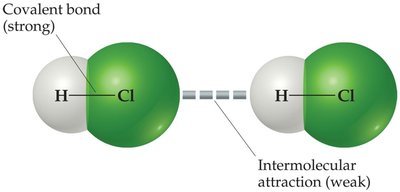
Intermolecular forces are the attractive forces that exist between molecules. They are much weaker than covalent or ionic bonds but are strong enough to influence physical properties such as boiling and melting points, vapor pressures, and viscosities.
Van der Waals forces: Collective term for intermolecular forces, including dipole-dipole interactions, hydrogen bonding, and London dispersion forces.
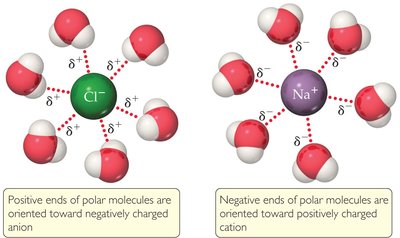
Ion-ion and ion-dipole forces: Occur when ions interact with other ions or polar molecules, important in solutions.
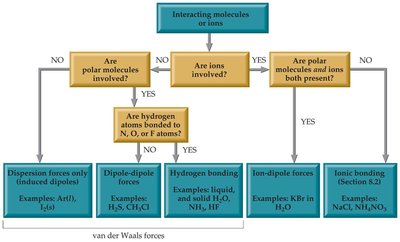
Types of Intermolecular Forces
Ion-Ion Forces: Attraction between fully charged ions (e.g., Na+ and Cl- in NaCl).
Ion-Dipole Forces: Attraction between an ion and a polar molecule (e.g., NaCl dissolving in water).
Dipole-Dipole Interactions: Attraction between polar molecules, where the positive end of one molecule is attracted to the negative end of another (e.g., HCl, H2O, NH3).
London Dispersion Forces: Present in all molecules, but the only intermolecular force in nonpolar molecules. Strength increases with molecular weight and polarizability.
Hydrogen Bonding: A special, strong type of dipole-dipole interaction occurring when hydrogen is bonded to N, O, or F.
Comparing Intermolecular Forces
For molecules of similar size, dipole-dipole interactions dominate if polarity is significant.
For larger molecules, dispersion forces become more important.
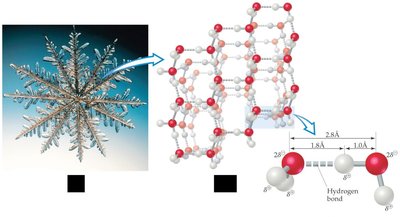
Hydrogen Bonding and Its Effects
Hydrogen bonding leads to unusually high boiling points and unique properties, especially in water and biological molecules.
11.3 Some Properties of Liquids
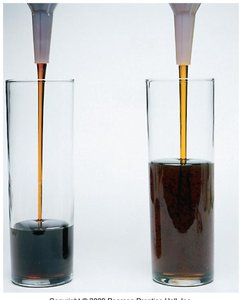
The strength of intermolecular forces in liquids affects properties such as viscosity, surface tension, and capillary action.
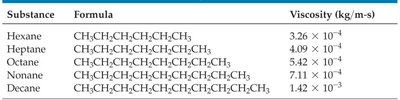
Viscosity: Resistance to flow; increases with stronger intermolecular forces and decreases with higher temperature.
Surface Tension: Energy required to increase the surface area of a liquid; results from net inward force on surface molecules.
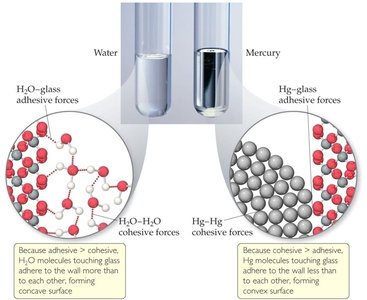
Capillary Action: The ability of a liquid to flow against gravity in a narrow tube, due to adhesive and cohesive forces.
Substance | Formula | Viscosity (kg/m·s) |
|---|---|---|
Hexane | CH3(CH2)4CH3 | 3.26 × 10⁻⁴ |
Heptane | CH3(CH2)5CH3 | 4.09 × 10⁻⁴ |
Octane | CH3(CH2)6CH3 | 5.42 × 10⁻⁴ |
Nonane | CH3(CH2)7CH3 | 7.11 × 10⁻⁴ |
Decane | CH3(CH2)8CH3 | 1.42 × 10⁻³ |
Surface Tension and Capillary Action
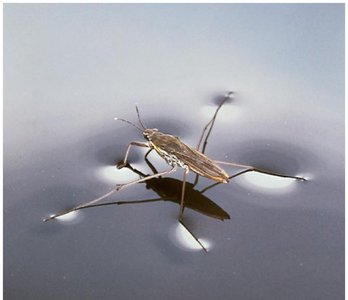
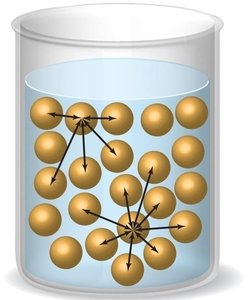
Cohesive forces bind similar molecules, while adhesive forces bind molecules to surfaces. The meniscus shape in a tube depends on the balance between these forces.
11.4 Phase Changes
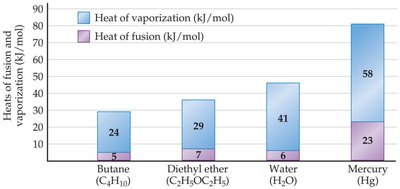
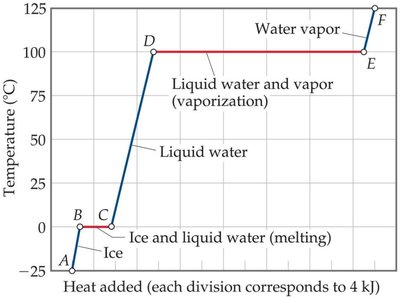
Phase changes are transformations between solid, liquid, and gas states. These changes involve energy transfer, either as heat of fusion (melting/freezing) or heat of vaporization (boiling/condensation).
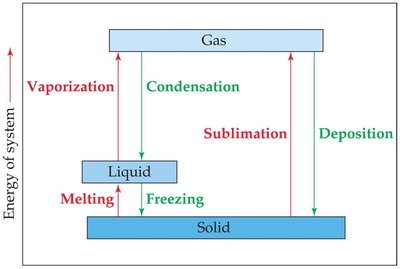
Heat of Fusion (\(\Delta H_{fus}\)): Energy required to melt a solid at its melting point.
Heat of Vaporization (\(\Delta H_{vap}\)): Energy required to vaporize a liquid at its boiling point.
Heating Curves
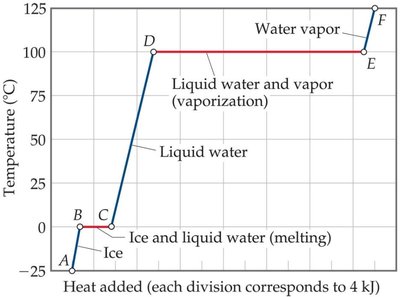
Heating curves graphically represent temperature changes as heat is added, showing plateaus during phase changes where temperature remains constant.
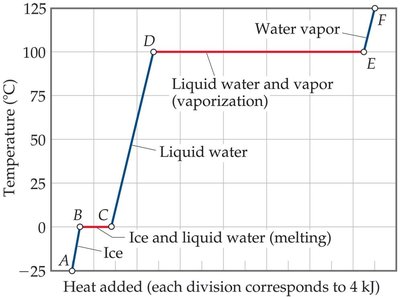
Sample Calculation: Heating Curve
To calculate the total heat required for a multi-step phase change, sum the energy for each segment (heating, melting, vaporizing, etc.):
(for temperature changes within a phase) (for melting/freezing) (for vaporization/condensation) 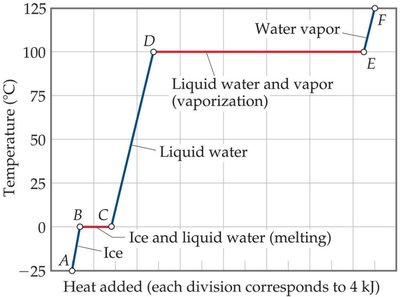
11.5 Vapor Pressure
Vapor pressure is the pressure exerted by a vapor in equilibrium with its liquid at a given temperature. Liquids with high vapor pressures evaporate easily and are called volatile.
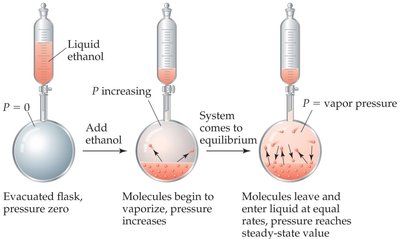
Boiling Point: The temperature at which vapor pressure equals external pressure. The normal boiling point is at 1 atm.
11.6 Phase Diagrams
A phase diagram is a plot of pressure versus temperature that shows the conditions under which the different phases of a substance exist. Key features include the triple point (where all three phases coexist) and the critical point (the highest temperature and pressure at which a liquid can exist).
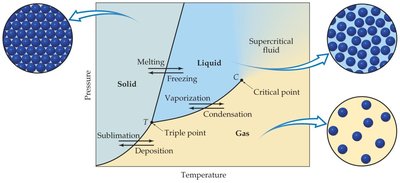
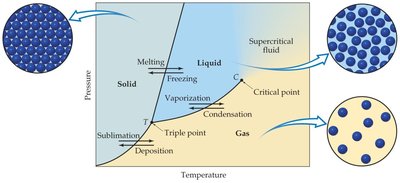
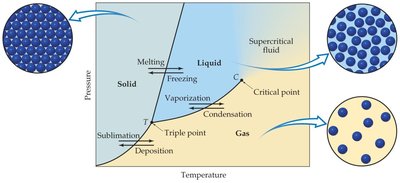
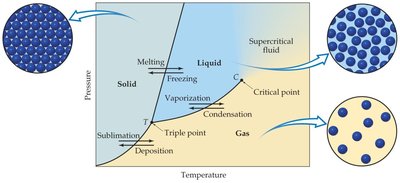
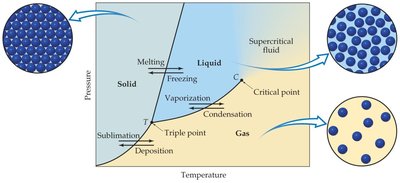
Water and carbon dioxide have unique phase diagrams due to their intermolecular forces. For example, CO2 sublimes at atmospheric pressure, while water has a high critical temperature and pressure due to strong hydrogen bonding.
