 Back
Intermolecular Forces: Types, Effects, and Applications
Study Guide - Smart Notes
 Tailored notes based on your materials, expanded with key definitions, examples, and context.
Liquids, Solids & Intermolecular Forces
Introduction to Intermolecular Forces (IMFs)
Intermolecular forces (IMFs) are the attractive forces that exist between molecules and/or ions. These forces are responsible for many physical properties of substances, such as boiling points, melting points, and solubility. Understanding IMFs is crucial for predicting and explaining the behavior of chemical compounds in different states of matter.
Electrostatic Attraction: IMFs arise from the attraction between opposite charges, including partial charges (δ+ and δ−) in molecules.
Types of IMFs: The main types include ionic bonds, ion-dipole attractions, hydrogen bonding, dipole-dipole attractions, and London dispersion forces.
Physical Properties: Stronger IMFs generally lead to higher boiling and melting points, and greater solubility when solute and solvent IMFs are similar ("like dissolves like").
Types of Intermolecular Forces
Ionic Bonds: Attraction between positive and negative ions.
Ion-Dipole Forces: Attraction between an ion and the partial charge on a polar molecule.
Dipole-Dipole Forces: Attraction between the positive end (δ+) of one polar molecule and the negative end (δ−) of another.
Hydrogen Bonding: A special, strong type of dipole-dipole interaction involving hydrogen bonded to N, O, or F.
London Dispersion Forces: Weak attractions due to temporary, induced dipoles in all molecules, especially significant in non-polar molecules.
Hydrogen Bonding
Definition and Requirements
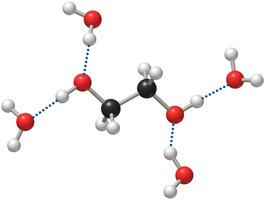
Hydrogen bonding is a strong type of dipole-dipole interaction that occurs when a hydrogen atom is covalently bonded to a highly electronegative atom (N, O, or F) and is attracted to a lone pair on another N, O, or F atom in a different molecule.
Electronegativity: N, O, and F are very electronegative and small, creating a strong partial positive charge on H.
Lone Pairs: The hydrogen bond acceptor must have a lone pair of electrons (e.g., O usually has 2, N has 1, F has 3).
Examples of Hydrogen Bonding
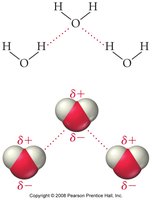
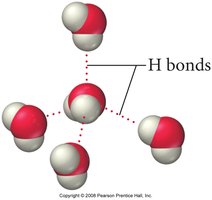
Water (H2O): Each water molecule can form up to four hydrogen bonds, leading to high boiling and melting points.
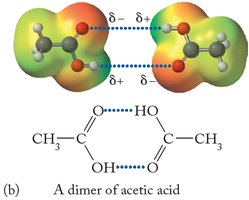
Acetic Acid Dimer: Acetic acid molecules can form dimers through hydrogen bonding, stabilizing the structure.
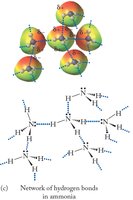
Ammonia (NH3): Ammonia molecules form a network of hydrogen bonds due to the presence of N-H bonds and lone pairs on nitrogen.
Donors and Acceptors in Hydrogen Bonding
Hydrogen bonds involve a donor (the molecule with the hydrogen atom bonded to N, O, or F) and an acceptor (the molecule with a lone pair on N, O, or F).
Donor: Molecule containing the H atom bonded to N, O, or F.
Acceptor: Molecule with a lone pair on N, O, or F.
Dual Role: Molecules like water and alcohols can both donate and accept hydrogen bonds.
Application Example: Acetic Acid in Vinegar
White vinegar is a solution of acetic acid (CH3COOH) in water. Both acetic acid and water can participate in hydrogen bonding, affecting solubility and physical properties.
London Dispersion Forces (Van der Waals Forces)
Definition and Mechanism
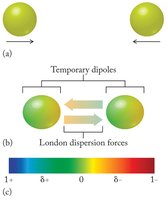
London dispersion forces are weak intermolecular attractions that arise from temporary, induced dipoles in atoms or molecules. These forces are present in all molecules but are the only IMFs in non-polar substances.
Temporary Dipoles: Electron movement creates momentary charge imbalances, inducing dipoles in neighboring molecules.
Induced Dipoles: Can be caused by nearby ions or permanent dipoles as well.
Van der Waals Forces: A general term for non-covalent interactions not involving ions; often used interchangeably with dispersion forces.
Factors Affecting Dispersion Forces
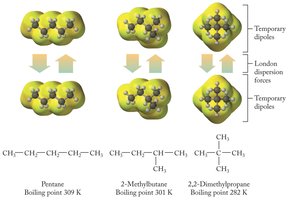
Polarizability: Larger atoms/molecules with more electrons are more easily polarized, leading to stronger dispersion forces.
Molecular Shape: More linear molecules have greater surface area for interactions, increasing dispersion forces.
Boiling Points: Substances with stronger dispersion forces have higher boiling points.
Categorizing Intermolecular Forces
Systematic Approach
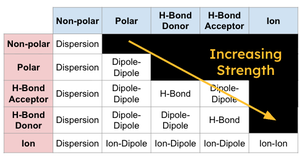
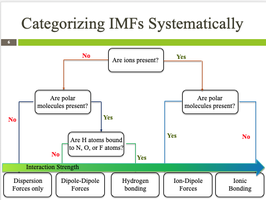
To determine the dominant IMF in a compound, use a flow chart or classification table based on the presence of ions, molecular polarity, and hydrogen bonding capability.
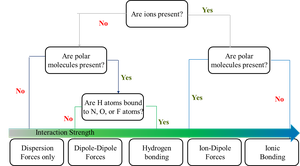
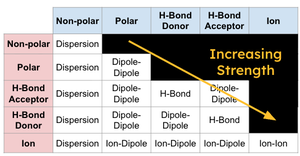
Using the Flow Chart: Example
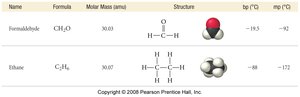
Consider formaldehyde (CH2O) and ethane (C2H6):
Formaldehyde: Polar molecule, exhibits dipole-dipole forces (and dispersion).
Ethane: Non-polar molecule, only dispersion forces present.
Boiling Points: Formaldehyde has a higher boiling point due to stronger IMFs.
Important Notes on IMF Classification
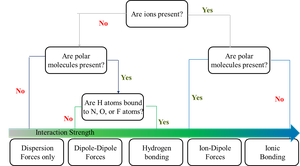
The strongest IMF present is used for classification, but weaker IMFs may also contribute to properties.
For very large molecules, dispersion forces can surpass dipole-dipole or hydrogen bonding in strength.
Practice and Application
Ranking Boiling Points
To rank compounds by boiling point, consider the type and strength of IMFs present, as well as molecular size and shape.
Summary Table: Types of Intermolecular Forces
Type of Force | Occurs Between | Relative Strength | Example |
|---|---|---|---|
Ionic Bonding | Ion and ion | Strongest | NaCl (sodium chloride) |
Ion-Dipole | Ion and polar molecule | Very strong | Na+ in water |
Hydrogen Bonding | H bonded to N, O, or F and another N, O, or F | Strong | H2O, NH3 |
Dipole-Dipole | Two polar molecules | Moderate | CH2O |
London Dispersion | All molecules (especially non-polar) | Weakest (but can be strong in large molecules) | C6H14 (hexane) |
Conclusion
Understanding intermolecular forces is essential for predicting the physical properties of substances and their behavior in different environments. By systematically identifying the types of IMFs present, students can explain trends in boiling points, melting points, and solubility, and apply this knowledge to real-world chemical systems.
