 Back
BackIntroduction to Matter, Measurement, and Scientific Method: General Chemistry I Study Notes
Study Guide - Smart Notes
 Tailored notes based on your materials, expanded with key definitions, examples, and context.
Introduction: Matter and Measurement
Learning Objectives
Distinguish between elements, compounds, and mixtures.
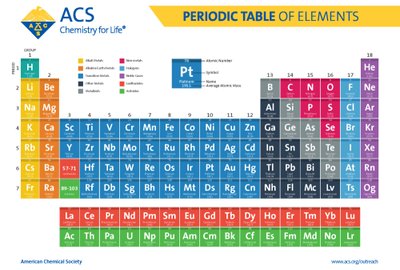
Identify symbols of common elements and metric prefixes.
Demonstrate the use of significant figures, scientific notation, and SI units in calculations.
Define quantities and employ dimensional analysis in calculations.
Scientific Method
Overview of the Scientific Method
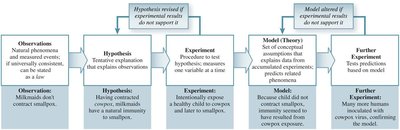
The scientific method is a systematic approach used by scientists to investigate natural phenomena. It involves making observations, forming hypotheses, conducting experiments, and developing theories or laws based on evidence.
Observation: Gathering data through experiments and noting patterns.
Hypothesis: A tentative explanation for observations.
Experiment: Testing the hypothesis by manipulating variables.
Scientific Law: A concise statement or equation summarizing observations.
Theory: A well-supported explanation of phenomena.
Matter: Definition and Classification
What is Matter?
Matter is anything that has mass and occupies space. Examples include solids, liquids, and gases. Non-matter includes concepts like time, sound, and energy.
Atoms: The fundamental building blocks of matter.
Molecules: Combinations of atoms held together in specific shapes.

Classification of Matter
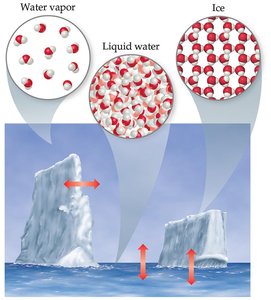
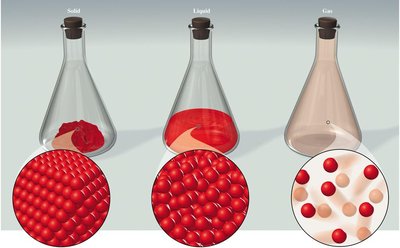
Matter can be classified by its physical state (solid, liquid, gas) and by its composition (element, compound, mixture).
Solid: Definite shape and volume; particles packed closely.
Liquid: Definite volume, takes shape of container; particles can slide past each other.
Gas: No fixed shape or volume; particles far apart and move rapidly.
Pure Substances vs. Mixtures
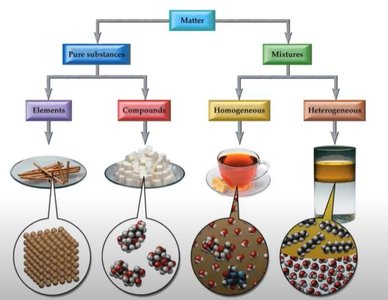
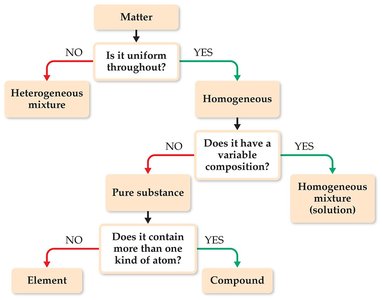
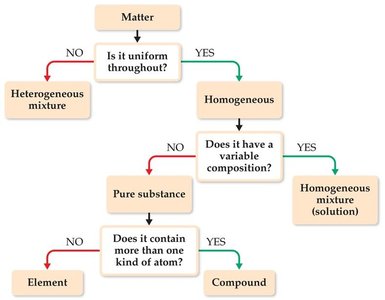
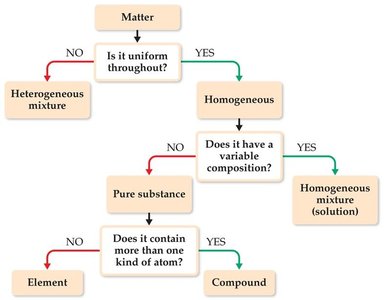
A pure substance has a fixed composition and distinct properties. It can be an element or a compound. A mixture contains two or more substances combined physically.
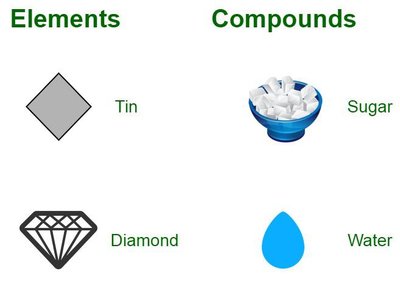
Element: Cannot be decomposed into simpler substances; made of one kind of atom.
Compound: Consists of two or more elements chemically combined in fixed ratios.
Mixture: Combination of pure substances; can be homogeneous (uniform) or heterogeneous (non-uniform).

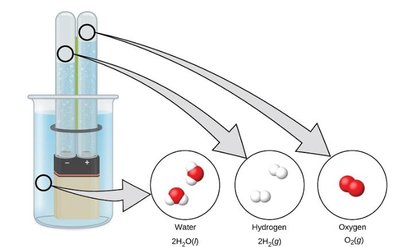
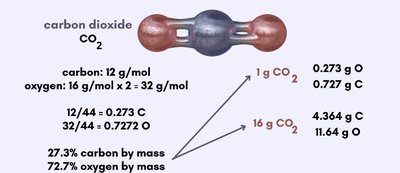
Law of Constant Composition (Definite Proportions)
The law of constant composition states that a chemical compound always contains its component elements in a fixed ratio by mass, regardless of the source or method of formation.
Example: Water (H2O) is always 11% hydrogen and 89% oxygen by mass.
Classification of Matter by Composition
Use flowcharts to determine if a sample is an element, compound, homogeneous mixture, or heterogeneous mixture.
Properties and Changes of Matter
Physical and Chemical Properties
Properties are characteristics that help identify and distinguish substances.
Physical properties: Measured without changing the substance (e.g., color, density, melting point).
Chemical properties: Describe how substances react or change to form new substances (e.g., combustion, oxidation).
Intensive vs. Extensive Properties
Intensive properties: Do not depend on the amount of substance (e.g., density, temperature).
Extensive properties: Depend on the quantity of substance (e.g., mass, volume).
Physical and Chemical Changes
Physical changes: Do not alter the composition (e.g., changes of state, temperature).
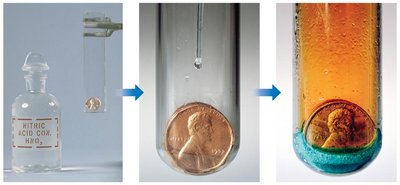
Chemical changes: Result in new substances (e.g., combustion, decomposition).
Separation of Mixtures
Separation Techniques
Mixtures can be separated based on differences in physical properties using various techniques:
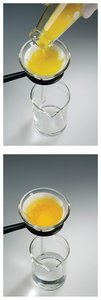
Filtration: Separates solids from liquids.
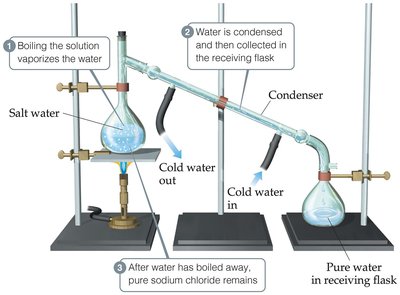
Distillation: Uses differences in boiling points to separate components.
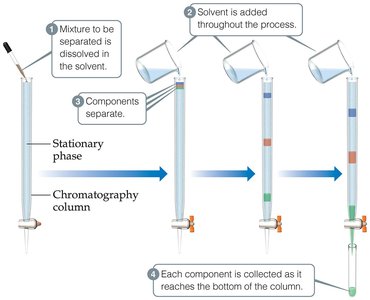
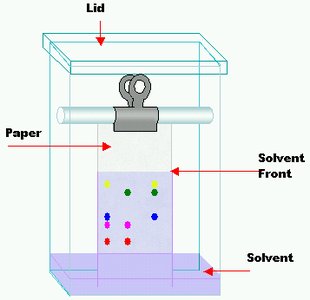
Chromatography: Separates substances based on their ability to adhere to a solid surface.
Units of Measurement
SI Units and Metric System
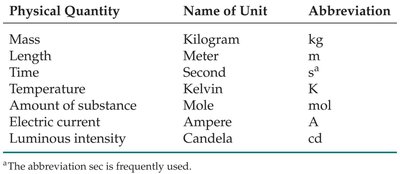
The Système International d’Unités (SI) is the standard system of measurement in science. Each physical quantity has a base unit.
Physical Quantity | Name of Unit | Abbreviation |
|---|---|---|
Mass | Kilogram | kg |
Length | Meter | m |
Time | Second | s |
Temperature | Kelvin | K |
Amount of substance | Mole | mol |
Electric current | Ampere | A |
Luminous intensity | Candela | cd |
Metric Prefixes
Prefixes are used to convert base units to appropriate sizes for measurement (e.g., kilo-, milli-, centi-).
Mass, Length, and Volume
Mass: Measured in kilograms (SI) or grams (metric).
Length: Measured in meters.
Volume: Derived unit; commonly measured in liters (L) or cubic centimeters (cm3).
Temperature Scales
Celsius (°C): Based on water properties; 0°C is freezing, 100°C is boiling.
Kelvin (K): SI unit; absolute zero is 0 K. Conversion:
Fahrenheit (°F): Not used in scientific measurements. Conversion:
Density
Density is a physical property defined as mass per unit volume.
Formula:
Common units: g/mL or g/cm3
Significant Figures and Measurement
Exact vs. Inexact Numbers
Exact numbers: Counted or defined values (e.g., 1 kg = 1000 g).
Inexact numbers: Obtained from measurements; subject to uncertainty.
Accuracy vs. Precision
Accuracy: How close a measurement is to the true value.
Precision: How close repeated measurements are to each other.
Rules for Significant Figures
All nonzero digits are significant.
Zeros between nonzero digits are significant.
Leading zeros are not significant.
Trailing zeros are significant if a decimal point is present.
Exact numbers have infinite significant figures.
Rounding Off, Addition/Subtraction, Multiplication/Division
Round off to the correct number of significant figures after calculations.
For addition/subtraction: answer rounded to the least number of decimal places.
For multiplication/division: answer rounded to the least number of significant figures.
Practice Problems and Exercises
Sample Questions
Classify substances as elements, compounds, or mixtures.
Convert units and calculate density, volume, and temperature.
Identify the number of significant figures in measurements.
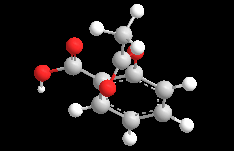
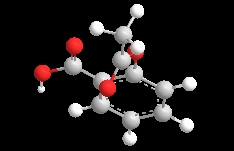
Example: Aspirin is composed of 60.0% carbon, 4.5% hydrogen, and 35.5% oxygen by mass, regardless of its source. It is a compound.
Example: A small amount of salt dissolved in water is a homogeneous mixture.
Summary Table: Classification of Matter
Type | Description | Example |
|---|---|---|
Element | One kind of atom | Oxygen (O2), Tin |
Compound | Two or more elements chemically combined | Water (H2O), Sugar |
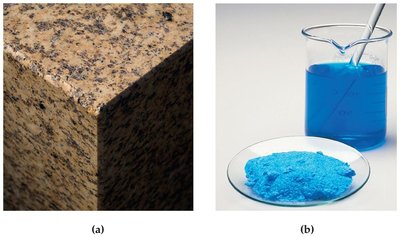
Homogeneous Mixture | Uniform composition | Salt water, air |
Heterogeneous Mixture | Non-uniform composition | Sand in water, granite |
Additional info: These notes provide foundational concepts for General Chemistry I, including the scientific method, classification of matter, properties and changes, separation techniques, units of measurement, and significant figures. Practice problems reinforce understanding and application of these concepts.
