 Back
Introduction to Organic Chemistry: Structure, Naming, and Molecular Shapes
Study Guide - Smart Notes
 Tailored notes based on your materials, expanded with key definitions, examples, and context.
Organic Chemistry Fundamentals
What Is Organic Chemistry?
Organic chemistry is the branch of chemistry focused on the study of carbon-containing compounds, especially those with carbon bonded to hydrogen, oxygen, nitrogen, sulfur, or halogens. Organic compounds are essential for life and are found in biological molecules such as carbohydrates, lipids, proteins, DNA, RNA, and many medications.
Key Point: Organic chemistry is crucial for healthcare professionals to understand how nutrients, drugs, and biomolecules function in the body.
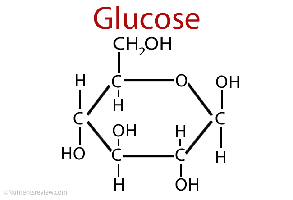
Example: Glucose is a carbohydrate that provides energy to cells.
Why Is Carbon So Important?
Carbon is the central element in organic chemistry due to its ability to form four covalent bonds, allowing for a vast diversity of molecular structures. Carbon atoms can bond with other carbons to form chains, branches, and rings, and can also form single, double, or triple bonds.
Key Point: Carbon's versatility enables the formation of complex molecules necessary for life.
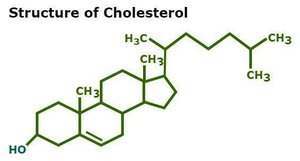
Example: Cholesterol is a complex organic molecule important in cell membranes.
Bonding Patterns and Valence Electrons
Important Nonmetals in Organic Compounds
Atoms in organic molecules form covalent bonds by sharing electrons. The typical bonding patterns are determined by the number of valence electrons, with most atoms aiming to achieve eight valence electrons (octet rule). Hydrogen is an exception, needing only two electrons.
Key Point: Carbon forms four bonds, nitrogen three, oxygen two, and hydrogen one.
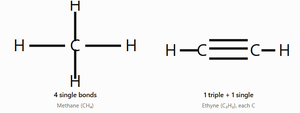
Example: The structural formula for methane (CH4) shows carbon with four single bonds.
Representing Organic Molecules
Structural, Condensed, and Skeletal Formulas
Organic molecules can be represented in several ways to simplify their depiction:
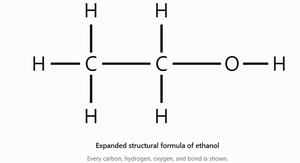
Structural formulas: Show all atoms and bonds.
Condensed formulas: Group atoms for brevity.
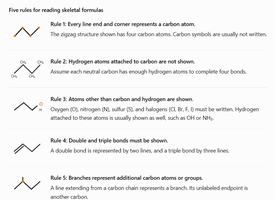
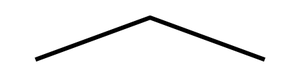
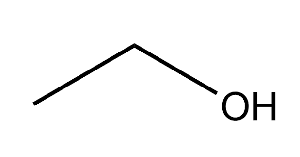
Skeletal formulas: Use lines to represent carbon frameworks, omitting most carbon and hydrogen symbols.
Key Point: Skeletal formulas are especially useful for large molecules.

Naming Organic Compounds
Prefixes and Suffixes
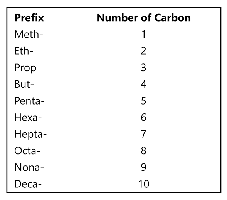
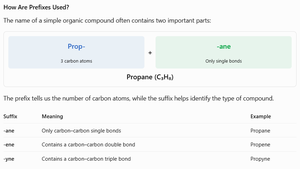
The names of organic compounds are based on prefixes that indicate the number of carbon atoms in the parent chain and suffixes that describe the type of bonding between carbon atoms.
Key Point: The prefix identifies the number of carbons; the suffix identifies the bond type.
Prefix | Number of Carbon |
|---|---|
Meth- | 1 |
Eth- | 2 |
Prop- | 3 |
But- | 4 |
Penta- | 5 |
Hexa- | 6 |
Hepta- | 7 |
Octa- | 8 |
Nona- | 9 |
Deca- | 10 |
Hydrocarbons: Classification and Examples
Types of Hydrocarbons
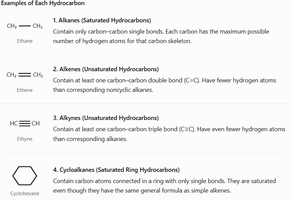
Hydrocarbons are organic compounds made up of only carbon and hydrogen. They are classified based on the types of bonds and whether they form chains or rings:
Alkanes: Only single bonds (saturated hydrocarbons), general formula
Alkenes: At least one double bond (unsaturated hydrocarbons), general formula
Alkynes: At least one triple bond (unsaturated hydrocarbons), general formula
Cycloalkanes: Single bonds forming a ring, general formula
Alkyl Groups and Functional Groups
Alkyl Groups (R Groups)
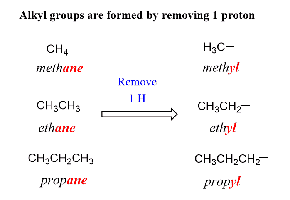
An alkyl group is a derivative of an alkane, formed by removing one hydrogen atom. The letter R is used as a placeholder for any generic carbon-containing group in organic structures.
Key Point: Alkyl groups simplify the representation of organic molecules.
Example: Methyl (CH3–), Ethyl (CH3CH2–), Propyl (CH3CH2CH2–)
Functional Groups
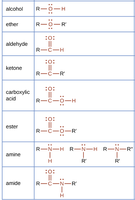
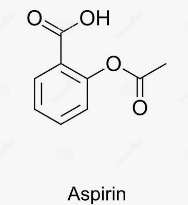
Functional groups are specific atoms or groups of atoms within an organic molecule that determine its chemical properties and reactivity. Common functional groups include hydroxyl (–OH), carbonyl (C=O), carboxyl (–COOH), amino (–NH2), and others.
Key Point: Functional groups influence solubility, acidity/basicity, reactivity, and biological activity.
Example: Alcohols have the general structure R–OH.
Molecular Shapes in Organic Chemistry
VSEPR Theory and Common Molecular Shapes
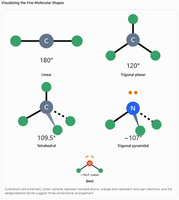
The shape of an organic molecule is determined by the number of bonds and lone pairs around an atom, as described by the Valence Shell Electron Pair Repulsion (VSEPR) theory. Electron groups arrange themselves as far apart as possible, resulting in characteristic molecular geometries.
Linear: 2 electron groups, bond angle 180° (e.g., ethyne)
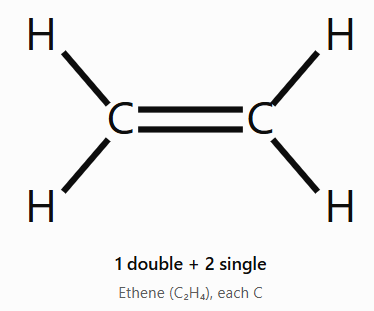
Trigonal planar: 3 electron groups, bond angle 120° (e.g., ethene)
Tetrahedral: 4 electron groups, bond angle 109.5° (e.g., methane)
Trigonal pyramidal: 4 electron groups (3 bonds, 1 lone pair), bond angle ~107° (e.g., methylamine)
Bent: 4 electron groups (2 bonds, 2 lone pairs), bond angle ~104.5° (e.g., water, alcohols)
Summary Table: Hydrocarbon Classification
Type | Carbon–Carbon Bonds | General Formula | Example |
|---|---|---|---|
Alkanes | Only single bonds (C–C) | Ethane (C2H6) | |
Alkenes | At least one double bond (C=C) | Ethene (C2H4) | |
Alkynes | At least one triple bond (C≡C) | Ethyne (C2H2) | |
Cycloalkanes | Single bonds forming a ring | Cyclohexane (C6H12) |
Practice and Application
Practice questions and molecular representations are essential for mastering organic chemistry concepts. Understanding how to interpret structural, condensed, and skeletal formulas, as well as recognizing functional groups and molecular shapes, is foundational for further study in organic and general chemistry.
