 Back
BackIntroduction to Solutions and Aqueous Reactions: Study Notes
Study Guide - Smart Notes
 Tailored notes based on your materials, expanded with key definitions, examples, and context.
Introduction to Solutions and Aqueous Reactions
Overview
This chapter explores the chemistry of solutions, particularly those in which water is the solvent (aqueous solutions). It covers how to describe, calculate, and predict the outcomes of chemical reactions in water, including precipitation, acid-base, gas-evolution, and redox reactions. Real-world applications, such as molecular gastronomy and water hardness, are also discussed.
Solutions and Their Properties
Definition of Solutions
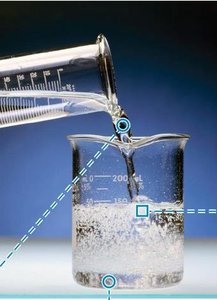
A solution is a homogeneous mixture of two or more substances. The solvent is the component present in the greatest amount, while the solute is present in a lesser amount. An aqueous solution is one in which water acts as the solvent.
Example: Salt dissolved in water forms an aqueous solution.
Concentration of Solutions
The concentration of a solution describes the amount of solute dissolved in a given quantity of solvent or solution. The most common unit is molarity (M), defined as:
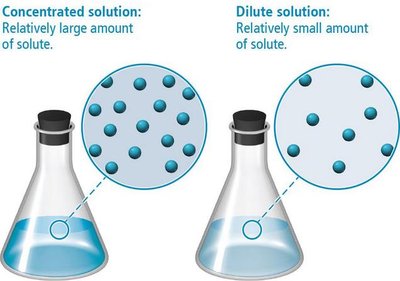
Dilute solution: Contains a small amount of solute relative to solvent.
Concentrated solution: Contains a large amount of solute relative to solvent.
Preparing Solutions of Specified Molarity
To prepare a solution of a specific molarity, dissolve the required amount of solute in a flask and add solvent until the total volume reaches the desired value. Do not simply add the solute to a fixed volume of solvent, as the final volume will change.
Example: To make 1 L of 1 M NaCl, dissolve 1 mol NaCl and add water until the total volume is 1 L.
Solution Dilution
Stock solutions are concentrated solutions that can be diluted to lower concentrations using the equation:
and are the molarity and volume of the stock solution.
and are the molarity and volume after dilution.
Note: Always add acid to water, not the reverse, for safety.
Solution Stoichiometry
Stoichiometric calculations in aqueous reactions often involve converting between volume, molarity, and moles using balanced chemical equations. The coefficients in the equation serve as conversion factors between reactants and products.
How Substances Dissolve
Solute-Solvent Interactions
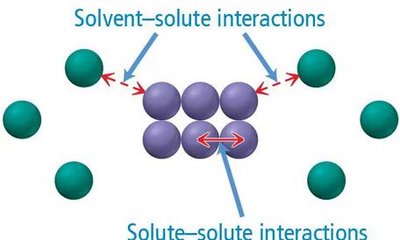
When a solid dissolves in a liquid, the attractive forces between solute particles (solute-solute interactions) compete with those between solute and solvent particles (solvent-solute interactions). If the attraction between solute and solvent is strong enough, the solute dissolves.
Electrolytes and Nonelectrolytes
Electrolyte Solutions
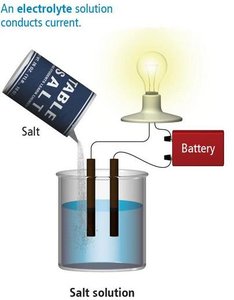
Electrolytes are substances that dissolve in water to produce ions, allowing the solution to conduct electricity. Ionic compounds typically dissociate into their component ions in water, making them strong electrolytes.
Nonelectrolyte Solutions
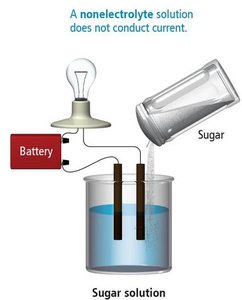
Nonelectrolytes are substances that dissolve in water as intact molecules and do not produce ions. As a result, their solutions do not conduct electricity. Most molecular compounds are nonelectrolytes.
Comparing Electrolytic Properties
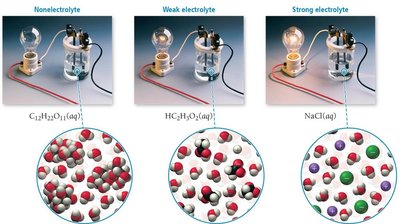
Solutions can be classified as nonelectrolytes, weak electrolytes, or strong electrolytes based on their ability to conduct electricity:
Nonelectrolyte: No ionization; does not conduct electricity (e.g., sugar solution).
Weak electrolyte: Partial ionization; weakly conducts electricity (e.g., acetic acid solution).
Strong electrolyte: Complete ionization; strongly conducts electricity (e.g., NaCl solution).
Acids as Electrolytes
Acids are molecular compounds that ionize in water. Strong acids completely ionize and are strong electrolytes, while weak acids only partially ionize and are weak electrolytes.
Solubility of Ionic Compounds
Solubility and Solubility Rules
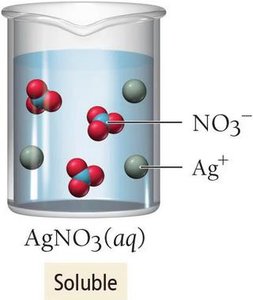
Not all ionic compounds dissolve in water. Compounds are classified as soluble or insoluble based on their ability to dissolve. Solubility rules help predict whether a compound will dissolve.
Solubility Rules (Summary Table)
Generally Soluble | Exceptions |
|---|---|
Li+, Na+, K+, NH4+ | None |
NO3-, C2H3O2- | None |
Cl-, Br-, I- | Ag+, Hg22+, Pb2+ |
SO42- | Sr2+, Ba2+, Pb2+, Ag+, Ca2+ |
Generally Insoluble | Exceptions |
|---|---|
OH-, S2- | Li+, Na+, K+, NH4+; S2- with Ca2+, Sr2+, Ba2+; OH- with Ca2+, Sr2+, Ba2+ (slightly soluble) |
CO32-, PO43- | Li+, Na+, K+, NH4+ |
Real World Example: Hard Water
Hard water contains dissolved ions such as Ca2+ and Mg2+ that react with soap to form insoluble precipitates, reducing cleaning effectiveness. Laundry detergents often contain substances to remove these ions.

Precipitation Reactions
Definition and Prediction
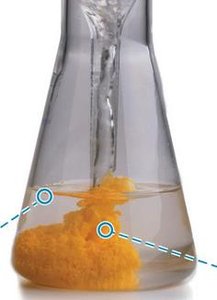
Precipitation reactions occur when two aqueous solutions are mixed and an insoluble solid (precipitate) forms. These reactions are predicted using solubility rules.
Write formulas for reactants and possible products.
Use solubility rules to determine if any product is insoluble.
If all products are soluble, write "NO REACTION."
Balance the equation.
Representing Aqueous Reactions
Molecular, Complete Ionic, and Net Ionic Equations
Molecular equation: Shows complete formulas for all reactants and products.
Complete ionic equation: Shows all strong electrolytes as ions.
Net ionic equation: Shows only the species that actually participate in the reaction (omits spectator ions).
Classes of Aqueous Solution Reactions
Acid-Base (Neutralization) Reactions
Acids produce H+ ions in solution, while bases produce OH- ions. When mixed, they neutralize each other to form water and a salt.
Net ionic equation for strong acid and strong base:
Titrations
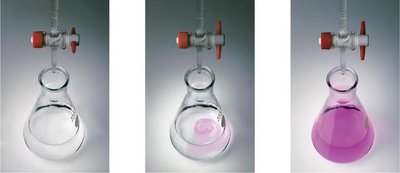
Titration is a laboratory technique in which a solution of known concentration is used to determine the concentration of an unknown solution. The equivalence point is reached when the amount of acid equals the amount of base.
Gas-Evolution Reactions
These reactions produce a gas when two aqueous solutions are mixed. Some gases form directly, while others form through decomposition of an intermediate.
Reactant Type | Intermediate Product | Gas Evolved |
|---|---|---|
Sulfides | None | H2S |
Carbonates, Bicarbonates | H2CO3 | CO2 |
Sulfites, Bisulfites | H2SO3 | SO2 |
Ammonium | NH4OH | NH3 |
Redox (Oxidation-Reduction) Reactions
Definition and Electron Transfer
Redox reactions involve the transfer of electrons between substances. Oxidation is the loss of electrons, and reduction is the gain of electrons. These reactions are essential in processes such as rusting, bleaching, and battery operation.
Oxidation States
The oxidation state (or number) is a theoretical charge assigned to atoms in compounds to track electron transfer. Rules for assigning oxidation states are hierarchical and must be followed in order.
Free element: 0
Monoatomic ion: Equal to its charge
Sum in neutral molecule: 0; in ion: equals ion charge
Group 1A: +1; Group 2A: +2
Nonmetals: F = -1, H = +1, O = -2, Group 7A = -1, Group 6A = -2, Group 5A = -3
Identifying Redox Reactions
Assign oxidation states to all elements in reactants and products. If an element's oxidation state increases, it is oxidized; if it decreases, it is reduced. The substance causing oxidation is the oxidizing agent (itself reduced), and the substance causing reduction is the reducing agent (itself oxidized).
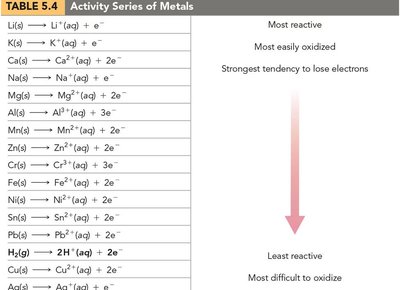
The Activity Series of Metals
The activity series ranks metals by their tendency to lose electrons (be oxidized). Metals higher in the series are more easily oxidized and can displace metals lower in the series from compounds.
Summary
Aqueous solutions are mixtures of water and another substance, with concentration expressed in molarity.
Solutes are classified by their ability to dissociate (strong, weak, or nonelectrolytes) and by solubility.
Precipitation reactions form solids, predicted by solubility rules.
Aqueous reactions are represented by molecular, complete ionic, and net ionic equations.
Acid-base reactions produce water and a salt; gas-evolution reactions produce a gas.
Redox reactions involve electron transfer, tracked by oxidation states and predicted by the activity series.
