 Back
BackIntroduction to Solutions and Aqueous Reactions (Sections 5.4–5.6)
Study Guide - Smart Notes
 Tailored notes based on your materials, expanded with key definitions, examples, and context.
Introduction to Solutions and Aqueous Reactions
Overview of Aqueous Solutions
Solutions are homogeneous mixtures composed of a solute dissolved in a solvent. In aqueous solutions, water acts as the solvent. Understanding how substances dissolve and interact in water is fundamental to predicting chemical behavior in solution.
Types of Aqueous Solutions and Solubility
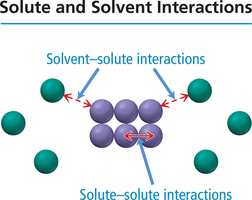
Solute and Solvent Interactions
When a solute dissolves in a solvent, several types of interactions must be considered:
Solute–solute interactions: Forces holding solute particles together.
Solvent–solvent interactions: Forces holding solvent molecules together.
Solute–solvent interactions: Forces between solute particles and solvent molecules. If these are strong enough, the solute will dissolve.
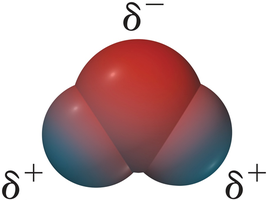
Charge Distribution in Water Molecules
Water is a polar molecule due to its uneven electron distribution. The oxygen atom carries a partial negative charge (δ−), while the hydrogen atoms carry partial positive charges (δ+). This polarity enables water to interact effectively with various solutes, especially ionic compounds.
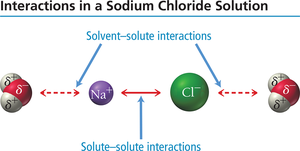
Solute and Solvent Interactions in Sodium Chloride Solution
When sodium chloride (NaCl) dissolves in water, the attraction between Na+ and Cl− ions is overcome by the attraction between these ions and the polar water molecules. This process leads to the dissociation of NaCl into its constituent ions.
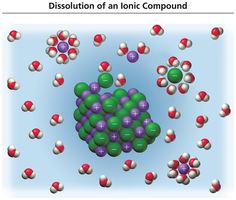
Dissolution of Ionic Compounds
As ionic compounds dissolve, each ion is surrounded by water molecules, a process called hydration. The ions are pulled away from the crystal lattice and dispersed throughout the solution, resulting in free-moving charged particles that can conduct electricity.
Electrolytes and Nonelectrolytes
Definition and Properties
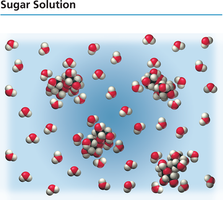
Substances that dissolve in water to produce ions are called electrolytes and can conduct electricity. Substances that dissolve without forming ions are nonelectrolytes and do not conduct electricity. For example, salt (NaCl) is an electrolyte, while sugar (C12H22O11) is a nonelectrolyte.
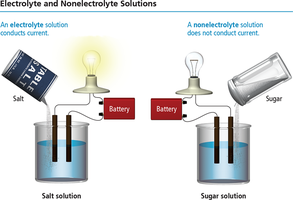
Strong and Weak Electrolytes
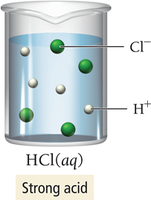
Strong electrolytes: Substances that completely dissociate into ions in water (e.g., most ionic compounds and strong acids).
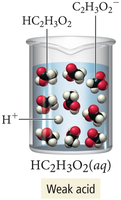
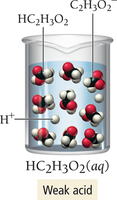
Weak electrolytes: Substances that partially dissociate into ions (e.g., weak acids).
Nonelectrolytes: Substances that do not form ions in solution (e.g., most molecular compounds except acids).
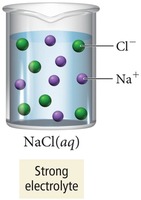
Sugar Dissolution in Water
Sugar dissolves in water through solute–solvent interactions, but the molecules remain intact and do not form ions. Thus, sugar solutions do not conduct electricity.
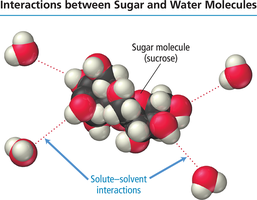
Acids in Aqueous Solution
Strong and Weak Acids
Acids are molecular compounds that ionize in water to produce H+ ions. Strong acids (e.g., HCl) ionize completely, making them strong electrolytes. Weak acids (e.g., acetic acid, HC2H3O2) ionize only partially, making them weak electrolytes.
Solubility of Ionic Compounds
Solubility and Insolubility
When an ionic compound dissolves, its ions are separated and dispersed in water. However, not all ionic compounds are soluble. A compound is soluble if it dissolves in water and insoluble if it does not. Solubility depends on the nature of the ions and the solvent.
Solubility Rules
Solubility rules are empirical guidelines developed from experimental observations. They help predict whether an ionic compound will dissolve in water. For example, compounds containing NO3− are generally soluble with no exceptions.
Precipitation Reactions
Formation of a Precipitate
Precipitation reactions occur when two aqueous solutions of ionic compounds are mixed and an insoluble product (precipitate) forms. The reaction can be predicted using solubility rules.
Mix solutions and identify the ions present.
Exchange ions to form possible products.
Use solubility rules to determine if a precipitate forms.
If all products are soluble, write "NO REACTION."
If a product is insoluble, write its formula with (s) for solid and balance the equation.
Representing Aqueous Reactions
Molecular, Complete Ionic, and Net Ionic Equations
Molecular equation: Shows complete, neutral formulas for all compounds.
Complete ionic equation: Shows all strong electrolytes as ions.
Net ionic equation: Shows only the species that actually participate in the reaction (spectator ions are omitted).
Example: Writing Complete and Net Ionic Equations
To write these equations:
Write the molecular equation.
Separate strong electrolytes into ions for the complete ionic equation.
Remove spectator ions to obtain the net ionic equation.
Summary Table: Electrolyte Classification
Type | Definition | Example | Conductivity |
|---|---|---|---|
Strong Electrolyte | Completely dissociates into ions | NaCl, HCl | High |
Weak Electrolyte | Partially dissociates into ions | HC2H3O2 | Low |
Nonelectrolyte | Does not form ions | C12H22O11 (sugar) | None |
Key Equations
Dissociation of NaCl in water:
Dissociation of HCl (strong acid):
Dissociation of acetic acid (weak acid):
