 Back
Ionic Bond: Definition and Example
Study Guide - Smart Notes
 Tailored notes based on your materials, expanded with key definitions, examples, and context.
Ionic Bonding
Definition and Basic Principles
An ionic bond is a type of chemical bond formed through the electrostatic attraction between oppositely charged ions. This occurs when one atom transfers one or more electrons to another atom, resulting in the formation of positive and negative ions.
Electrostatic Attraction: The force that holds the ions together is the attraction between their opposite charges.
Electron Transfer: One atom (typically a metal) loses electrons to become a positively charged cation, while another atom (typically a nonmetal) gains electrons to become a negatively charged anion.
Example: Sodium and Chlorine
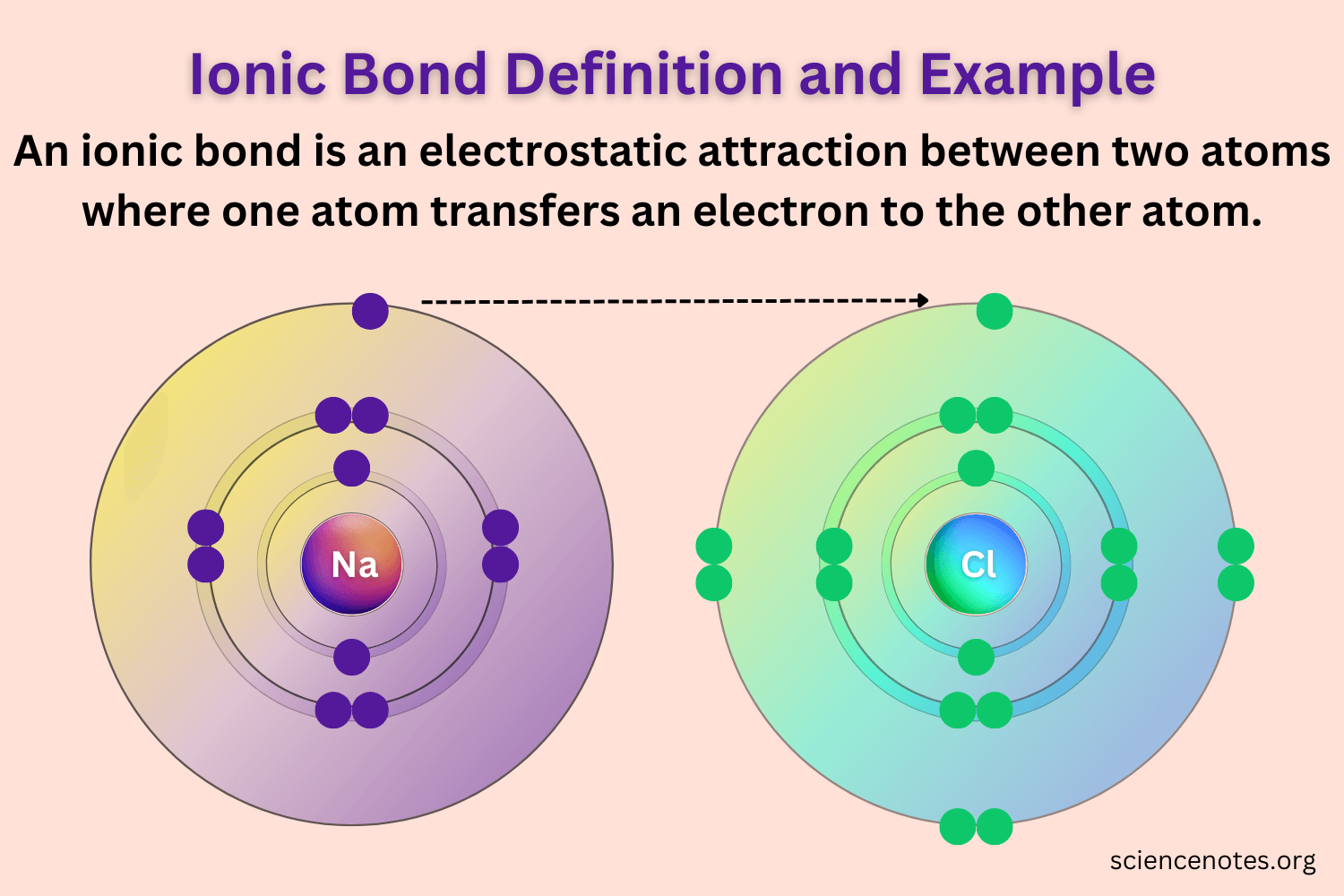
The formation of sodium chloride (NaCl) is a classic example of ionic bonding:
Sodium (Na): Has one electron in its outer shell, which it readily loses to achieve a stable electron configuration.
Chlorine (Cl): Has seven electrons in its outer shell and needs one more to complete its octet. It gains the electron lost by sodium.
After the transfer, sodium becomes Na+ and chlorine becomes Cl-, and the two ions are held together by their opposite charges.
Equation:
Example: Table salt (NaCl) is formed by the ionic bonding of sodium and chlorine.
Properties of Ionic Compounds
High Melting and Boiling Points: Due to strong electrostatic forces between ions.
Solubility: Many ionic compounds are soluble in water.
Electrical Conductivity: Ionic compounds conduct electricity when dissolved in water or melted, as ions are free to move.
Comparison: Ionic vs. Covalent Bonds
Ionic Bonds: Involve electron transfer and formation of ions.
Covalent Bonds: Involve sharing of electrons between atoms.
Additional info: Ionic bonding is covered in General Chemistry under Chapter 8: Basic Concepts of Chemical Bonding.
