 Back
BackIonic Compounds: Structure, Formation, and Examples
Study Guide - Smart Notes
 Tailored notes based on your materials, expanded with key definitions, examples, and context.
Ionic Compounds
Definition and Formation
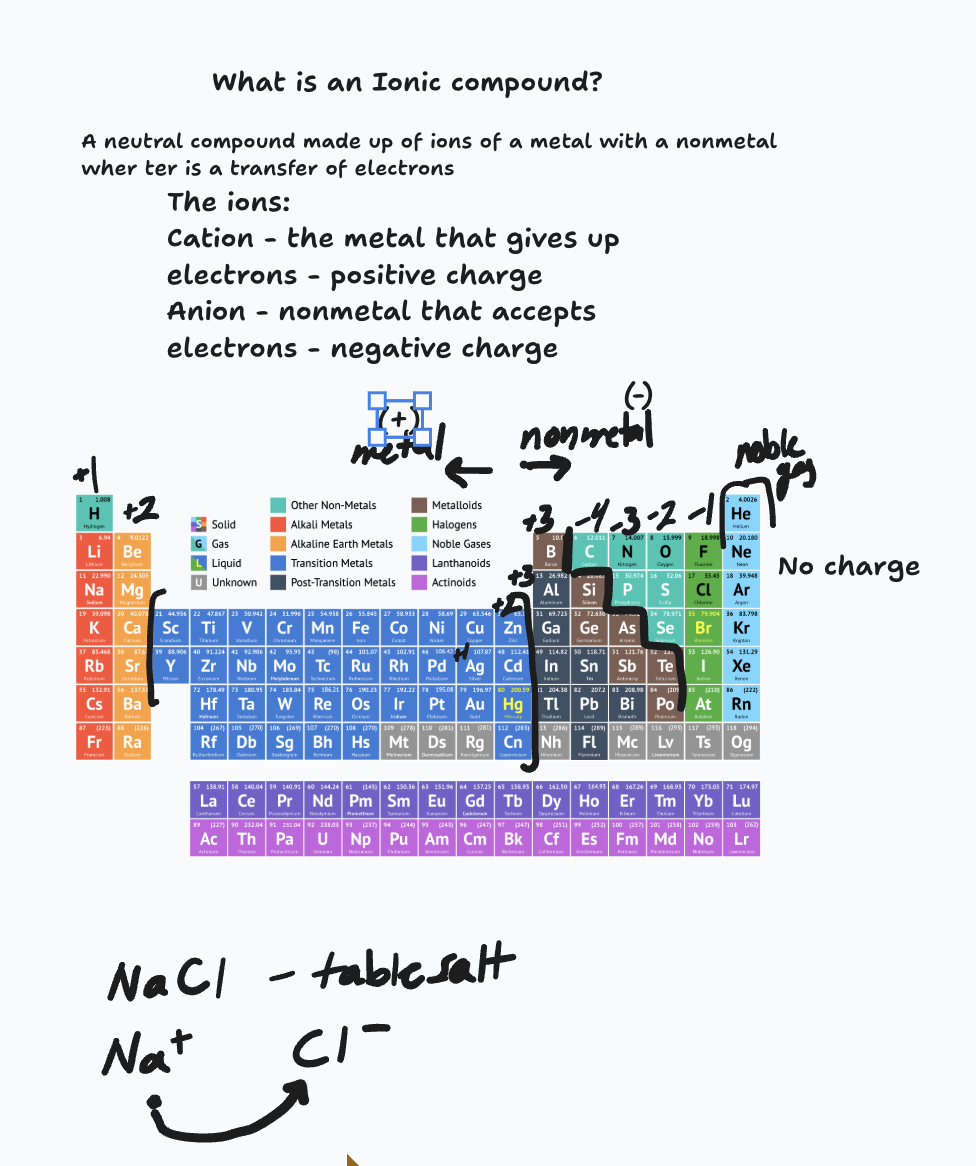
An ionic compound is a neutral chemical compound composed of ions held together by electrostatic forces known as ionic bonds. These compounds typically form between a metal and a nonmetal, where there is a transfer of electrons from the metal to the nonmetal.
Cation: The metal atom loses one or more electrons, becoming a positively charged ion (cation).
Anion: The nonmetal atom gains one or more electrons, becoming a negatively charged ion (anion).
The resulting compound is electrically neutral because the total positive charge of the cations equals the total negative charge of the anions.
Key Terms
Cation: A positively charged ion formed when a metal atom loses electrons.
Anion: A negatively charged ion formed when a nonmetal atom gains electrons.
Ionic Bond: The electrostatic attraction between oppositely charged ions in an ionic compound.
Periodic Table Trends in Ionic Compounds
Metals, found on the left side of the periodic table, tend to lose electrons and form cations. Nonmetals, found on the right side, tend to gain electrons and form anions. The noble gases (far right column) do not typically form ions because they already have a stable electron configuration.
Example: Sodium Chloride (NaCl)
Sodium (Na): A metal that loses one electron to form a sodium cation ().
Chlorine (Cl): A nonmetal that gains one electron to form a chloride anion ().
Formula: (table salt), which is neutral overall.
Equation for formation:
Properties of Ionic Compounds
High melting and boiling points due to strong ionic bonds.
Conduct electricity when dissolved in water (as ions are free to move).
Usually solid at room temperature and form crystalline structures.
Summary Table: Cations and Anions
Type of Ion | Formed by | Charge | Example |
|---|---|---|---|
Cation | Metal | Positive (+) | Na+, Ca2+ |
Anion | Nonmetal | Negative (−) | Cl−, O2− |
